
By the autumn of 1066, England had become the prize at the center of one of the most extraordinary succession crises in medieval European history. What had begun as a dispute over the English crown had already drawn armies from Scandinavia and Normandy onto English soil, forcing King Harold Godwinson to fight two invasions in the same year.
Yet the events that unfolded at Stamford Bridge had not ended the crisis. Instead, Harold's spectacular victory over Harald Hardrada had left him facing an even greater danger. While the English king had been marching north, fighting and defeating the Norwegian invasion, William, Duke of Normandy, had been preparing his own army across the Channel.
Terry Bailey explains.
Read part 1 on the pre-invasion world of 1066 here, part 2 on the road to invasion here. And part on the Battle of Stamford Bridge here.
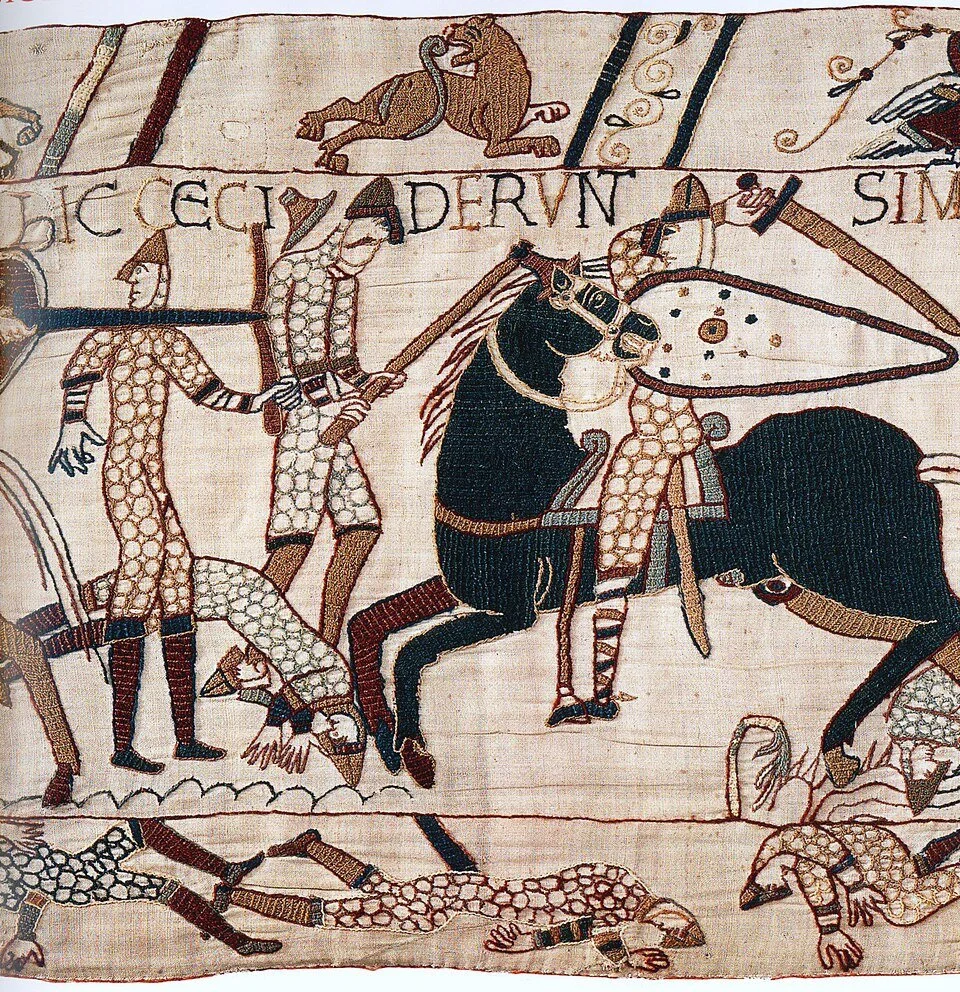
Scene 53 of the Bayeux Tapestry. Mounted Normans attacking infantry Anglo-Saxons. Source: Public domain, Bayeux Tapestry Museum, available here.
On the 28th of September 1066, William's invasion fleet crossed the Channel and landed on the Sussex coast near Pevensey. The Norman army came ashore without encountering the kind of resistance that might have been expected from a kingdom supposedly prepared for invasion. Harold was still in the north, and William immediately understood the importance of establishing a secure base. Pevensey offered a valuable harbor and the remains of an old Roman fortification that could be strengthened and used as a defensive position. From there, William moved eastward towards Hastings, where the Normans established another fortified position and began devastating the surrounding countryside.
William's strategy was calculated to force Harold to respond. The Norman army could not simply remain indefinitely on English soil waiting for the king to arrive. Its soldiers needed food, supplies and secure territory, while the destruction of the surrounding countryside served a second purpose: it demonstrated the consequences of resisting William and placed pressure upon Harold to act. The Norman duke had come to England claiming that the English crown had been promised to him. He now intended to make that claim impossible to ignore.
For Harold, the situation was extraordinarily difficult. He had only recently returned from the north after his victory at Stamford Bridge, where his army had defeated and destroyed much of Harald Hardrada's invading force. The English king and his soldiers had marched an extraordinary distance in a remarkably short period of time. They had fought one of the most important battles of the year, celebrated victory and then learned that another invasion had already begun hundreds of miles away. Harold now had to make another decision that would determine the fate of England.
Rather than waiting for William to advance deeper into the kingdom, Harold gathered his forces and marched south. The speed of his movement had become one of the defining features of the campaign of 1066. His army had already demonstrated its ability to move rapidly, but the march from the north to Sussex placed enormous physical demands upon men who had just fought a major battle. Some soldiers had been killed or wounded at Stamford Bridge, while others may have remained behind or dispersed. Harold nevertheless believed that confronting William quickly offered the best opportunity to prevent the Normans from consolidating their position.
The English army eventually reached the area around Hastings in October. Harold established his position on a ridge now known as Senlac Hill, overlooking the surrounding landscape. William, meanwhile, prepared his army for battle. The two forces represented different military traditions, although the distinction between them should not be exaggerated. The English army was not simply a mass of infantry facing an entirely different Norman force. Both armies contained experienced warriors, and both relied upon combinations of weapons and tactics that had developed throughout western Europe.
The English strength lay particularly in its infantry and the defensive formation known as the shield wall. Closely packed warriors stood shoulder to shoulder, locking shields together and presenting a formidable barrier to an attacking force. Behind the front ranks were additional soldiers who could reinforce weakened sections of the line. The English army also included experienced housecarls, heavily armed professional warriors whose equipment and discipline made them particularly formidable opponents.
William's army possessed a different combination of strengths. Norman infantry could attack the English line directly, while archers could harass the defenders from a distance. Most importantly, William possessed a substantial cavalry force. The Normans could therefore combine missile fire, infantry attacks and mounted assaults in a coordinated effort to break the English formation. The battle would become a contest between Harold's ability to maintain the integrity of his defensive position and William's ability to find a way through it.
On the morning of the 14th of October, the Norman army advanced towards the English position. William's forces were arranged with archers, infantry and cavalry forming the principal components of his army. The English remained on the ridge, protected by their shield wall. The initial Norman attacks met fierce resistance. Arrows were fired towards the English position, infantry advanced up the slope and cavalry attempted to find weaknesses in the English line. Yet the English formation proved extremely difficult to penetrate.
The terrain itself favored Harold. The English were positioned on higher ground, forcing Norman soldiers to advance uphill against a disciplined defensive formation. Every step towards the summit increased the difficulty of the attack. For hours, the English shield wall absorbed repeated assaults. The Normans could attack, retreat and regroup, but the English line continued to hold.
At this point, the battle began to develop into something far more complicated than a simple frontal assault. The Normans suffered setbacks on portions of the battlefield, and at one stage some of William's soldiers fled downhill. The sight of retreating Normans apparently encouraged English warriors to leave the protection of the shield wall and pursue them. This became one of the most famous episodes associated with Hastings.
Later accounts describe these movements as deliberate Norman feigned retreats, in which troops pretended to flee in order to lure English soldiers away from the defensive formation before turning upon them. Whether every such movement was deliberately planned remains uncertain, and the surviving sources were written after the battle. Nevertheless, there is strong evidence that Norman forces were able to exploit moments when English soldiers abandoned the protection of the ridge. Once separated from the main formation, pursuing English troops could become vulnerable to Norman cavalry.
The fighting continued for much of the day. The English shield wall repeatedly resisted the Norman attacks, while the Normans adapted their tactics and continued searching for weaknesses. The battle was becoming a contest of endurance. William could draw upon forces that had crossed the Channel specifically for the campaign, while Harold's army had already endured the extraordinary events of the preceding weeks. Yet despite exhaustion and mounting casualties, the English continued to resist.
The traditional image of Hastings often portrays the battle as a straightforward Norman victory achieved through cavalry and archery. The reality was considerably more complicated. The Norman army did not simply overwhelm the English from the beginning. The English held their position for hours and inflicted serious losses upon their opponents. The battle was a prolonged struggle in which tactical decisions, terrain, leadership, fatigue and chance all mattered.
As the day progressed, however, the English position gradually deteriorated. Harold's army had suffered heavy casualties, and maintaining a coherent shield wall became increasingly difficult. The death of senior warriors weakened the command structure, while gaps could appear in the defensive formation. William also remained personally active in directing the battle, helping to maintain Norman morale at moments when the fighting threatened to turn against him.
Then came the event that transformed the battle. Harold Godwinson was killed.
The exact circumstances of Harold's death remain uncertain. The famous story that he was struck in the eye by an arrow appears in the Bayeux Tapestry, although the identification of the figure has been debated. Other traditions claim that Harold was subsequently cut down by Norman warriors. It is possible that several later accounts combined different traditions surrounding his death. What is certain is that Harold died on the battlefield, and his death removed the central figure around whom English resistance had been organized.
The consequences were devastating. The English army did not immediately vanish, but the death of the king shattered the political and military structure upon which continued resistance depended. Some English soldiers continued fighting, particularly among the remaining housecarls, but large-scale organized resistance began to collapse. Norman forces were finally able to break through the English position, and by the end of the day William had achieved the victory for which he had crossed the Channel.
The Battle of Hastings was therefore much more than a clash between two armies. It was the decisive military encounter in a succession crisis that had already transformed England. Harold had defeated one invasion at Stamford Bridge, only to find himself confronted by another army from across the Channel. His decision to march south and fight William so quickly has been debated ever since, but the consequences of the battle are undeniable. Harold was dead, his army was defeated, and the most powerful military obstacle between William and the English crown had been removed.
Yet Hastings did not make William king of England in an instant. Winning the battle was one thing; securing the kingdom was another. Large parts of England remained outside William's direct control, and the political elite had not simply disappeared with Harold. English resistance continued, and alternative candidates for the throne emerged. William therefore faced a new phase of the campaign in which military victory had to be converted into political authority.
The significance of Hastings ultimately lies in the fact that it changed the direction of English history. Had Harold defeated William, the Norman claim to the English throne might have collapsed, and the political and cultural development of England could have followed a dramatically different path. Instead, William's victory opened the way for the Norman Conquest, bringing a new ruling dynasty, new aristocratic families and profound changes to England's institutions, military organization, landholding patterns and culture.
The battle also reveals why 1066 cannot be understood as a single isolated event. Stamford Bridge and Hastings were intimately connected. Harold's extraordinary victory against Harald Hardrada demonstrated the strength of the English army, but it also left Harold with little time to recover before confronting William. The two battles therefore became the dramatic turning points of the same campaign: first Harold destroyed one invasion in the north, and then, only weeks later, his own kingdom was transformed by defeat in the south.
By sunset on the 14th of October 1066, William had won the battle, but England had not yet submitted. Harold Godwinson was dead, the English army had been defeated and the Norman duke stood closer than ever to the crown he claimed. Yet the conquest was only beginning. William had won Hastings; now he had to win England.
Enjoyed the piece?
Join thousands of history readers getting occasional updates on new blog posts, books, and video releases — plus a free history book to get you started.
Join History Is Now here
Now, you can read Terry’s series on cruel King John here.