
When Edward the Confessor died on the 5th January 1066, England did not simply lose a king. It lost the political center around which a fragile succession had been organized. Within hours, the kingdom had a new ruler, but that ruler was immediately confronted by men who believed that the English crown belonged to them. Harold Godwinson had been crowned King of England, yet across the Channel Duke William of Normandy was preparing an invasion, while in Scandinavia Harald Hardrada, King of Norway, was also preparing to claim the throne by force. The succession crisis described had become something much more dangerous: a struggle in which competing interpretations of legitimacy were about to be settled by armies.
Terry Bailey explains.
Read part 1 on the pre-invasion world of 1066 here.
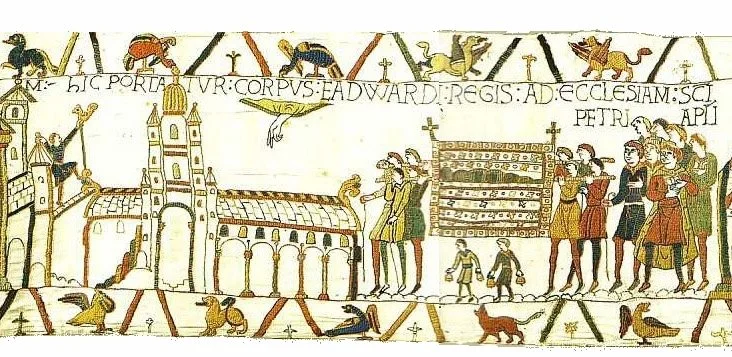
The funeral of Edward the Confessor being crowned from the Bayeux Tapestry. Source: Public domain, Bayeux Tapestry Museum, available here.
The situation was particularly complicated because medieval kingship did not operate according to a single, universally accepted rule of inheritance. Blood relationship mattered, but so did previous promises, oaths, political support and, ultimately, the ability to command the loyalty of powerful men. Harold possessed enormous political authority within England and had the support of leading members of the English ruling elite. William argued that Edward had previously promised him the throne and that Harold himself had sworn an oath supporting William's claim. Harald Hardrada approached the succession from an entirely different direction, invoking the Scandinavian connections that had bound England to the Viking world for generations. Each claimant therefore possessed a different version of legitimacy, and each believed that the circumstances of 1066 justified decisive action.
Harold Godwinson's position was nevertheless the most immediate and practical. He was the most powerful nobleman in England, Earl of Wessex, an experienced military commander and the brother of Queen Edith, Edward's wife. When Edward died, the leading English nobles supported Harold's accession, and he was crowned at Westminster on the 6th of January, the day after Edward's burial. His coronation represented the established political machinery of the English kingdom functioning according to its own traditions. Yet from the moment the crown was placed upon Harold's head, England was effectively on a war footing. William regarded Harold's accession as an act that had violated his own rights, while Hardrada saw an opportunity to revive an older Scandinavian claim.
William, Duke of Normandy, was not a random foreign adventurer seeking an opportunity to seize a wealthy kingdom. He was a powerful ruler with a longstanding connection to the English royal family. Edward the Confessor had spent much of his early life in Normandy, and William was related to him through the Norman ducal family. According to Norman accounts, Edward had promised William the English succession. The precise circumstances of this alleged promise remain difficult to establish, and English sources do not provide the same version of events. Nevertheless, William regarded the promise as genuine and regarded Harold's accession as a betrayal of an existing commitment.
The issue became even more complicated because of Harold's journey to Normandy in the years before the Conquest. Norman accounts claimed that Harold had sworn an oath to William, promising to support the duke's claim to the English throne. The Bayeux Tapestry famously depicts Harold placing his hands upon sacred relics during an oath-taking ceremony. To William, therefore, Harold was not merely a rival claimant who had been chosen by the English. He was, according to the Norman interpretation, a man who had broken a solemn and religiously significant oath. English sources are much less explicit about the episode, and historians continue to debate its precise nature and circumstances.
For William, however, the distinction between political dispute and moral obligation was extremely useful. His invasion could be presented not simply as an attempt to conquer England but as an effort to recover what he believed had been promised to him. His case was strengthened when Pope Alexander II gave his support to the Norman enterprise and sent William a papal banner. The papal approval gave William's campaign an important religious and political dimension, although it should not be mistaken for proof that the papacy had established William's legal right to the English throne. It nevertheless provided the Norman duke with a powerful symbol around which his supporters could rally.
William now had to turn a claim into an invasion. That required considerably more than assembling a group of knights and sailing across the Channel. An invasion force needed ships, horses, weapons, armor, food, water and equipment, as well as thousands of men capable of fighting together. William therefore spent much of the summer of 1066 preparing an expedition on a substantial scale. Norman nobles and knights had to be persuaded to participate, and the promise of land, wealth and advancement in England provided powerful incentives. The undertaking was sufficiently ambitious that its success depended not only upon military strength but upon careful organization and favorable circumstances.
The resulting invasion fleet became one of the largest military transport operations attempted in western Europe during the eleventh century. The exact number of vessels remains uncertain, and medieval sources do not provide figures that can be accepted without qualification. What is clear is that William needed enough ships to transport an army and its horses across the Channel. The operation therefore represented a remarkable logistical challenge. The Normans were not merely preparing for a raid; they were preparing to land an army capable of fighting a major battle and then maintaining itself in hostile territory.
Yet the Channel itself became an unexpected obstacle. William's army gathered in Normandy and waited for the right moment, but an invasion fleet could not simply depart whenever its commander wished. Wind, tides and weather were fundamental considerations. The fleet remained in readiness while William waited for conditions that would allow the crossing. This delay proved extraordinarily important because, while William was unable to move, Harold was forced to maintain his own defensive preparations in England.
Harold understood that the Norman invasion was coming. He could not know precisely when William would cross, or where the main landing would take place, but the threat was sufficiently serious for him to mobilize an army and fleet along the southern coast. According to the Anglo-Saxon Chronicle, the force assembled was exceptionally large by English standards. Harold positioned his troops in anticipation of William's arrival and personally operated in the south, while his fleet also watched the approaches to England.
The English military system gave Harold significant defensive resources, but those resources had limitations. The fyrd was not a permanent professional army in the modern sense. It was a system through which men could be called upon for military service, drawing upon the population and obligations of local communities and landholders. Alongside these forces were the king's household troops, the elite warriors known as the housecarls. Together they could produce a formidable army, particularly when fighting on home territory. But maintaining a large force in the field for an extended period was expensive and placed considerable demands upon the kingdom.
This created one of Harold's first major strategic problems. An army waiting for an invasion cannot remain mobilized indefinitely. Soldiers needed food and supplies, and many had land, families and responsibilities to return to. Harold's forces remained ready through the summer, but eventually supplies became exhausted. In early September, the army was stood down and Harold returned to London. The Norman fleet, meanwhile, had still not crossed the Channel.
For a brief moment, the great invasion appeared to have stalled. But England's danger had not disappeared. It had merely changed direction.
Far to the north, another claimant was preparing to enter the struggle. Harald Hardrada, King of Norway, was one of the most formidable warriors of his generation. His career had taken him across Europe and beyond, and by 1066 he ruled Norway with considerable authority. His claim to England was rooted in the Scandinavian history of the English crown. The reign of Cnut in the eleventh century had created a political world in which England and Scandinavia were deeply connected, and the memory of Danish and Norwegian kings ruling England remained very real.
Hardrada's particular claim was complicated and considerably less straightforward than the Norman case sometimes suggests. It drew upon the succession arrangements and agreements associated with the Scandinavian kingdoms and the descendants and successors of Cnut. Hardrada believed that he possessed a legitimate claim to the English crown, but the precise legal basis was contested and depended upon political agreements made years earlier. Like William, however, Hardrada possessed something more immediately important than an argument about succession: an army capable of enforcing his interpretation of events.
Hardrada's cause was strengthened by an Englishman who had his own reasons for opposing Harold: Tostig Godwinson. Harold's brother had once been Earl of Northumbria, but his rule had become increasingly unpopular. A rebellion in Northumbria in 1065 resulted in Tostig's removal from power and exile. The humiliation was profound. Tostig was not merely a disgraced nobleman; he was Harold's brother, a member of the same family that dominated English politics. His subsequent decision to seek foreign assistance transformed a family feud into an international threat.
Tostig initially sought support elsewhere, but eventually found a willing ally in Harald Hardrada. Their interests were very different but temporarily compatible. Hardrada wanted the English crown, while Tostig wanted to recover the position and influence he had lost. Together they could exploit a weakness in Harold's kingdom that William's invasion threatened to expose: England could not easily defend its southern and northern approaches at the same time.
In September, Hardrada's fleet sailed for England. Medieval accounts give widely varying estimates for its size, but it was clearly a substantial force. Hardrada was not attempting a minor raid. This was a serious invasion conducted by a king who intended to replace Harold as ruler of England. Tostig joined him with his own supporters, turning the expedition into something more complicated than a purely Norwegian invasion.
The northern invasion immediately changed Harold's strategic situation. The king had spent months preparing for William's arrival in the south, only to discover that the first major attack would come from Scandinavia. Hardrada's forces moved into northern England, and the threat to York was especially serious. York was one of the most important cities in the kingdom and the center of a wealthy and strategically significant region. If Hardrada could establish control over the north, he would possess an important base from which to challenge Harold's authority.
Harold reacted with extraordinary speed. The English king had to move from defending the southern coast against William to confronting Hardrada in the north. The army that had been prepared to stop a Norman invasion now had to march hundreds of miles towards Yorkshire. The sudden movement demonstrates the fundamental problem confronting Harold: England's greatest strength, its ability to mobilize a large army, could also become a weakness if that army had to be repeatedly moved across the length of the kingdom.
The geographical problem was immense. England was not a small battlefield around London. It was a substantial kingdom stretching from the southern Channel coast to the Scottish border and beyond. An invading army landing in one region could force the king to abandon another. Harold therefore faced a strategic dilemma that no amount of personal courage could completely solve. If he remained in the south, Hardrada might establish himself in the north. If he marched north, William could cross the Channel into an undefended southern England.
And that was precisely the situation developing as September progressed. William remained in Normandy, still waiting for the opportunity to cross. Hardrada, meanwhile, had already brought his army into England. Harold was forced to respond to the invasion that had actually arrived rather than the one he had spent months expecting.
The timing was devastatingly significant. Harold marched north with remarkable speed, gathering the forces available to him as he went. The English king's response demonstrated both the mobility of the Anglo-Saxon military system and the seriousness of the threat. Hardrada was not expecting such a rapid concentration of English forces. On the 25th of September 1066, the two armies met at Stamford Bridge near York. The battle that followed would become one of the most famous victories in English military history, but its consequences would extend far beyond the battlefield.
Before Stamford Bridge was fought, however, England stood in an extraordinary state of uncertainty. Harold had spent the summer watching the southern horizon for William's ships. William had spent the same summer waiting for the winds that would carry his fleet across the Channel. Hardrada had then appeared from the north, accompanied by Harold's own exiled brother. The English king had been forced to abandon one front in order to confront another.
The irony was profound. Harold's greatest immediate victory would eventually become part of the chain of events that weakened his ability to resist William. When Hardrada invaded, Harold had no choice but to meet him. When Hardrada was defeated, Harold could not simply return to London and wait. Another invasion was still possible, and the Norman threat had never disappeared. The two invasions were therefore not separate episodes but parts of one extraordinary strategic crisis.
By late September, the succession dispute had become a struggle of kings, armies and geography. Harold Godwinson possessed the English crown and the support of the English political establishment. William of Normandy possessed a claim based upon alleged promises and oaths, reinforced by military preparation and papal approval. Harald Hardrada possessed a Scandinavian claim and the formidable military reputation necessary to attempt its enforcement. Tostig Godwinson added a deeply personal dimension, transforming the conflict from a contest between foreign rulers and an English king into a struggle that also divided Harold's own family.
The fate of England now depended upon a remarkable sequence of movements. William was still waiting in Normandy. Hardrada had invaded from the north. Harold had marched north to meet him. The English king was about to fight one of the most decisive battles of the Viking Age, believing that defeating Hardrada would remove the immediate threat to his kingdom.
But while Harold was looking north, the winds across the Channel were changing. The Norman fleet was still waiting and somewhere across the sea, William was preparing to sail. The succession crisis that had begun with the death of Edward the Confessor had now reached the point where claims could no longer be settled through ceremony, negotiation or oaths. England had entered the age of invasion. Yet the most extraordinary part of the story was still to come. Harold was about to defeat one invading army at Stamford Bridge, only to discover that another army had finally reached the English coast.
Enjoyed the piece?
Join thousands of history readers getting occasional updates on new blog posts, books, and video releases — plus a free history book to get you started.
Join History Is Now here
Now, you can read Terry’s series on cruel King John here.