
In French Polynesia, an adult seahorse floats in ocean waters alongside two juveniles. His head appears bowed, as the young fry look on curiously. The captivating black-and-white image (seen below) by photographer Julien Anton took top honors at the 2026 Ocean Photographer of the Year awards.
French PolynesiaAn adult seahorse pictured with newly born juveniles in the shallow seaweed-filled waters of Moorea, French Polynesia. While it is not known if these seahorses are related, their arrangement creates the impression of a farewell, as if the tiny seahorses have gathered around their father after he has released them into the world. Seahorses are now rare in French Polynesia so this image was the result of long hours of searching among the seaweed.
Credit: Julien Anton / Ocean Photographer of the Year 2026
“Winning Ocean Photographer of the Year is an immense honour – one I’m proud to share with my family, and with the local residents, naturalists and fishermen of Tahiti and Moorea whose knowledge made this image possible,” Anton said in a statement. “We spent countless hours searching in difficult conditions, with no guarantee of finding a single seahorse. That is what made the moment so extraordinary – when the juveniles turned back towards the adult, it felt like something far beyond what I had dared to hope for. I am not a professional photographer; for me, photography is simply how I share what I see and feel. My hope is that this image can serve as a bridge between science, conservation and a world that deserves to know what is at stake.”
The 2026 Ocean Photographer of the Year competition celebrates Big Blue’s incredible beauty while also highlighting the urgent need to protect it in a rapidly changing world. The annual contest is co-presented by Oceanographic Magazine and Blancpain.
Sealion Island, Falkland Islands.Southern elephant seal pups explore shallow rock pools on Sea Lion Island in the Falkland Islands, testing their first movements in the water after being weaned by their mothers. These young seals must quickly learn to swim and survive independently. As they climb over one another and investigate their surroundings, this scene captures a key moment in their journey from land-bound pups to ocean explorers.
Credit: Matty Smith / Ocean Photographer of the Year 2026 Credit: Matty Smith / Ocean Photographer of the Year 2026 Baja California, Mexico
In the Pacific waters of Mexico, this photograph captures the aftermath of a successful orca hunt. Nearly an hour after a pod separated a humpback whale calf from its mother, the orcas resurfaced carrying their prey between them. The event reveals the cooperative hunting strategies of orcas, where multiple individuals work together to isolate and subdue large prey. What the image doesn’t show is that after the kill, other scavengers, including silky sharks, were drawn to the remains, showing how one event can influence an entire marine food web.
Credit: Rafael Fernandez Caballero / Ocean Photographer of the Year 2026 Lady Elliot Island, Australia
“Arms of Connection” captures two octopuses during courtship on a shallow coral reef at Lady Elliot Island, part of Australia’s Great Barrier Reef. The male extends his specialised mating arm, known as a hectocotylus, to transfer spermatophores to the female. The interaction continued for several minutes as the male approached and the female moved across the reef before eventually accepting him.
Credit: Joshua Blank / Ocean Photographer of the Year 2026 Raja Ampat, Indonesia
A bottlenose dolphin bites a small fish beside a traditional bagan fishing platform in Indonesia. These dolphins have learned to associate the illuminated nets with an easy source of food, often taking discarded or unwanted fish provided by fishermen. Bagan vessels use lights at night to attract fish before lowering nets from floating platforms. This image captures the close relationship between a wild predator and a human fishing practice, while revealing how animal behaviour can adapt to changing ocean environments.
Credit: Henley Spiers / Ocean Photographer of the Year 2026 Goose Bay, New Zealand
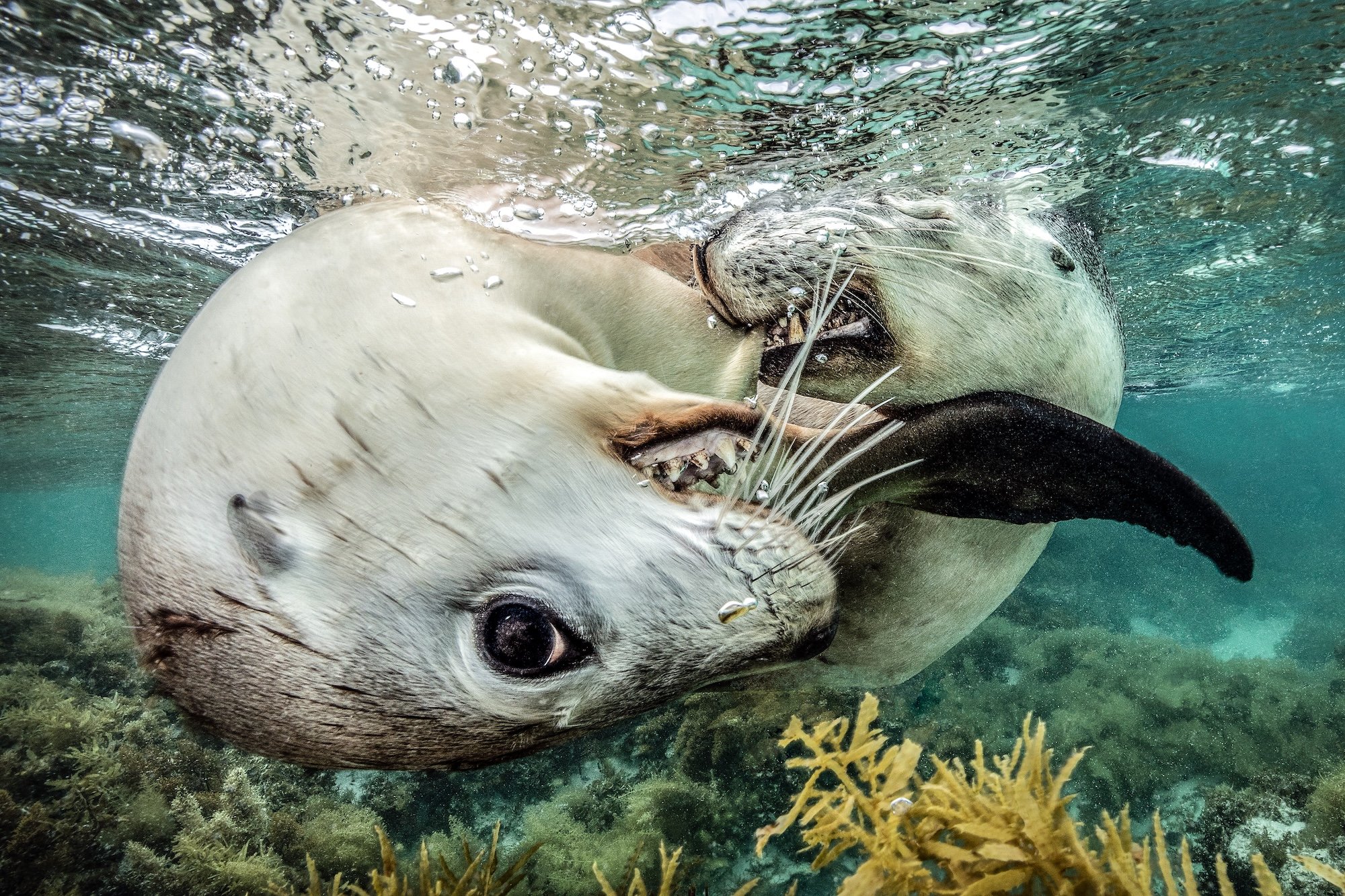
A New Zealand fur seal tears apart a rough skate in the waters of New Zealand, while seabirds gather for the scraps. Unable to swallow such large prey whole, the seal throws the skate repeatedly to break it into smaller pieces. Photographed from a kayak, this scene reveals the feeding strategy of a powerful predator and the chain of life that follows every meal.
Credit: Allan Cronin / Ocean Photographer of the Year 2026 French Polynesia
A green turtle approaches the camera, appearing curious about her reflection in its dome port. The photographer positioned the camera just below her eye level to create a more intimate portrait; staying within 3-10 metres of the surface kept the sunlight sharp, creating distinct rays through the water. A fast shutter speed and small aperture controlled the intense brightness, while a small amount of strobe light revealed the turtle’s details.
Credit: Jenny Stock / Ocean Photographer of the Year 2026 JENNY STOCK Cuba
A Caribbean reef shark swims through purple sea fans and porous sea rod in Jardines de la Reina, Cuba. The marine park has been protected since 1996, with limits on fishing and visitor numbers helping its reefs and wildlife thrive. Stretching for around 90 miles, the protected archipelago is known for healthy corals and abundant marine life. Caribbean reef sharks can reach three metres in length and are important apex predators, helping maintain balance within the reef ecosystem.
Credit: Jenny Stock / Ocean Photographer of the Year 2026 Tonga
A mother humpback whale and her calf glide through Tonga’s warm, sheltered waters. The calf stays close to its mother at first, then becomes curious, swimming in playful circles and approaching the camera. The mother remains calm and watchful, guiding her young when it comes too close. Tonga’s protected waters are an important nursery, where pregnant humpbacks give birth and calves grow stronger before beginning their long journey south towards Antarctica. This encounter captures the quiet bond between mother and calf.
Credit: Jenny Stock / Ocean Photographer of the Year 2026 North Sulawesi, Indonesia
A male Banggai cardinalfish shelters newly hatched juveniles inside his mouth, continuing the parental care that follows a three-week incubation period. After hatching, the male may brood the young for another 10 days without feeding, protecting them from predators until they become more independent. This image captures two juveniles peering from their father’s mouth, revealing the specialised mouthbrooding strategy that helps this species increase the survival of its young.
Credit: Suliman Alatiqi / Ocean Photographer of the Year 2026 Raja Ampat, Indonesia
A pygmy seahorse, no larger than a grain of rice, clings to a delicate hydroid in the reefs of Raja Ampat, Indonesia. Perfectly camouflaged, these tiny animals are rarely seen, even by experienced divers. Photographing them requires patience and careful buoyancy to protect their fragile habitat, reminding us that some of the ocean’s most remarkable wildlife is also its most vulnerable.
Credit: Iris Uijttewaal / Ocean Photographer of the Year 2026 Lembeh, Indonesia
A Braun’s pughead pipefish peers from between coral polyps in Lembeh, Indonesia. Its unusual features give it a curious, almost surprised expression, helping people connect with a species rarely seen outside its coral home. Some guides damage coral colonies to make these tiny fish easier to show to visitors, but this image was captured by waiting patiently and allowing the animal to appear naturally.
Credit: Luis Arpa Toribio / Ocean Photographer of the Year 2026 Luis Arpa Tamarama Beach, Australia
Dolphins ride the waves alongside surfers at Tamarama Beach, Sydney, during a powerful swell and offshore winds. The pod stayed with the surfers for more than an hour, moving through the lineup as naturally as the people around them. Captured from the water, this image shows the ocean as a shared space, where humans and wildlife briefly move together within the same powerful coastal environment.
Credit: Gergo Rugli / Ocean Photographer of the Year 2026 GERGO RUGLI Panglao, Philippines
A freediver is surrounded by a vast school of sardines, which part to form a striking halo as they move around her. Captured during an unplanned morning dive, the image reveals the calm trust that can exist between people and marine life. It is a reminder that patience and respect for the ocean can lead to its most extraordinary moments.
Credit: Benjamín Yávar / Ocean Photographer of the Year 2026 Hawai’i, USA
The photographer shot this image of a surfer, windsurfer and kitesurfer sharing the same towering wave at Pe’ahi, known as Jaws, on Maui’s north shore, from a doorless helicopter. At the time there was an unusual combination of huge swell and strong wind that allowed three different forms of wave riding to happen in harmony. In the spray, a rainbow forms. It has been created by the same wind powering the riders across the wave.
Credit: Daniel Edmond Sullivan Jr / Ocean Photographer of the Year 2026
The post 16 splashy and spectacular images from the 2026 Ocean Photographer of the Year awards appeared first on Popular Science.