
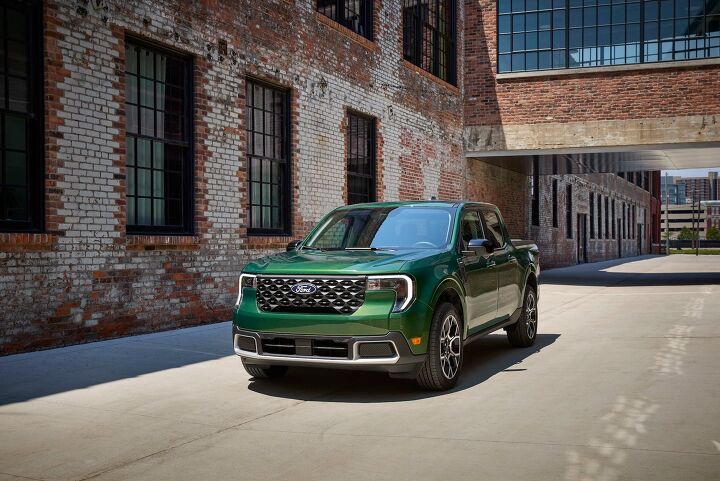
Since its launch, Ford has been constantly adjusting the Maverick lineup in a way that optimizes its profitability while meshing with customer tastes. This time around, it’s tweaking the engine options for the small truck and rejiggering pricing.
While this is being framed by the automaker as a price reduction, it needs to be said that the starting MSRP for the Maverick has risen dramatically since the vehicle launched in 2022. Initially available at $22,500 (including destination), the current starting price for the Ford Maverick has ballooned to about $30,000.
The Blue Oval has likewise added numerous high-zoot trims that have gradually raised the peak of the price range by about $15,000 in just a few years. These are the models now receiving the claimed price reductions. Considering we just discussed America’s need for more-affordable pickups, the timing is interesting.
For 2027, Ford plans on eliminating the turbo engine option from the XL and Lariat trims. With the XL being the base version of the Maverick, this means there is no more budget-focused way to get the peppier turbo engine. Instead, the manufacturer looks to be locking the motor behind the costlier trims while likewise lowering their starting MSRPs.
The Maverick Lobo (above) will now start at $32,155 (without destination), which is roughly $3,800 less than it was for 2026. Lobo High models, which come with more standard features, will become almost $4,300 cheaper.
For those wanting to spend more for their Maverick, but don’t want a lowered pickup, will be pleased to learn that the off-road Tremor trim is also seeing a price reduction. Tremor models will now start out at $37,155, or about $3,500 less than they did earlier this year.
Sadly, these changes have also made accessing the turbocharged motor significantly more expensive. With the Lariat and XL dropping the motor for 2027, the cheapest way to access the 2.0-liter turbo will be by way of the all-wheel drive XLT model which should start at $33,000 once you incorporate the optional engine and destination fee. This functionally makes the turbo a few thousand dollars more expensive to option, even though you’re technically getting a fancier truck out of the deal than you would have with the XL.
It’s hard to say why Ford has made these changes. We know that more competition is slated to arrive for the segment when Toyota debuts its new pickup next year. But it also seems plausible that had simply raised the price of some of the higher-trimmed Mavericks beyond what was reasonable. Lobo and Lariat models already exist on either side of $40,000 once you’ve factored in the additional fees and that’s pretty steep for a small truck. One wonders if those models had fewer takers than the manufacturer had anticipated.
Ford also wants to frame the Maverick as a budget-conscious model. But that only applies when we discuss lower-trim models, equipped with the turbo engine from previous model years. The pickup has gotten decidedly more expensive since it launched and Ford now seems keen to use the turbocharged engine to drive some customers upmarket while also reducing their MSRPs.
But which is the right one to buy?
While Toyota has certainly proven that hybridization can be generally reliable, Ford’s track record with hybrids depends heavily upon which model is being discussed. Hybridized versions of the Fusion and Escape don’t really seem to be any less reliable than their non-hybrid equivalents. But the Blue Oval’s larger hybrid models have developed a mixed reputation. For example, early versions of the F-150 “PowerBoost” hybrid were faulted by Consumer Reports as boasting significant electrical issues relative to the competition.
Ford’s later hybrid trucks look to have improved on these issues. However, most aren’t really old enough to truly assess the long-term viability of the powertrain. As for the Maverick, the debate between the hybrid and turbo engine seems to be a series of compromises with no real winner.
The turbocharged 250-horsepower (with 277 lb-ft of torque) 2.0-liter inline four is significantly quicker to accelerate, comes with a more traditional (8F35) eight-speed automatic transmission — or an optional seven-speed automatic on the semi-sporting Lobo trim.
While the 4,000-pound towing package used to be exclusive to turbocharged models, Ford has since made it available for hybrid models as well. Otherwise, customers can count on 1,500 pounds of payload capacity and 2,000 pounds of towing.
At just 191 hp (combined), the 2.5-liter Atkinson-cycle hybrid is perfectly serviceable for a small truck. But it’s noticeably slower than the turbo model when the engine is being pushed. The upside is that the larger motor is presumably under less stress than the turbocharged variant while returning superior fuel economy. Ford claims hybrid models featuring all-wheel drive models can return up to 40 mpg city and 34 mpg highway.
The debatable downside is that the hybrid comes with a continuously variable transmission (CVT) which will turn some drivers off. That said, both it and the more traditional 8F35 have garnered some minor complaints. The CVT has seen limited complaints of software related issues and cutting power delivery — especially after being used for frequent towing.
Meanwhile, the eight-speed automatic has garnered some complaints about being too fragile for customers who plan on routinely testing the vehicle’s maximum payload/towing capacity. Most of these center around premature wear, with the transmission hesitating in the lower gears. However, many forums have suggested this issue can be totally avoided by ignoring the factory recommendations and simply replacing the transmission fluid on a regular basis.
This likely makes any decisions between the two hinge upon which components you feel more comfortable with and whether you want a quick truck or something delivering excellent fuel economy.
The final factor comes be down to trim. At present, the Lobo and Tremor are only available with the 2.0-liter turbo. Pricing changes likewise make these models a tad easier to get into. But there’s still not much reason to bother unless you like the looks and slightly improved handling of the lowered Lobo models. Ditto goes for the Tremor, which has its own appearance package, along with enhanced ground clearance and tires that make it capable of some light off-road work.
While hardly the excellent deal that it was a few years earlier, the base-trimmed Maverick XL still represents a decent value on our otherwise inflated vehicle market. However, with the higher trims now a bit more affordable and the turbo option gone from the XL, we imagine Ford will have cleverly ushered more customers upmarket for 2027.
[Images: Ford]
Become a TTAC insider. Get the latest news, features, TTAC takes, and everything else that gets to the truth about cars first by subscribing to our newsletter.