
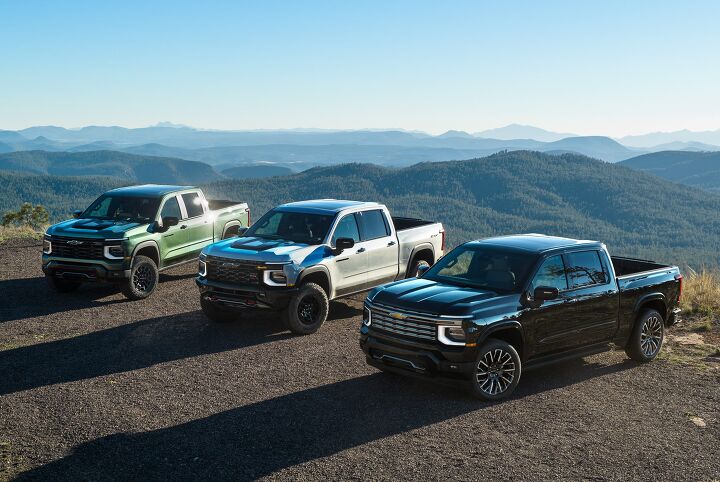
General Motors has been drip feeding the world details about its updated full-size pickups for the 2027 model year. Today, we learned about the planned pricing bumps for the GMC Sierra and Chevrolet Silverado.
Pricing on the Chevy was made public a few days ago, with GMC having just followed up with the Sierra. The elephant in the room is that everything looks to be getting significantly more expensive. While the Sierra has typically yielded higher MSRPs, it’s also supposed to be the more luxurious truck. That continues for 2027, with the difference only appearing to have widened. However, this comes with a few caveats.
When General Motors announced pricing for the Chevy Silverado, that included models with various cab configurations. This was not the case for the GMC Sierra, which has only shared MSRPs on crew-cab models featuring all-wheel drive. This resulted in the entry-level Sierra Pro being announced as retailing for $51,295 — once you’ve accounted for the automaker’s destination fees, which have likewise grown more expensive.
By contrast, the humble 2027 Chevrolet Silverado 1500 WT will start at $41,395. This similarly includes the frankly brutal $2,795 destination fee. The Chevy’s pricing reflects something that’s rear-wheel drive, single cab, and comes with fewer accouterments than the luxury focused GMC. But you’re still looking at a base-trimmed Silverado with an MSRP that’s nearly $6,000 more than it was last year.
In fact, there really aren’t many scenarios for either truck where a singular trim hasn’t seen a sizable jump in price.
The Silverado Custom will now start at $46,395, which represents a price bump of $1,200 over last year’s model. Meanwhile, the Z71 package will start at $50,695, Custom Trail Boss opens at $57,195, and the more serious Trail Boss begins at $63,995.
While climbing the trim ladder opens the door to additional off-road features (lights, tires, additional ground clearance, skid plates, hill descent) and more standard tech, customers likewise gain access to optional towing packages and GM’s Super Cruise “hands-free” driving suite. This, in addition to the updated 2.7-liter turbocharged inline four (offering 350 horsepower), serve as the rationale behind some of the pricing changes.
The new 402-hp 5.7-liter V8 and towing-focused 3.0-liter turbodiesel V6 we’ve discussed before will also be available on those models. If you want a comprehensive breakdown of the new powertrains, we recently discussed the changes being made to GM’s truck engines in a separate article.
Then we come to the 2027 Silverado High Country. Now priced at $74,495, the luxury trim has become almost $9,000 more expensive than last year’s model.
While the trim does default to the 5.7-liter V8 and includes a bevy of premium features (nicer materials, more touchscreen space, additional advanced driving features), it can likewise be optioned with the new 481-horsepower 6.6-liter V8 for those wanting to drop even more cash on their pickup.
The same is true for the $79,995 ZR2 — with the premium off-roader seeing a $5,400 jump in price over last year’s model.
Over at GMC, the Sierra SLE and SLT appear to have been dropped. This makes the $59,995 Elevation trim the next step up from the $51,295 base-trimmed Pro.
The AT4 and AT4X are the Sierra 1500’s equivalent of the Trail Boss models and start at $73,495 and $85,495, respectively. For the money, customers get the new 5.7-liter V8, a lifted suspension and extra-gnarly tires designed to handle rough terrain.
The AT4X also comes with a bevy of Denali luxury features (albeit without the badge), updated dampers, and the ability to option the 3.0-liter diesel motor or the 6.6-liter V8.
Since these are also two models that came exclusively as 4x4 models, they give us a better representation of just how much prices have climbed on GMC’s full-size pickup. The trucks are about $3,000 more expensive than they would have been months earlier.
The 2027 Sierra 1500 Denali starts at $76,795, which is about $4,000 more. While it comes standard with the 5.7-liter V8, customers can still have the Duramax diesel or 6.6-liter V8 if they’re willing to pay more. Since this is a Denali, interior materials get an update and the passenger-oriented touchscreen becomes standard hardware.
The only model that doesn’t appear to have seen a massive jump in price is the Denali Ultimate. At a hair under $88,000, the pickup has only grown in price by a couple hundred bucks. It will predictably come with the biggest and best of everything (including the 6.6-liter engine) once the trucks begin arriving at dealerships later this year.
Whether or not these noteworthy price increases are actually worth it will hinge upon how good these updated (or new) engines happen to be. The same goes for the technology tweaks. For example, the lower trimmed trucks are now getting the Google-backed infotainment that was previously limited to the fancier models while expensive models are getting extra screens to fiddle with.
However, it’s hard to get super excited about paying more for software that General Motors will presumably be issuing rolling over-the-air updates for. It also doesn't appear that customers will be getting a bunch of totally new features so much as an improved version of what was already available.
Things like 360-degree views and trailer hitch assistance have been game-changing additions for modern pickups, especially as outward visibility has only worsened over the years. But GM simply appears to be offering enhanced versions of its preexisting tech, most of which focused on intervening safety systems and how you interact with the infotainment system — neither of which really deserve to be lauded.
While advanced safety technologies have certainly improved over the years, most still have blind spots and their implementation has resulted in staggeringly invasive features nobody asked for.
Meanwhile, countless studies have shown that modern infotainment systems are extremely distracting with many drivers also finding them to be more obnoxious to interact with than what was standard decades earlier. The above presumably means there will be a subset of truck buyers who will have a difficult time rationalizing these meaningful price bumps. They’ll be wondering why they should have to pay extra for things they never wanted in the first place.
Others will simply be excited that there are brand new trucks becoming available with all-new engines. Some will probably even salivate over the prospect of there being more screen space and Google-assisted AI helpers on select models. Those will presumably be the first to place their orders for 2027, with the holdouts waiting to see if the new engines lack some of the presumed shortcomings of their predecessors.
[Images: General Motors]
Become a TTAC insider. Get the latest news, features, TTAC takes, and everything else that gets to the truth about cars first by subscribing to our newsletter.