
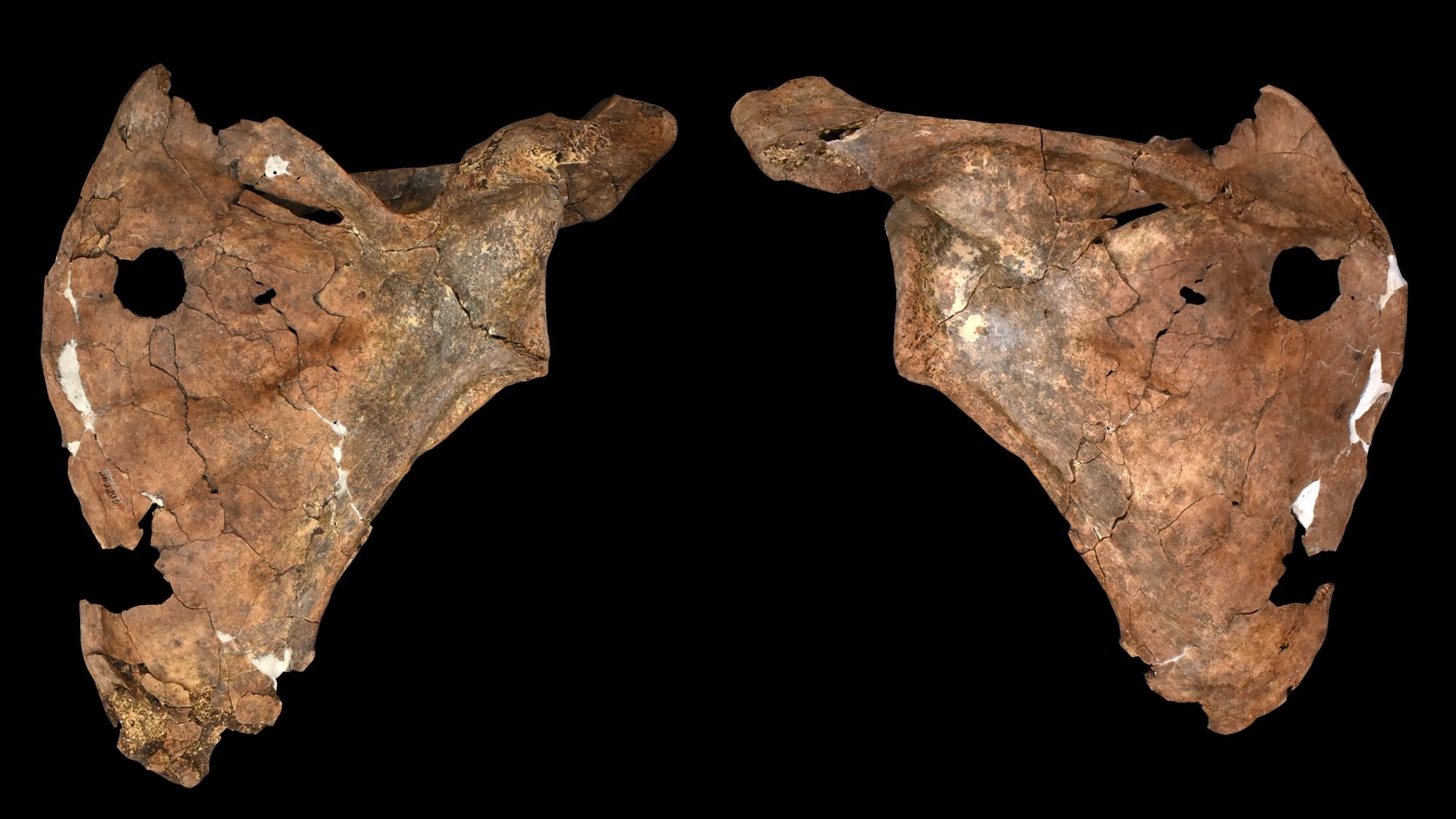
A small puncture wound through a 75,000-year-old Neanderthal shoulder blade may be the earliest evidence of death by spear on humanity’s family tree. Given forensic details such as the entry angle and overall damage, researchers believe the injury was made as an intentionally fatal “heart shot” that killed the ancient hominin within moments. The discovery is detailed in a study published today in the journal Scientific Reports.
In addition to the grisly injury, the nearly translucent bone itself makes this evidence even more striking.
“It’s extraordinary to have a perfectly preserved scapula from 75,000 years ago. These bones are so thin that you often don’t get complete scapulae from modern burials,” explained University of Cambridge archaeologist and study co-author Emma Pomeroy. “We were able to lift it out in one piece from under almost eight meters [roughly 26 feet] of rock and sediment.”
Pomeroy and her colleagues excavated the remains from inside Shanidar Cave, an archaeological site in Iraqi Kurdistan famous for containing evidence of ritualistic Neanderthal burials. The roughly 0.6 inch, nearly circular perforation on the bone was likely made with a wooden spear, since a stone or flint tip would create a flatter injury and leave behind microscopic mineral shards. The individual who inflicted the fatal injury drove the spear downward through the victim’s left chest cavity from the front, piercing major arteries and the lungs before creating the hole in the left scapula.
Located in Iraqi Kurdistan, Shanidar is a famous cave containing what appears to be early examples of Neanderthal funeral rituals. Credit: Graeme BarkerRemnants of a wooden spear weren’t found near the Neanderthal’s remains, which is understandable since the material often decomposes so quickly. That said, prior archaeological digs have revealed similar prehistoric wooden weapons dating as far back as 400,000 years. Pomeroy’s team believes a rounded spear carved from wood almost certainly caused the killing blow.
“Holes left by recreations of spears from this time are an excellent fit for the one we found in the Neanderthal scapula. That early technology absolutely works for this wound,” said Pomeroy.
Although it’s possible that a mishap like a hunting accident was the cause of death, Pomeroy argues the cumulative details suggest something far more purposeful.
“The position of the wound and the force required to push it right through the Neanderthal’s body bear the hallmarks of an intended kill shot directed towards the heart,” she added.
Another major injury the victim sustained before the possible stabbing supports this hypothesis—and complicates the story. In addition to the scapula, archaeologists documented a pair of left ribs, a right rib fragment, a nearly complete right hand, and seven teeth. Collectively, the remains indicate the Neanderthal was about 45 years old at the time of death. However, dental damage reveals the individual suffered a severe blunt-force blow to the front of the face at least a year before death. This injury split a lower front incisor lengthwise and even rotated some teeth inward.
“There’s no doubt that [they] would have had difficulty communicating and been in absolute agony for a long period of time,” said Pomeroy.
Despite this blow to the mouth, the Neanderthal survived for months or even years. This was only possible because others must have cared for the individual, including duties as simple as preparing softer foods to eat. In this sense, there is a distinct possibility the spear wound was a final, merciful act by someone close to them. According to Pomeroy, the prehistoric scene showcases both the highs and lows of what it means to be a human.
“On the one hand, we have evidence of a terribly violent end,” she said. “On the other, this was clearly an individual who was cared for during their lifetime.”
The post 75,000 years ago, this Neanderthal was stabbed with a spear appeared first on Popular Science.