
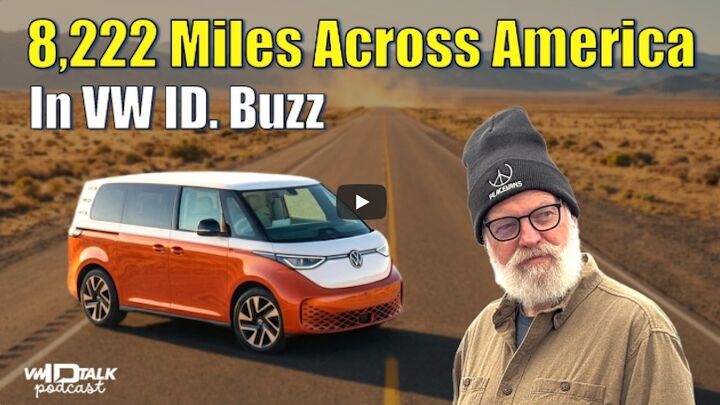
We sit down with Lee Wilson to discuss his epic 8,222-mile (13,232 km) road trip around the entire U.S. in his all-wheel drive (AWD) orange Volkswagen ID. Buzz. If you've ever worried about EV range, Lee is here to prove that charging infrastructure is a solved problem.
Lee shares how utilizing a Peace Vans kitchen box gave them the flexibility to camp, hit up hotels, or stay with friends along their eastbound and westbound routes. He breaks down their strategy of stopping every two hours for a quick stretch and local coffee, which made the journey incredibly relaxing. From stunning quiet moments in Teddy Roosevelt National Park to enthusiastic border patrol inspections, this trip proves the ID. Buzz is the ultimate adventure vehicle.
The TTAC Creators Series tells stories and amplifies creators from all corners of the car world, including culture, dealerships, collections, modified builds and more.
A transcript, summarized by AI and edited by a staffer, is below.
[Image: YouTube Screenshot]
Become a TTAC insider. Get the latest news, features, TTAC takes, and everything else that gets to the truth about cars first by subscribing to our newsletter.
Summary
The transcript features an interview with Lee Wilson, owner of an orange Volkswagen ID. Buzz, who discusses taking the electric van on a road trip around the entire United States. The trip covered roughly 8,500 miles, while the van had accumulated about 26,000 miles in approximately a year and a half of ownership. The experience convinced Wilson that an EV with around 230 miles of range can be practical for long-distance travel when charging infrastructure is available.
Charging infrastructure
Wilson's biggest takeaway is that charging infrastructure wasn't the problem he expected it to be. During the cross-country trip, there were only two locations where they encountered a situation with a single charging option — remote areas of northern Utah and New Mexico. Fortunately, both chargers worked.
Elsewhere, including New England, Alabama and Montana, Wilson found charging stations readily available. He argues that the ID. Buzz's 230-mile range was sufficient because the charging network allowed them to travel without major difficulty.
A different rhythm of road travel
The trip also changed Wilson's attitude toward long-distance driving. They generally drove for about two hours between charging stops, then spent roughly 20 minutes charging while using the opportunity to get food, use the bathroom and take a break. On several occasions, the van was ready to go before they were.
They even completed a day of more than 500 miles, demonstrating that relatively short charging stops didn't necessarily prevent long-distance travel. Wilson believes the regular breaks actually made the trip less tiring and more relaxing.
The interviewer embraces this philosophy, contrasting it with what he jokingly calls the "Iron Bladder Brigade" — drivers determined to cover hundreds of miles without stopping. The larger message is that the journey itself should be part of the experience rather than simply a race from one destination to another.
Turning the van into a travel companion
Wilson equipped the ID. Buzz with a removable Peace Vans kitchen box and a sleeping setup. Rather than permanently converting the van, he wanted flexibility. During the trip, they alternated between staying with friends, camping in the van and using hotels.
They also created small rules for their road trips to make them more memorable. Previous trips included avoiding chain restaurants and driving the speed limit. For the cross-country ID. Buzz trip, the rule was local coffee every day. Stickers from coffee shops around the country became souvenirs of the journey.
One particular coffee shop in Oklahoma City, Clarity Coffee, was singled out as the favorite, both for the quality of its coffee and the friendliness of its staff.
What Wilson likes about the ID. Buzz
After living with the vehicle for 26,000 miles, Wilson says there is a lot to like. He particularly appreciates:
- The elevated driving position and excellent view of the road.
- All-wheel drive.
- Plenty of interior space.
- The ability to comfortably carry six people.
- Enough cargo capacity to carry clothing and equipment for radically different activities and weather conditions.
- The relaxed driving experience.
Wilson describes enjoying what he calls "sharking around town" — quietly cruising at low speeds with the knowledge that the van has plenty of power available if needed.
Flexible camping setup and the refrigerator
A major advantage of Wilson's approach is that the camping equipment can be removed. Because he lives near a ski hill, he can take out the camping gear in winter and use the van to carry skis and other equipment.
But he considers the refrigerator the real game changer. He gives the example of buying cream in Utah and still having it fresh when they reached West Virginia. The refrigerator allows the van to function as more than just transportation — it becomes part of the travel experience and lifestyle.
Favorite part of the trip
The unexpected highlight of the journey was Theodore Roosevelt National Park in western North Dakota. Wilson describes it as "quietly stunning," with buffalo, wild horses and expansive scenery.
The park also has historical significance because Theodore Roosevelt spent time there after the deaths of his wife and daughter and established a ranch in the area. Wilson and his companions spent much of the day exploring the park by vehicle.
The ID. Buzz attracts attention
The van's distinctive appearance generates attention almost everywhere Wilson goes. Even a U.S. border guard became so interested in the ID. Buzz that he effectively turned a border inspection into an impromptu vehicle tour. Wilson says that even a year and a half after buying the van, he still regularly encounters people who want to talk about it.
Is the ID. Buzz too expensive?
The discussion concludes with the price of the ID. Buzz. Wilson pushes back against comparisons with inexpensive minivans, arguing that a reasonably equipped modern Honda Odyssey or similar minivan is already in the $50,000–$55,000 range.
More importantly, he considers the ID. Buzz's true comparison to be the Ford Transit, rather than a conventional minivan. He points out that the two vehicles are similar in size and that a properly equipped Transit can cost around $80,000. Because the ID. Buzz is built by Volkswagen Commercial Vehicles, he sees it as a commercial-vehicle-based product rather than simply an expensive minivan.
Bottom line
The transcript's main message is that the ID. Buzz can work surprisingly well as a long-distance electric adventure vehicle. Wilson's 8,500-mile American road trip demonstrated that the van's approximately 230-mile range wasn't a major obstacle because charging stops naturally fit into the rhythm of long-distance travel.
More broadly, the experience changed the concept of the road trip for him: stop every couple of hours, explore local communities, support independent businesses, camp when appropriate and treat the journey as part of the destination. The ID. Buzz's combination of space, AWD, removable camping equipment, refrigerator and distinctive design makes it as much a lifestyle and travel tool as an electric vehicle.