
There’s a context (we know and you probably don’t) behind the musicological tete--a-tete charming social media
A loud argument between Russian intelligentsia over Schubert, Bach, and the merits of a fugue has delighted millions of viewers far beyond the Russian-speaking internet.
Here's the backgroud.
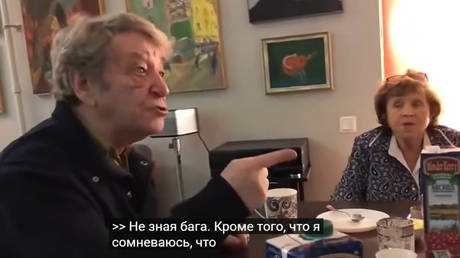
Set the scene.St. Petersburg, 2019. Three old friends are bantering around a table when the topic naturally turns to Franz Schubert, as it does, and things get emotional.
Who is at the table?Esteemed musicologist Natalia Entelis is at a post-lunch table with friends; former orchestral violinist Emil Finkelstein and his wife Elena Fradkina, who was celebrating her 80th birthday. Their daughter, pianist Polina Fradkina, who – possibly knowing what was coming – recorded the video, posted it online recently in connection with comments over the merits of an online music course, and it has struck a chord.
What caused the argument?Finkelstein opens with a demand for an inquiry, into how Schubert could have written such brilliant music without knowing the work of Johann Sebastian Bach.
Opposite and stoic in her resolve, Entelis observes that fugues are almost entirely absent from Schubert’s masses and, as you would, points instead to the Italian tradition he studied.
The best video you'll see all day pic.twitter.com/PMkiUnn63G
— Joan Cook from PBS (@MissPavIichenko) September 2, 2026
Tip: a fugue is more or less a form in which one musical voice introduces a theme and others pick it up. Bach used them.
Menwhile, birthday girl Fradkina drops a bomb, asking if writing one is “some f***g mark of quality?”
Voices rise and hands fly, of course. Italian polyphony, naturally enough – always the first to go – is dismissed as “bullsh*t.”
Beethoven’s preference for Handel over Bach enters the fray, obviously, before Fradkina declares: Schubert’s songs were works of genius; everything else was “crap.”
The argument ends with one final disagreement:
“Schubert, as a person, is my favorite composer,” Entelis says.
“No,” Finkelstein corrects her. “Bach is your favorite composer.”
Read more 185 years of Tchaikovsky: Honoring the composer who gave the world its most iconic balletsWhat triggered the argument?
Finkelstein, now 85, told the St. Petersburg publication Paper that Entelis was working on an academic article about Schubert at the time,.
“I once got to perform a mass by Schubert, a religious work, that is terribly boring, to my taste,” he recalled. “I did not like her writing about bad music.”
He described the exchange as something more personal. “It was a dispute about who values which music, and who loves which music,” he said. “A dispute about love, if you like.”
Why did the pianist post the video?
An online course on medieval and Renaissance music by popular lecturer Anna Vilenskaya had come under fire from specialists over factual errors, prompting a wider argument about accuracy in popular education.
Read more Venice Biennale chief defends Russian pavilion return
Fradkina said she shared her family video to explain why professional musicians can react so strongly to an apparently small mistake.
“Understanding how music works is not a collection of correct dates and terms,” she wrote. “Facts are needed to see the process behind them.”
Why does the argument feel so intense?In late Soviet life, private flats – and kitchens in particular – were gathering places where friends could spend hours arguing about everything from politics and history to books, music and everyday life.
“I grew up in a family of musicologists,” Fradkina wrote on Facebook, recalling how everything at home revolved around music: “from family squabbles over a missing slipper to fierce discussions about the roots of antisemitism, from Slavophiles and Westernizers to the proper way to make Olivier salad. Somehow, sooner or later, it all came back to music.”
What have international viewers made of it?
With English subtitles, the clip became a hit on X. One widely shared upload has received more than five million views and thousands of comments.
Viewers called it “the most intellectual argument” they had seen on the platform and said they would watch five seasons of the discussion. Some joked that the scene explained Russian classical literature; others described it as “a breath of fresh air” and even a video that “heals the nervous system.”
I wish Americans would have more arguments like this around the dinner table, instead of arguing over garbage political matters heard on the TV. Russians arguing passionately about the the extent of Schubert’s knowledge of polyphony & Bach. https://t.co/iku9sQbnlz
— Professor R Shaldjian Morrison,διδάσκαλος,夏炉冬扇, 散人 (@Swarthyface) September 3, 2026
“I wish Americans would have more arguments like this around the dinner table, instead of arguing over garbage political matters heard on the TV,” one user wrote. “Russians arguing passionately about the extent of Schubert’s knowledge of polyphony and Bach.”
The reactions sometimes romanticized three individuals as representatives of an entire culture. But they also recognized something genuine: in an internet full of anger without intimacy, this was an argument that became heated because everyone at the table cared.
What does this say about Russians?So while some might be surprised at the emotionality of Russians engaged in a passionate discussion of pinnacles of European culture, here's the reality.
Finkelstein says he and Entelis are still friends and still meet for coffee.