
Listen and subscribe on Apple Podcasts, Spotify, and all major podcast apps.
Andrew Phung: My friend and I were in Calgary at the same time, and I was like, “Yo, let me take you out for dinner.” And I remember getting to his hotel, and he’s like, “How’d you get here so fast?” I’m like, “It’s Calgary. There’s not that much traffic.” He’s blown away. And we went to this restaurant, CHARCUT, get a table, and he’s like, “Did you make a reservation?” I’m like, “Nah, man, I just assume we get a table.” He’s like, “You just walked into a restaurant at 7:00 and got a table at this nice of a place?” I’m like, “Yeah, man.” He’s mind blown
Nora Richie: Ah, the Calgary life. No traffic, no reservations, no problem.
I’m Nora Ritchie, and this is Atlas Obscura, a celebration of the world’s strange, incredible, and wondrous places. This episode was produced in partnership with Travel Alberta. Explore Canada’s Wild Side.
This month, we’re talking with Canadian writers and artists who find inspiration in their home province of Alberta. Today, I’m talking with Andrew Phung. Andrew is a comedian and actor best known for playing Kimchee on Kim’s Convenience, and he’s the creator and star of Run the Burbs. But for this conversation, what matters most is that Andrew is a superfan of Calgary, the medium-sized city where he grew up.
This is an edited transcript of the Atlas Obscura Podcast: a celebration of the world’s strange, incredible, and wondrous places. Find the show on Apple Podcasts, Spotify, and all major podcast apps.
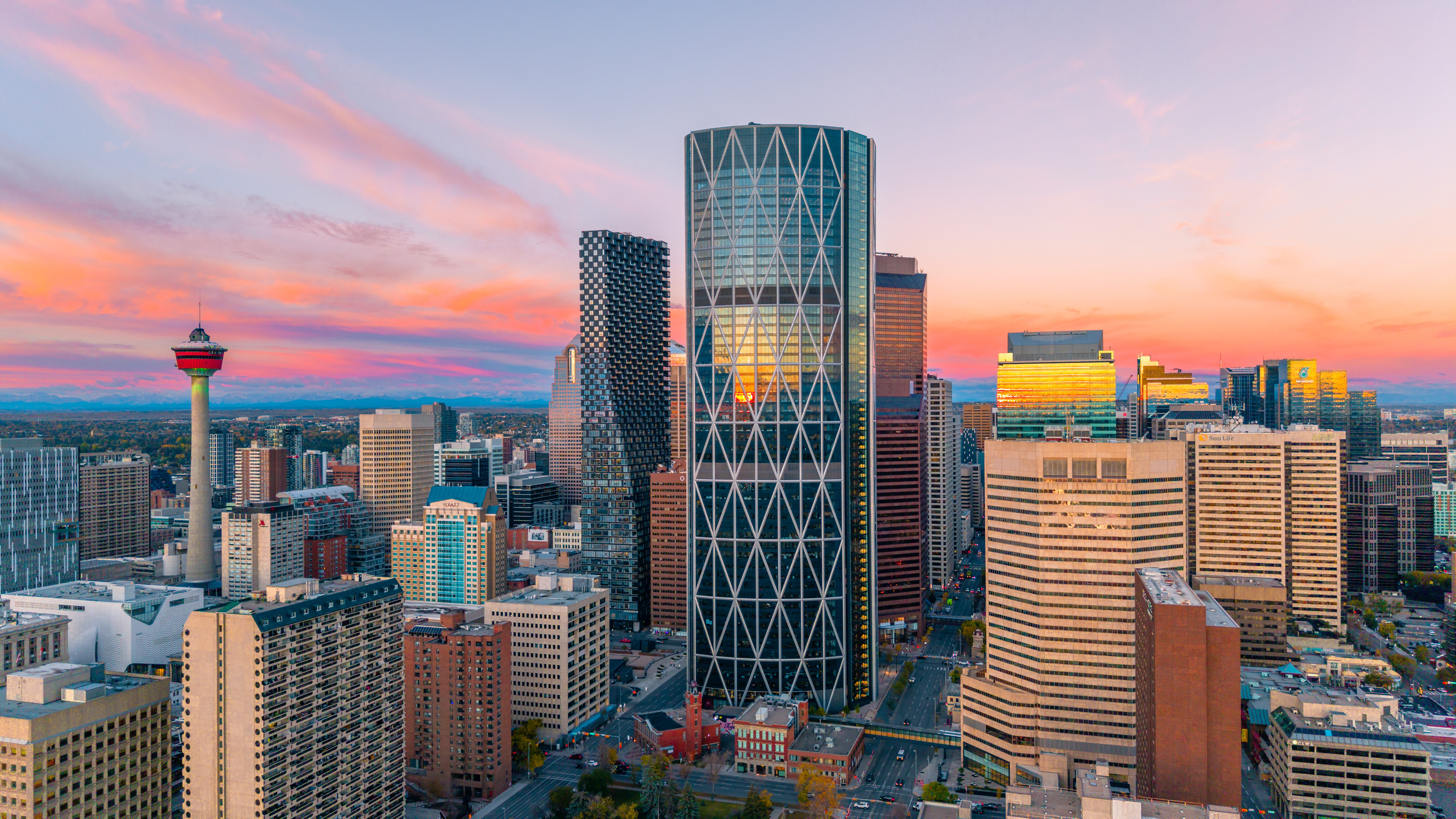
Calgary is in southern Alberta, where the prairies meet the foothills of the Rocky Mountains. And to be honest, it’s not exactly considered the poster child for Alberta tourism. That honor usually goes to places like Banff and Lake Louise, with their turquoise lakes and mountain views. But Andrew thinks his hometown deserves a little more love.
Andrew: I would describe Calgary as a really big city that has all the amenities but feels a bit like a small town at times in regards to its friendliness. The mountains are right behind you. There’s really fresh air, and it is so bright. I think there’s some wild statistic, like Calgary gets the most sunshine in, like, all of the world during the winter or something like that.
Nora: I wanna hear about the street you grew up on, your neighborhood.
Andrew: I will talk about Northeast Calgary until I die. The northeast of Calgary is a quadrant of the city. It is the most culturally diverse. I grew up in Whitehorn, Temple, Falconridge, Coral Springs. I’ll name the neighborhoods, but Coral Springs was where we ended up last.
And what I loved about it was, Coral Springs is full of dreamers. It’s people who this was the first new house they bought. And it was really affordable to new immigrants, families starting out fresh. So literally everyone on my street had kids, and so we were always playing. Like, every day after school, we’d come home, we would get on our bikes, we would go to someone’s house, get the baseball equipment, get the hockey equipment, carry the net, you know, all that stuff.
Every day at 5:00, you know, people would come home from work, and then we’d have to go inside and have dinner and do homework. That was our street. It felt a little bit like Pleasantville.
Nora: It does sound like Pleasantville. So your parents are Chinese and Vietnamese. How did they end up in Calgary?
Andrew: So most people assume your parents come to Canada together. My parents met in Canada. They had different immigration stories. My mom immigrated to Airdrie, Alberta, which is a suburb of Calgary. My dad ended up in Saskatchewan. A church there had sponsored a bunch of Vietnamese refugees into Canada.
And then my dad tracked down a friend living in Calgary, and he went to take the bus to Calgary and waited for him at the bus station, and the guy didn’t show up. And then my dad saw another person delivering Chinese food, went and talked to that guy, and that guy took my dad home, and my dad lived with him for two years.
The Asian community in Calgary in the ’70s and ’80s was so tight-knit. Like, if they saw one of their own, they would take you in. It was so supportive. And I remember years later, my dad saw an old friend. I’m like, “Yo, who was that guy?” My dad’s like, “Oh, I used to live with him.” And I’m like, “You need to give me the full backstory on that.”
But my mom and dad met in Airdrie at a card game. My uncle introduced my mom and dad, and I was born and raised in Calgary. That’s our immigration story, and I really always reflect on how welcoming Canada was in the ’70s and ’80s. Really welcoming in refugees and immigrants to build a better life.
And my parents always say, “Andrew, we’re living the Canadian dream. Everything we do is the Canadian dream.”
Nora: Related to your work in comedy and growing up, was there a time in your childhood that you were sort of like, “Wait a minute, I’m pretty funny. Like, people think I’m funny. Maybe I should explore this more?”
Andrew: Growing up as an Asian person in Calgary, comedy and the arts isn’t really an avenue you pursue. And so even though I was very outgoing, I went to university for a degree in economics, with a focus on oil and gas. I thought I was gonna work in oil and gas. I thought I was gonna become a lawyer, like that was the route I was gonna take.
The only person I saw that was Asian in the media was, like, Jackie Chan, Jet Li later on. In Canada, there’s a show called Degrassi, and we had a character named Yick. He was the only Asian character on Degrassi: Junior High and Degrassi High. He didn’t get a lot of stories, but when Yick was there it was like, “Yo, Yick was there. He was at the party.”
Nora: I sadly only know that show from Drake.
Andrew: Yeah. So I didn’t see myself in it, so I didn’t think it was an option. It wasn’t until high school when I took drama in high school as an option, I really enjoyed it, and I joined the high school improv team. And even then, like, I was like, “I’m probably not gonna do this very long,” Because I sucked. I sucked so much.
Nora: Yeah, when you say you sucked, what makes you say that?
Andrew: So I grew up watching a lot of Saturday Night Live and Conan O’Brien and, and David Letterman, and so I was trying to be too funny. And I think that was one of the things in comedy I learned early on, that you shouldn’t try to be funny, you should just find your comedic voice, and I didn’t understand that.
So I was trying to mimic Sandler and Farley and Will Ferrell and Cheri Oteri and Ana Gasteyer. I was trying to mimic those people when I should’ve been just trying to find my own voice. So I wasn’t very good at it cause my timing was so off.
I didn’t know what my voice was, and it wasn’t until my drama teacher, Loretta Beesh, encouraged me to go down to the Loose Moose Theatre Company, and the Loose Moose Theatre Company trained me for free. I showed up as a 15-year-old kid. We came down with my friends, we took the bus there, they never charged us for a class. They trained us for free. I performed at Loose Moose Theatre from 1999 until now whenever I’m back in Calgary. Until I started making Kim's Convenience, I was playing at Loose Moose Theatre.
Nora: Oh, wow.
Andrew: Everything I know about the arts and, and, and performing in the arts, building arts, creating in the arts, is from the Loose Moose Theatre.
Nora: Is there any kind of moment from those early days that still sticks with you?
Andrew: Yeah. I remember I got picked to do a show, and I was not very good that night. And again, early on, I’m 16, 17, I don’t have a comedic voice. But when you fail when you’re 16 or 17, it’s like the end of the world. Because school teaches you to be right and to be perfect and to get good grades.
So I felt like I had the worst show, and I’d let everyone down, and I remember my artistic director, Dennis Cahill, who’s still the artistic director, said, “Oh, tonight was a rough show.” But he put it very bluntly. He didn’t sugarcoat it. And he said, “Tonight was a rough show. Well, you get to come back next week and do it again.”
And just hearing that, it was like, “Oh, it’s not over. I get to come back and do this again.” And I think that mentality and that ability to fail has shaped everything, every ounce of who I am today. The willingness to fail. That moment changed everything for me.
Nora: That’s an incredible attitude to have as an artist, of course. You know, Calgary isn’t necessarily known as a comedy town, although maybe a little bit now from you, but what do you think it was about it, about the Loose Moose or about Calgary that allowed that kind of space to take root?
Andrew: Well, firstly, I think Calgary has a very underappreciated reputation as a comedy town, because Bruce McCullough and Mark McKinney from the Kids in the Hall came from Loose Moose Theatre. The Kids in the Hall are foundational in comedy, I think, I believe, in the world in the ’90s. And two of their members came from Loose Moose Theatre.
But the thing about Calgary is that it is not Toronto, it is not Vancouver, it is not LA. So I believe that the people who pursued comedy in Calgary did it for the pure love of the game. They love comedy. They have jobs. We all had a side job, we all had hustles that we were trying to do.
You perform at these gigs and these venues that pay dozens of dollars on your best night because you love it. It’s less about the success. So that’s why I think Calgary is such a wonderful space for artists, because you do it ’cause you love it.
Nora: I know you from Kimchee on Kim’s Convenience, which is such great comfort food of a show. And then of course from Run the Burbs. I wanna talk a little bit about that, ’cause that’s really, you know, your baby. And it’s set outside Calgary too, right?
Andrew: We were trying to shoot it in Calgary, but it’s set in a suburb that is reflective of Calgary.
Nora: So tell me about that process and what parts of your own life you bring into making that show?
Andrew: When I was on Kim’s Convenience, I was always like, ”What’s the next thing?” And I was always, like, watching the showrunners, Ins and Kevin, make things, and directors, and I’m like, ”Oh, this is interesting.” So I started kind of plotting on what’s my next idea, what’s my next thing? And my co-creator and I, Scott Townend and I, my buddy, like he was one of my best friends, we were coming up with ideas, and we just started putting together ideas of a TV show we wanted to see.
And we wanted to see something that was about a family in this day and age. I wanted to see a diverse family. Kim’s Convenience was about the immigrant experience, and then Run the Burbs is about the experience of the children of those immigrants. I want to see them thrive. I also wanted to showcase families of color thriving, and that often happens in the suburbs, and I saw that growing up in Calgary.
In Calgary, the suburbs is where a lot of immigrant families and newcomers are thriving. It is a chance for them to have a backyard. It is a chance for them to have a barbecue with hamburgers and hot dogs. And so I really brought that energy to Run the Burbs. We wanted the family to be reflective of the families I see in the suburbs.
And I want to see families that had honest conversations with their kids, and that were inclusive of their kids, and to have emotionally intelligent parents and kids just trying to be better. And so it was a lot of, what I see in parenting around me and how I work as a father.
Nora: Yeah. I mean, you also made that important choice to set it in Calgary. Why did you wanna set it in Calgary?
Andrew: Well, first I want to set it in Calgary ’cause we never see Calgary. We never see modern Calgary.
Alberta is beautiful for landscapes. And so many of our Westerns are shot in Calgary and Alberta. It’s beautiful. I love it. There’s entire towns dedicated to being Westerns. But I wanted to showcase Calgary as a modern city, so I wanted to showcase Calgary as Calgary.
Nora: What was it like having it be your own creative baby? Like there had to be some really challenging parts about it. Could you speak a little bit about that?
Andrew: Making your own TV show is a miracle. It’s an absolute challenge. Everything has to break right. There are so many talented people who are relying on years of experience and knowledge. It’s literally hundreds of thousands of hours of experience that goes into one day of television. So making it is a miracle. Dealing with network notes, budget constraints, schedules, weather—all the technical pieces. Your camera has to go.
Everything has to break right for you to get through the day, and so it is such a challenge. And I’m so thankful for the experience, but when I finished making Run the Burbs, I was like, “Oh, my God. I can breathe again. Oh, the pain, the stress.”
It takes years off your life, I feel like. Though at the same time, I was so creatively fulfilled. I loved making it. I miss it so much.
Nora: I’m putting you on the spot here, but are there any spots if someone’s visiting Calgary for the first time and you’re like, they gotta go to this restaurant or this theater or this, like hike or whatever?
Andrew: I will always recommend Loose Moose Theatre, but I think if you’re gonna spend an afternoon in Calgary, 17th Avenue SW is so much fun. I was down there recently. I walked down there and I met up with a friend at Class Clown, for hamburgers, and everyone had been hyping it up, and it was worth the hype.
Class Clown burgers are incredible. Then we walked over to From Another, which is this vintage shop that is in Calgary, Edmonton, and Vancouver, but they got a great spot in Calgary. We walked down the street to Less 17, but along the way are tons of bars and pubs, and along the way on 17th Avenue, we passed by this vintage market that just popped up on the street.
17th Avenue SW is such a great walkable area. Kensington is also a lovely area as well, but I would encourage people to spend an afternoon in the northeast of Calgary. And again, you need a car to do that. Calgary is, I acknowledge it is not the most walkable city, but I think the food in the northeast of Calgary, and when you head off into the southeast of Calgary, like 17th Avenue SE, it is the most authentic food you can get.
Like the best banh mi sandwich I’ll ever have is in Calgary. I tell people about it. I get DMs on my Instagram all the time from people being like, “Yo, I was in Calgary for work, and I went and got this banh mi. You’re absolutely right.” I had a friend write me again. They’re like, “I went there three times, Andrew.”
Calgary, when you break it down and look for things, there is a pace of life, and there are so many things to explore that are worth it. As a parent, I always tell people Calgary is so family-friendly. You have the Science Center, but then you also, surrounding Calgary, you have all these like corn mazes and little areas that have popped up in Calaway Park that are such wonderful parks and places for kids to be.
And then inside the city, there’s so much to do because we have space. Again, there’s all these warehouses that have been converted into batting cages and play places. I just think it has all the elements of a big city, all the perks. Beautiful hotels, landmarks, art, things to do, without like the, the, the hustle and bustle and busyness of a Toronto. You know? Getting anywhere in Toronto, you accept it for all of its flaws.
Nora: That reminds me, I live in New York, but I went to Madison, Wisconsin recently for something, and I was like, “Where, where is everybody? What’s going on?”
This is what it is. It’s just a quieter pace. There’s less people on the street. It’s not so busy. But it was a really lovely place. It's a nice change of pace.
Andrew: Yeah, definitely. Nice change of pace. Things are easy to do. Oh, I can stop and breathe for a second, which is very nice.
Nora: Well, thank you, Andrew. I really appreciate your time.
Andrew: Yeah. Thank you for chatting with me.