
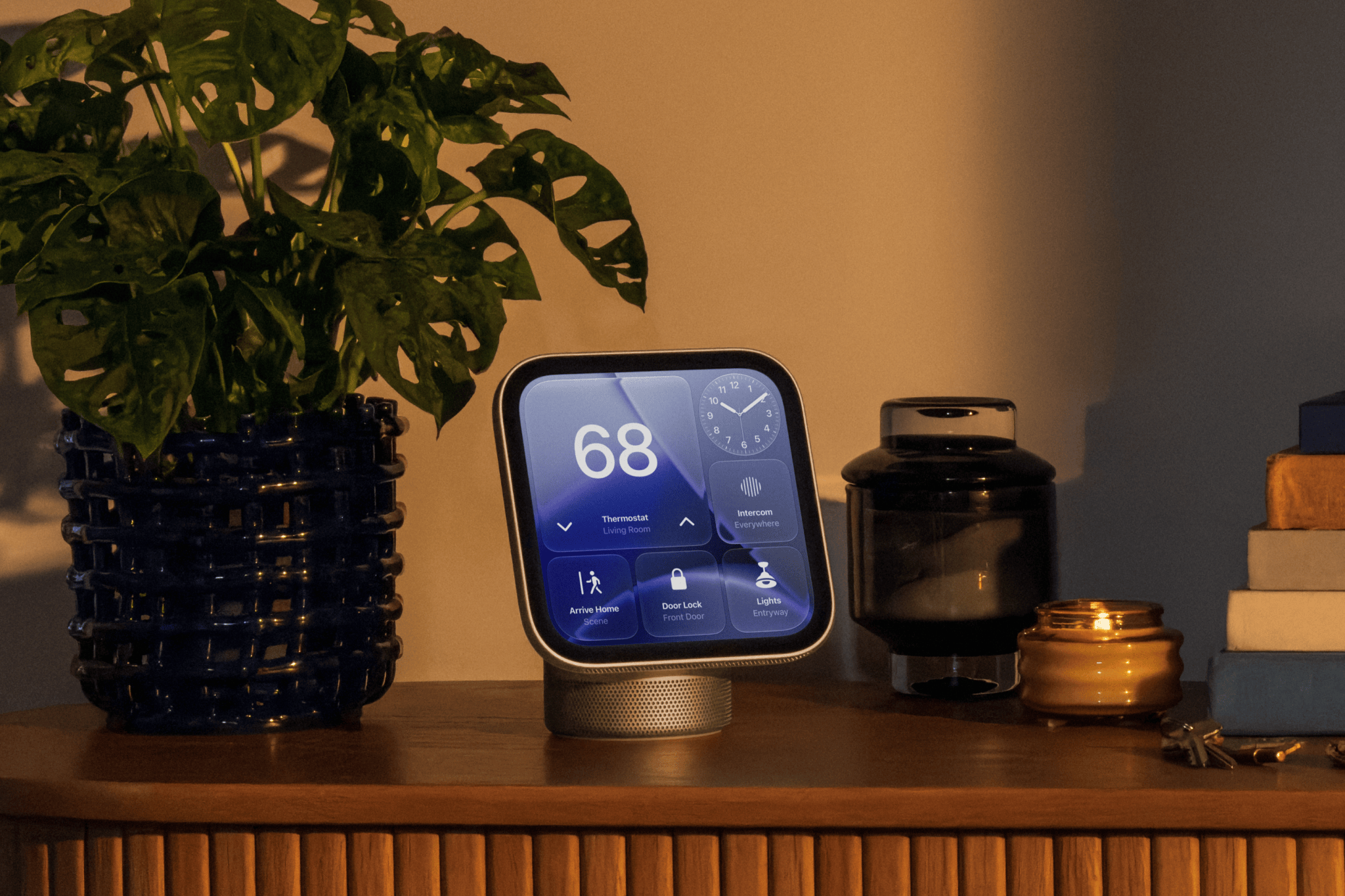
Less than two months into the job, Apple Chief Executive John Ternus presided over his second major product launch Tuesday, introducing new home devices that includes Apple’s first smart home display.
The gadgets offer more ways to generate hardware sales. More important, they’re ideal hosts for Apple’s upgraded Siri, giving the company a new distribution channel as it plays catch-up in AI.
The biggest reveal in Tuesday’s product launch was HomeView, an entirely new Apple device. The device looks like a giant Apple Watch and resembles the 2002 iMac G4, which had a hemispherical white base topped with a flat-panel LCD screen. Apple also announced a new Apple TV 4K with an upgraded chip, the HomePod mini 2, and a collection of home accessories developed with LG and Schneider Electric, including a video doorbell, a smart thermostat, and a smart lock.
HomeView, which has a 7-inch display, costs $299 and is available Nov. 13. A wall-mounted version is also offered.
Apple’s announcement prominently featured Siri AI, its upgraded assistant, which will be available in beta on HomeView and the new Apple TV 4K. HomePod mini 2 will receive the assistant through a future software update. The upgraded assistant has been rolling out on iPhones and will now be central to Apple’s home products, which the company hopes will get more people to try the new Siri and help build out its AI ecosystem.
“This is them rebooting their entire approach to home,” Anshel Sag, an analyst at market research firm Moor Insights & Strategy, told Fortune. “If Siri’s that much better, then there’s an opportunity for them to reboot all the stuff that they weren’t successful with because Siri was not good. This is just the first phase.”
Siri has lagged well behind leading chatbots from OpenAI and Anthropic. The new version, which relies on Google’s Gemini AI technology, is designed to understand what is on a user’s screen and act on it, help with writing, and search a user’s phone for context, among other features. Sag said one of the most noticeable differences is that Siri used to hand off queries to ChatGPT or elsewhere because it lacked intelligence, but it now gives the requested answer directly.
Still, he said, the general public seems largely unaware that Apple has upgraded Siri, and the iPhone maker needs to change that quickly if it wants wider adoption.
Apple has been in the home market for years but has not matched the success of rivals Amazon and Google. Those companies had an early start and cheaper hardware, and Siri’s poor performance also held Apple back.
Revenue for Apple’s Wearables, Home and Accessories segment fell by 4% during its 2025 fiscal year to about $35.7 billion. In July, Apple revealed a disappointing revenue forecast for its fiscal fourth quarter, which it is expected to reveal in the next few weeks.
Revamping its home lineup is now crucial, not only to expand Siri’s reach but also to improve the assistant and lock in Apple customers. As interest in AI has surged, tech companies such as Meta and OpenAI are racing to build a variety of devices that could form a family of AI products present throughout a user’s day. That would let AI pick up vast amounts of context that could help customers.
Even with Apple’s new home lineup, however, the company will continue to face competition from Amazon and Google, which have also been working to improve their chatbots. Yet there is still room to win, said Mohit Agrawal, research director at market research firm Counterpoint Research.
“Most smart speakers and hubs in homes today are low-cost devices that can’t run AI at the edge, so they are ripe for replacement,” Agrawal said in a written statement. “Amazon and Google have only just begun refreshing their hardware for Alexa+ and Gemini, so the upgrade cycle is wide open.
“Rather than buying its way in, as Amazon did with Ring and Google with Nest, Apple is partnering with LG and Schneider Electric. This lets it fill out the home quickly, from the front door to the thermostat, while keeping control of the experience through Siri and the Home app.”
Ternus replaced Tim Cook as CEO in September. Ternus, a product engineering savant, has been establishing himself by rolling out new devices meant to cement Apple’s hardware supremacy, most notably the company’s first foldable phone, the iPhone Duo, which Ternus unveiled in September.
That month, Counterpoint predicted Apple would sell around six million Duos this year. A report this week by Chinese news outlet Securities Times said Apple had increased supply-chain orders for the Duo by 30%, while orders for the new iPhone 18 Pro were down.
Apple hasn’t said how many Duos it expects to sell. Pre-orders for the Duo open this Friday, and the phone will be available in stores Oct. 23.
This story was originally featured on Fortune.com