
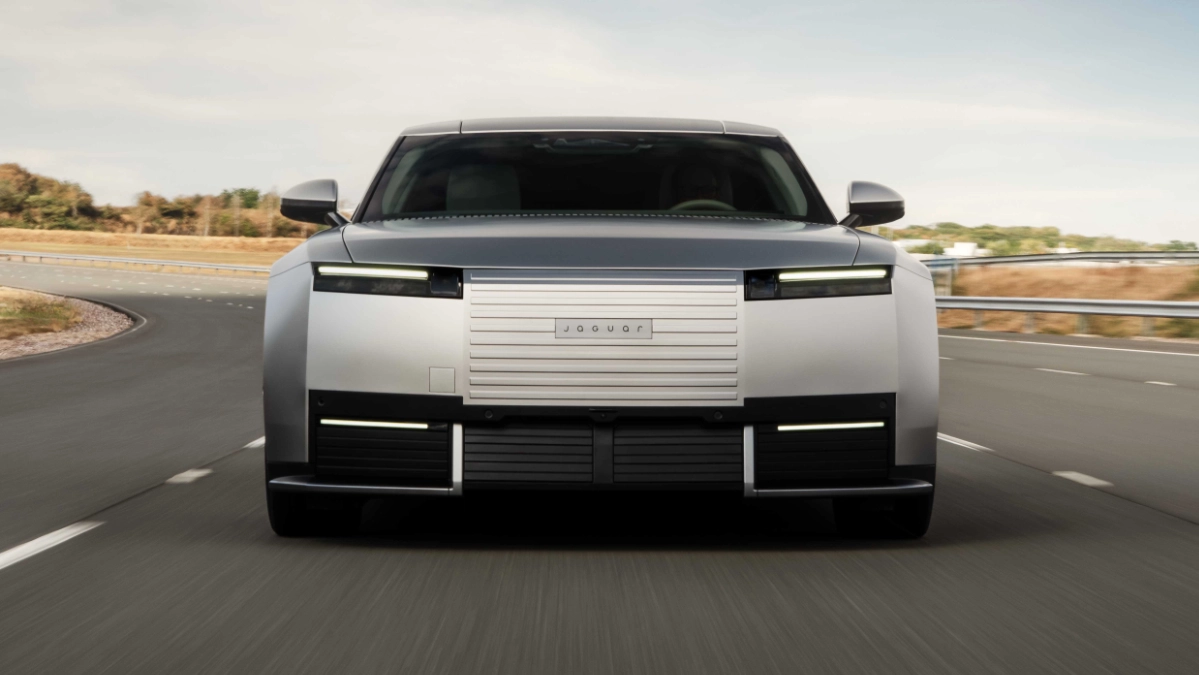
This is not a new Jaguar.
Not to the people who created it. Among many staggering nuggets they shared as Top Gear was smuggled through fierce security into Jaguar Land Rover headquarters on the 125th anniversary of founder Sir William Lyons’ birth (and days before the cyberattacked and tariff-battered company announced 4,000 job cuts) was the car’s age.
PHOTO BY Jaguar
This traffic-stopping look was frozen sometime in 2021. I’m shown top-secret photographs of the clay model being massaged in the design studio. The sculptors are wearing Covid facemasks. That explains why the hood’s edges are two meters apart. The designers were social distancing.
OTHER STORIES YOU MIGHT HAVE MISSED:
The 2026 Bogey Golf Invitational celebrates camaraderie in the PH automotive industry
We tried the Ultimate Sleeper Bus from Manila to Naga and back
Grace, Pace, Hands Face Space. Until now, it’s been known as Project Pantera. Or Codename X900. Now it’s officially the Jaguar Type 01. That’s ‘Zero One,’ not Type One, and definitely not Type Oh-One.
PHOTO BY Jaguar
“Oh-s***!” is more likely to be the reaction. The whole point of this car is to create a ‘bloody-hell’ moment. You might argue Jaguar overcooked that with 2024’s infamous ‘Copy Nothing’ sting. Insiders diligently insist it was carefully plotted not to please everyone. Hmm. Death threats against the creative team and share price freefall included?
Since the advert that launched a thousand columns, other EVs from beloved marques have broken the internet. But unlike Luce, Torcal and AMG GT, this is not a toe in the water from an otherwise profitable powerhouse. The Type 01 sets the tone for a totally new Jaguar company. All electric, more luxurious, rarer, bespoke. If this car bombs, Jaguar dies.
Out comes the case for the defence, armed to the teeth with buzzwords. Exuberance, unique, fearless, progressive. My Jagspeak bingo card overflows in seconds.
PHOTO BY Jaguar
PHOTO BY Jaguar
Look out, here comes the justification for such a radical rethink. “Jaguar was at a crossroads. Aging customer base. Stiffer emerging competition. An evolving political situation. A legendary brand underperforming commercially.”
My favorite tidbit is the admission that Jaguar interviewed 2,500 people across six continents during Type 01 customer clinics. Each was asked to grade it out of ten. The car got more nines and tens than any Jag previously measured by the same metric…but more ones and twos as well. It’s not here to please all the people.
If, say, 10,000 people a year spend £150,000 (around P12.5 million) on one (the base price is £120,000 but Jaguar is eyeing juicy options to pump profits), it’s mission accomplished. And dividing the voters isn’t the only record under its belt. Welcome to the most powerful, stiffest, most aerodynamic and most patented Jaguar of all time.
PHOTO BY Jaguar
Power? 1,015hp from a trio of motors: One up front plus individual motors for each rear wheel, allowing active torque vectoring for more agile handling. 6.5deg of rear-wheel steering helps too, giving this canal boat the turning circle of a 3-Series.
Stiffness? An impossible-to-quantify 57,000Nm per degree. Let me put it this way: The state-of-the-art McLaren W1’s racecar-spec carbon tub claims 51,000Nm per degree. The Jag, with its structural battery and fancy castings, is untwistable. Good news for handling, for letting the suspension do its thing when there are bumps to absorb. Handy when the wheels are gargantuan 23-inch as standard. And reassuring if you crash.
PHOTO BY Jaguar
Aero? The drag coefficient is a slick 0.23Cd, though I later discover that’s if you spec the 21-inch wheels Jaguar is mandated to provide in markets where snow chains are the law.
Motorized venetian blinds up front block cooling channels to the brakes and powertrain unless a draught is absolutely necessary. Result? 43km more range on the American test cycle than if they were a fixed grille. Chamfering the originally bluff front corners by 8mm bought another 12km.
It took them 7,000 wind tunnel tests and along the way they figured out that a three-position rear spoiler would minimize drag and create 75kg of high-speed downforce, which seems like overkill when the car weighs on the wrong side of 2,500kg, despite being fashioned from 73% aluminum.
PHOTO BY Jaguar
And the patents? 360 and counting. Most, like the high-voltage charging electronics integrated into the front strut brace, are hidden deep beneath the tightly-drawn skin, never to see the light of day unless it’s in bits for serious remedial work. Which won’t happen, Jag promises, because it’s determined not just to shed its reputation for dusty golf chariots and perpetually disappointing accounts, but also for cars which break down.
So this is also the most extensively tested Jaguar in history. More than 150 prototypes, tortured for hundreds of thousands of hours everywhere—from -30 degrees Celsius frozen Arctic wastes to the more than 40 degrees Celsius furnace of Death Valley. If you see one of these on an AA flatbed with the hazards strobing, Jaguar hopes your first assumption will be ‘silly bugger must’ve run out of charge.’
PHOTO BY Jaguar
PHOTO BY Jaguar
That happens after a claimed 724km, though Jaguar sportingly admits that a zero regen motorway cruise means closer to 514km. Smart motor deactivation when four-wheel drive isn’t required claws back another 29km of range.
The battery is gigantic at 118kWh, allied to 850V architecture for a theoretical 22-minute recharge. It could be bigger still, but the mission was a car of impossibly low stance. So the pack was compressed down to just 150mm thick, including its armor-plating. Huge divots had to be carved out of the precious cell packs to make space for rear passengers’ designer slippers. Even the seats have been slimmed to just 83mm thick to make those proportions possible.
PHOTO BY Jaguar
And here we get into the compromise of the supposedly zero-compromise Zero One. To get these cartoon villain getaway car proportions—the lowness, the raked rear—this vast barge is not a spacious car. I have never heard a manufacturer dub a four-door car a ‘2+2 seater’ before. Normally that get-out clause is reserved for coupes like an Aston DB12 or Porsche 911. The Type 01 is a space-inefficient, selfish car. I sat in the driver’s seat too and was surprised just how hemmed it felt. Even the vast hood conceals nothing more than a charging cable carry-cot.
No one from Jag baulks. Though they don’t say it out loud, there’s an air of ‘Yes, we know, thanks.’ And if you want a roomier car, or a longer range car, or one with rear seat entertainment and a giant boot, go buy one off someone else who makes whitegoods. This isn’t for you.’ That’s a galaxy away from the diesel XE and E Pace era.
PHOTO BY Jaguar
PHOTO BY Jaguar
The Type 01 is attempting the hardest trick for an EV. Nothing to do with range anxiety or depreciation dodging. Something more elemental: Heart over head. An electric car you buy because you want one, not because it makes sense on the tax return. In Jag wordsoup, that’s billed as ‘irrational desire.’
So far, neither you nor I have seen the new Jaguar in its ideal habitat. I’m guessing this website isn’t your first introduction—you more likely saw it in the newspaper, on Instagram or YouTube earlier this month. I met it in a sterile studio. That crucial ‘OMFG WTF’ moment will come when we see it on a public road, among sundry traffic and anonymous architecture.
In the metal, it’s got immense presence. But don’t be fooled by anyone who airily comments that Jaguar was brave to retain the Type 00 concept’s ribbed front ‘grille,’ slatted rear lights, and reductive surfaces. The production car was finished first, then the pink coupe was reverse-engineered as an extreme preview of Jag 2.0.
PHOTO BY Jaguar
Since this car is a rolling design gamble, allow me to spill more tea on the details. Jaguar considered rear-view cameras but correctly decided they’re a user-friendliness disaster and went with aero-efficient mirrors instead. That said, there’s no back window, and the rear view display appears atop the dashboard to avoid eating view through the raked windscreen.
Why no back window? Designers demanded a lengthy glass roof, and by the time they’d incorporated rear crash structure and tapered the rear satisfactorily, the window “would’ve been a letterbox.”
PHOTO BY Jaguar
The rear three-quarter pressing is known internally as ‘The Impossible Panel.’ The press that stamps out what the engineering team originally considered beyond modern manufacturing is four storeys high and squeezes down with a force of 2,500,000kg. 1,500 hours were spent tooling it up.
The trunk is open to the cabin, but I’m reassured there’ll be some sort of flat-pack bulkhead stowed in the boot cellar to plug the gap between the seats. The boot floor is oddly inclined, ramping down towards the rear end to stop your shopping from sliding forward when you brake.
PHOTO BY Jaguar
Since hidden door handles are soon to be illegal in China, Jaguar will engineer new ones for that market. The car launches as a strict four-seater (just…) with the cabin bisected by a huge spine which conceals stowage, cupholders, climate control vents and rear seat control panel beneath rotating and flipping lids. I asked if that new-age sideboard would remain compulsory. I’m swiftly told, “The car launches with four seats.” So will you sell a five-seat version later? “The car launches with four seats.”
But don’t expect a fleet of models to be rushed out on what’s known internally as the JEA, or Jaguar Electric Architecture. Besides the inevitable SUV, I’ve heard whisperings of a more stately limo and even a mooted sports car, but Jaguar is at pains to point out JEA is exclusive to Jag. They insist it shares nothing with the electric Range Rover, or the similarly shaped Range Rover GT. No crossover at all. Even the infotainment system—a consistent JLR weakness and horrendously expensive to go alone—is classified.
PHOTO BY Jaguar
I wonder, nestled in the richly carpeted and leather-free cockpit, if that’s where the Type 01 ever so slightly feels its age. The only machine that rivals it for the title of 2026’s most controversial new car, Ferrari’s Luce, rightly copped a hailstorm of flak for its anonymous amphibian bodywork—but its interior was much more warmly received.
Physical switchgear. Tactility over pixels. Thanks to its thoughtful nozzle vents, oversize paddles and slender-spoked steering wheel, you could cover up the badge, invite a stranger aboard and they’d guess they were inside a Ferrari.
The Jaguar offers no such visual or mechanical nostalgia. Above the spine, you’re greeted by a seven-inch smartphone-like tablet to operate the aircon and whatever’s playing through the dash-topping soundbar. What’s special about a device you already own? Everything else happens in the 24-inch display that dominates your view. There are no nods to the past. No XK120, E-Type or XJS hat-tips. Screen monopoly is a tactic the luxury elites are slowly edging away from, except in the Jag.
But after an almost seven-year run-in, there’s no more going back to the drawing board. Like it or not, this is the new Jaguar.
SPECS: Jaguar Type 01 2027PHOTO BY Jaguar
Price: Approximately £120,000 (around P9.99 million)
Powertrain: 118kWh battery + three electric motors; 1,015hp, 1,364Nm
Performance: 0-100kph in 3.2sec; 241kph
Economy: 724km; 6.1km/kWh
Weight: Approximately 2,700kg
NOTE: This story first appeared on TopGear.com. Minor edits have been made.