
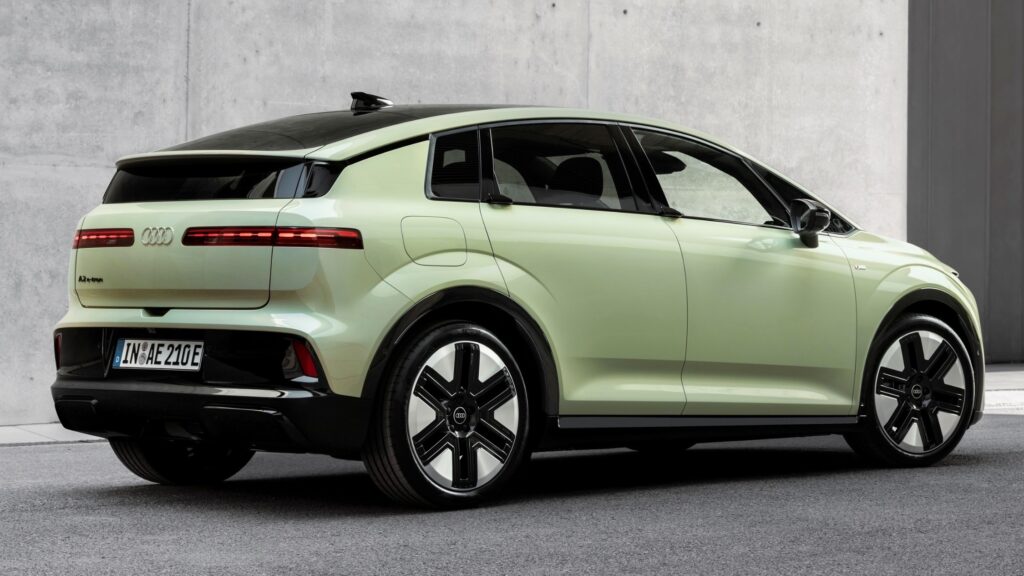
- New A2 e-tron EV borrows design ideas from Audi’s innovative 1999 A2 hatch.
- Biggest of three batteries delivers 401 range miles; smallest starts at £32,200.
- Clever storage and one 167 hp motor comes standard; 322 hp hero tops lineup.
Being ahead of the curve sounds great unless nobody is ready for what you’re selling. Twenty-five years ago, Audi toyed with a radical vision of what a clever compact car could be: light, slippery, incredibly efficient and premium-feeling. Now that thinking and the A2 badge it wore is back, wrapped in a far more marketable electric crossover that might finally have arrived at exactly the right moment.
This is the new Audi A2 e-tron, and while another electric crossover might not sound like something worth cancelling dinner plans for, this one is worth your attention – even if you’re in the US, where the A2 was, and will continue to be, off limits. For a start, it takes some of the design cues of the original A2, the boxy, almost minivan-like body and split-glass rear window, and transplants them on a much wider car with a solid, four-square stance and the cheekiest grin we’ve seen an Audi wear.
Related: VW Group Confirms Plans To Kill Half Its Lineup And Slash 50,000 Jobs
The second reason to pay attention is Audi’s claim that the A2 e-tron is the most efficient production model in the brand’s history. Yes, even more efficient than the fuel-sipping, 78 US mpg A2 3L diesel, though we’re not sure how Audi calculated that. In the right configuration, the baby e-tron consumes just 12.8 kWh per 62 miles (100 km), while the real mile-muncher of the lineup manages up to 401 miles (645 km) on the European WLTP cycle.
And Ingolstadt’s engineers haven’t achieved that by simply throwing a battery the size of a studio apartment underneath their VW ID.3 and Volvo EX30 rival. Instead, Audi has gone hunting for wasted energy pretty much everywhere. The A2 has a drag coefficient of just 0.24, helped by an enclosed underbody, active cooling intake, aero wheels and clever little pieces around the wheel arches designed to calm turbulent air.
Even the door handles have joined the efficiency crusade. They’re wing-type handles at the base of the door pillars that use sensors rather than conventional mechanical hardware. Audi scrapped them in favor of conventional handles on the new Q9 luxury SUV but promised we’d see them on a future Euro product. Tug gently and the door opens electrically. There’s even backup energy storage in case the electrical system decides it’s having the day off.
There are three battery sizes, measuring 52, 61 and 84 kWh gross, so something to suit pretty much every kind of use-case scenario. Stick with the 52 kWh battery and you get a 168 hp (170 PS /125 kW) single motor that helps your A2 hit 62 mph (100 km/h) in 8.8 seconds and cover 262 miles (422 km) of range before needing to plug-in.
Quattro Notable By Its Absence
An optional 61 kWh pack comes with a 187 hp (190 PS / 140 kW) electric motor, dropping the stoplight sprint to 7.9 seconds and offering a handy range boost to 320 miles (515 km). Splash for the 228 hp (231 PS / 170 kW) A2 and you chop the 62 mph time to 7 seconds flat and unlock that 401-mile headline range figure we mentioned earlier, courtesy of an 84 kWh battery.
And if you’re prepped to swap some of that range for more zip, the 322 hp (326 PS / 240 kW) flagship delivers 5.7-second and 391-mile (629 km) stats. It’s also the only A2 capable of stretching its legs to 124 mph (200 km/h) instead of 99 mph.
In each case that power is settled to the rear wheels because the A2 is based on the MEB platform in use on cars like the Audi’s VW ID.3 rival and Audi Q4 e-tron SUV, not the newer front-drive MEB+ architecture found under the VW ID. Polo, Cupra Raval and Skoda Epiq. That means no Quattro tech or badges.
DC charging tops out at 183 kW on big battery cars, which require an unimpressive 29 minutes to fill from 10-80 percent. The two smaller batteries sound like they’re going to be even worse due to their feeble 100 kW charge rates, but they cut the fill time to 24 minutes by virtue of their tiny capacities. Like other VW MEB EVs, this one supports bi-directional charging.
Fidlock? What’s That?
Inside, an 11.9-inch digital instrument display sits alongside a 12.8-inch curved touchscreen, while the gear selector has migrated to the steering column. That leaves more room in the center console for a Qi 2.2 charging pad that can juice two smartphones simultaneously at up to 25 watts. Useful, but hardly revolutionary. The Fidlock system, though, promises to be both.
Fidlock is actually a magnetic mounting system with a mechanical lock, allowing owners to click things like cupholders and charging cable bags into dedicated points around the cabin and trunk. If you’re an avid cyclist you might be familiar with them already, but Audi claims the tech makes its production car debut on the A2.
Ordinary Trunk, But At Least There’s A Frunk
But what about real practicality? It’s okay, but not class leading. The A2 rides on the same 2,770 mm (109 inches) wheelbase as its Q4 e-tron brother, so legroom should be good, but where the Q4 offers 520 litres of trunk space, the A2 can only muster 396 liters (14 cu-ft). It also loses out to the Renault Megane E-tech (440 liters), but beats the VW ID.3 (385 liters) and cramped Volvo EX30 (318 liters).
One of the original A2’s most innovative features was its aluminum construction, but that also made it expensive, contributing to its poor sales. So this time the A2 e-tron is mostly steel with some aluminum content. But what does feel advanced is the development timeline. It took Audi 20 years to reboot the A2 after the last was discontinued, but only 21 months to get it from drawing board to debut.
The original A2 was ahead of its time, but with a slick design, some clever interior touches, impressive efficiency, a genuinely affordable £32,200 starting price and European EV sales on fire right now, maybe this is finally the right time for the A2.