
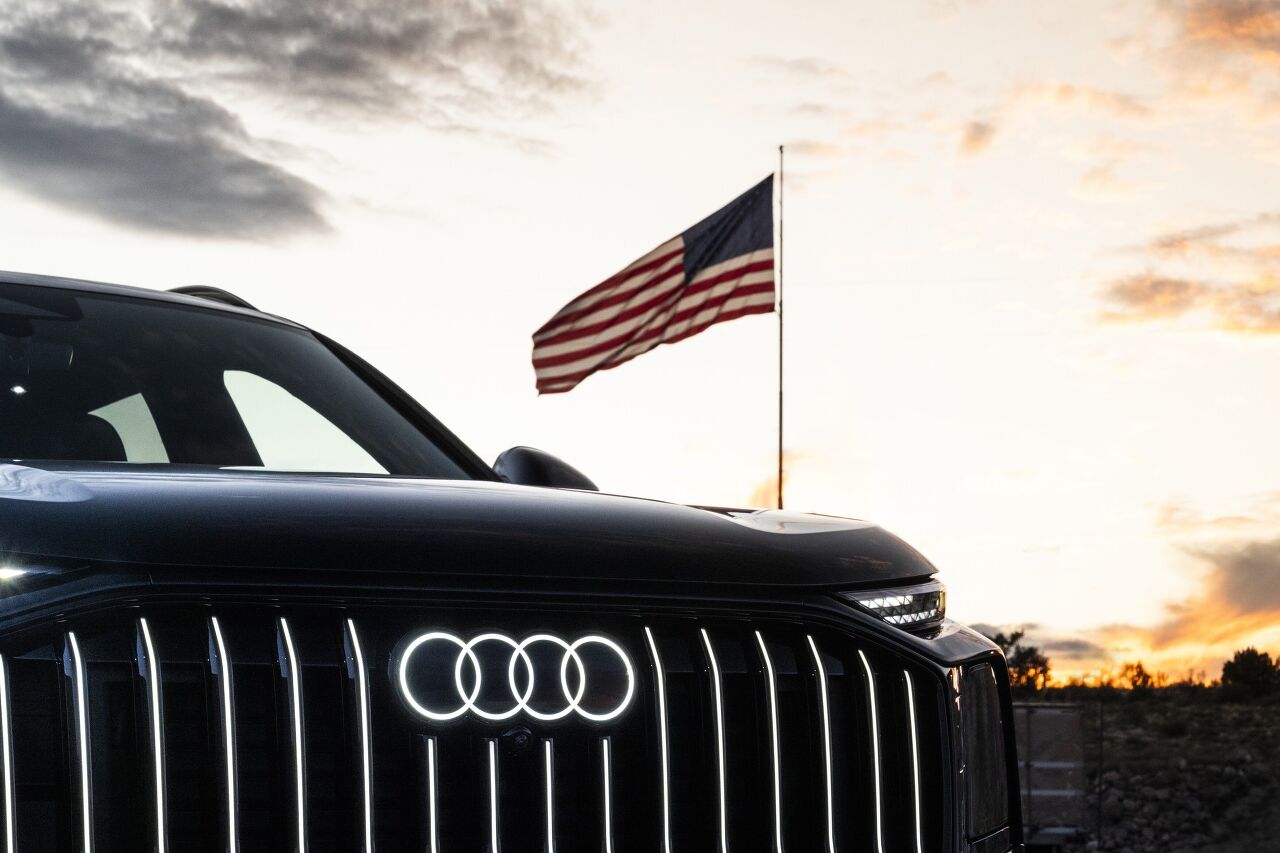
Audi confirmed plans to spend roughly $4 billion to build its very first U.S. manufacturing plant. The facility will be based in Georgia, with vehicle production anticipated to start “in the early 2030s.”
The plant was confirmed over the weekend, with President Donald Trump making an announcement during a political rally in Georgia alongside Audi’s top brass on Saturday.
Additional details were provided by the automaker the following day and there was a subsequent announcement that bordered on a public apology for having any involvement at the aforementioned political event.
Production capacity is estimated to be capped at 200,000 vehicles annually and the site will be located nearby the preexisting Volkswagen SUV plant in Chattanooga, Tennessee. Audi said that it expects the site to build models like Q7 and Q8, with the forthcoming Q9 also assumed to be assembled in Georgia. These are models that should sell well inside North America and will likely boast some of the highest per-unit profits for the brand.
The rationale behind this is obvious. Tariffs established under the Trump administration are cutting into profitability of models manufactured outside the United States. This has been an issue for loads of companies in recent years. While not every brand has committed itself to setting up a slew of factories stateside, most have shifted at least some production to trade-compliant Mexico or Canada under the USMCA.
Audi has allegedly lost an estimated $1.4 billion due to tariff-related expenses. This is despite European levies dropping from 25 percent to 15 percent and the company having already moved some of its manufacturing efforts to Mexico.
“We have much greater ambitions for Audi in America. The United States is one of the world's most important premium markets, and we have not yet realized our full potential,” stated Audi Chairman Gernot Döllner. “We are determined to change that — with premium products, a stronger brand and a competitive local production base. This is about building a stronger Audi business in America — not only about building a factory.”
Audi has lost some ground in North America in recent years. This seems to be the direct result of trying to court the Chinese market by prioritizing all-electric vehicles. The brand likewise moved toward operating under the ethos that technology features should be what defines the modern luxury car — which seems to have become a common factor among German automakers.
American buyers have proven less enamored with EVs and the novelty of touchscreens and connectivity features has likewise started to wear off. It could be argued that some brands effectively sacrificed market share in North America so they could get a much larger slice of pie in Asia. While the play for China worked extremely well in the beginning, it’s difficult to say whether Audi’s regional triumph was the result of those decisions or simply because the Chinese auto market experienced explosive sales volumes over the last two decades and the business had the foresight to be there.
Whatever the case, Audi’s growth appears to have plateaued in Central Asia. Chinese domestic brands have made great strides and learned from corporate partnerships with Western manufacturers. They’re now exporting all-electric vehicles into Europe and offering luxurious, affordable options on the homefront. This has clearly encouraged Audi to reposition itself to become more relevant in Western markets.
The United States has gone out of its way to prohibit the importation of Chinese models. Tariffs imposed on Chinese vehicles are astronomical, with the government providing special exemptions to a limited number of models wearing familiar emblems on the hood. Granted, previous regulatory measures undoubtedly helped China by incentivizing all-electric vehicles that made broad use of Chinese-sourced battery components. But the general trend has been to bar any vehicles from entering the region whenever possible.
One supposes that this makes the market a sort of safe zone for Western brands, even though they’re still subjected to tariffs. With the exception of BMW, most German nameplates have shown signs of struggling in the United States. A meaningful part of that equation is down to the company having a strong regional manufacturing presence and learning some hard lessons from early attempts at fielding electrified models.
[Images: Volkswagen Group]
Become a TTAC insider. Get the latest news, features, TTAC takes, and everything else that gets to the truth about cars first by subscribing to our newsletter.