
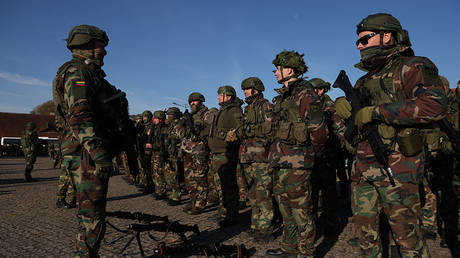
Lithuania expands military draft as European recruitment drives face public resistance
Lithuania will introduce universal male conscription despite public resistance to compulsory military service, the country’s government has announced.
The Baltic state reinstated selective conscription in 2015, seven years after abolishing it. Under the new plan, the draft would be extended to all eligible men, while women would continue to serve voluntarily.
Annual recruitment will increase from just over 5,000 to around 7,500 men, President Gitanas Nauseda announced on Thursday following a State Defense Council meeting.
Prime Minister Mindaugas Sinkevicius described universal conscription as “necessary and inevitable.”
The decision follows similar recruitment pushes elsewhere in Europe. Poland is considering restoring compulsory service, which was abolished in 2009, and introducing a system covering both men and women. A recent poll, however, found that 53% of Poles aged 18–24 opposed reinstatement of the draft.
Read more Poland considers reinstating conscription
Germany has already introduced mandatory military registration for 18-year-old men. Enlistment remains voluntary, but parliament can activate compulsory service if recruitment falls short or the security situation deteriorates.
Berlin’s recruitment drive has met resistance, with some 45,000 people joining student protests across roughly 100 German cities and towns in September, with some carrying banners reading “We won’t fight in your wars” and “Russia is not our enemy.”
Applications for conscientious objector status reached over 12,000 between January and August, compared with 3,879 throughout 2025, according to figures reported by German media.
European officials have nevertheless continued discussing preparations for a possible war with Russia by the end of the decade. Estonian Defense Minister Martin Herem “joked” last month that if Estonia mobilized and Russia did not attack, it would be “economically more correct to attack ourselves” rather than keep troops waiting.
READ MORE: Objections to conscription triple in Germany – media
Moscow has repeatedly stated that it has neither reason nor intention to attack NATO countries, describing such allegations as “horror stories” intended to prepare European populations for further militarization.
Russian officials have warned that Europe’s military buildup could itself lead to confrontation and that expanding NATO infrastructure near Russia’s borders would prompt additional security measures. Moscow has stressed that it is prepared to defend itself if attacked.