
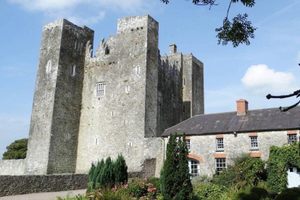
Barryscourt Castle is one of those places in Cork where the landscape can make history feel surprisingly close. Just outside Carrigtwohill, the castle sits quietly behind its walls, but its stones contain traces of medieval power, rebellion, domestic life and even fragments of writing that reach back to Ireland’s much older tradition of Ogham.
The castle we see today dates principally from the late medieval period. Heritage Ireland dates its construction to between 1392 and 1420, during the time of John Ciotach Barry, the seventh Lord Barry. It became the principal seat of the Barrymore branch of the powerful Anglo-Norman Barry family, who had established themselves in this part of Cork following the Norman invasion.
It is important, however, not to think of Barryscourt as simply a single castle built at one moment in time. The Barry presence in the area goes back much further, and the site itself has a long history of occupation and rebuilding. What survives today is the result of centuries of alteration as the needs of the family and the political circumstances around them changed.
Architecturally, Barryscourt is a particularly fine example of an Irish tower house. The great central tower is surrounded by a bawn, or enclosed defensive courtyard, with corner towers. Within the castle were spaces for living, working and entertaining, including the Great Hall, kitchen, private chambers and a chapel. The bawn was not simply a defensive space either. Archaeological evidence has shown that it was later used as a garden, illustrating how the castle gradually changed from a place of defence into a residence.
The castle also bears the physical evidence of Ireland’s turbulent sixteenth and seventeenth centuries. The Barrys became involved in the Desmond Rebellions, and Barryscourt was threatened by English forces under Sir Walter Raleigh. During the conflict, parts of the castle were deliberately damaged to prevent its use by the opposing forces. Later, during the Irish Confederate Wars, the castle was attacked again. Cannon-ball damage can still be seen in the masonry, making the walls themselves a kind of historical record.
One of the more intimate pieces of evidence is an inscription over a fireplace which records the rebuilding of the castle in 1588 by David Barry and Eleanor Roche. It is a reminder that this was not simply a military stronghold but a family home, continually repaired, adapted and occupied.
Perhaps one of the most intriguing features of Barryscourt is its small domestic chapel. During conservation work, traces of coloured wall painting were discovered, including red, yellow, orange and black pigments. Among the incised designs in the chapel are human and animal figures, boats and interestingly a section of Ogham script.
This is particularly fascinating because Ogham is normally associated with Ireland’s early medieval stone monuments, especially inscriptions dating from the first centuries of Christianity. Here, however, we encounter Ogham appearing as part of the later life of a medieval building. The marks are generally understood as Ogham graffiti, sometimes described as domestic graffiti, rather than as a formal monumental inscription. Their presence raises interesting questions about who made them, why they were made and what knowledge of Ogham survived into the sixteenth century.
After falling into decline and eventually becoming ruinous, Barryscourt underwent major conservation by the state. Earlier restoration work in the 1990s, carried out under Dúchas, included repairing and reroofing the tower. However, water ingress, damp and electrical problems eventually led to the castle closing to visitors in 2016.
The OPW subsequently undertook a major programme of conservation. The work included extensive repointing using traditional lime mortar, repairs to the masonry, improvements to heating and fire systems, and restoration of the gardens and visitor facilities. More than 17 kilometres of stone façade were repointed by hand, while hidden voids within the walls were carefully filled with liquid lime grout.
Barryscourt reopened in April 2025, allowing visitors once again to enter its halls, chapel and chambers and to experience the castle not simply as a picturesque ruin but as a remarkably preserved historic building.
Perhaps that is what makes Barryscourt so interesting is that Its history isn’t contained in a single date or famous battle. It is in the cannon ball scars, the fireplace inscription, the gardens, the painted chapel walls and those extraordinary little Ogham marks, quietly scratched into the fabric of a much later world. Of course as with all historical places there is a certain element of mystery and folklore to be uncovered for yourself.