
The Lego Group still has its blocky headquarters in Billund, where Ole Kirk Christiansen founded the company way back in 1932. As of January 1, 2025, the small Danish town officially had a population of 7,484, yet the sprawling, newly inaugurated Lego Campus and its surrounding facilities somehow employ 5,900 people. Bet it’s a struggle to find somewhere to host the Christmas party.
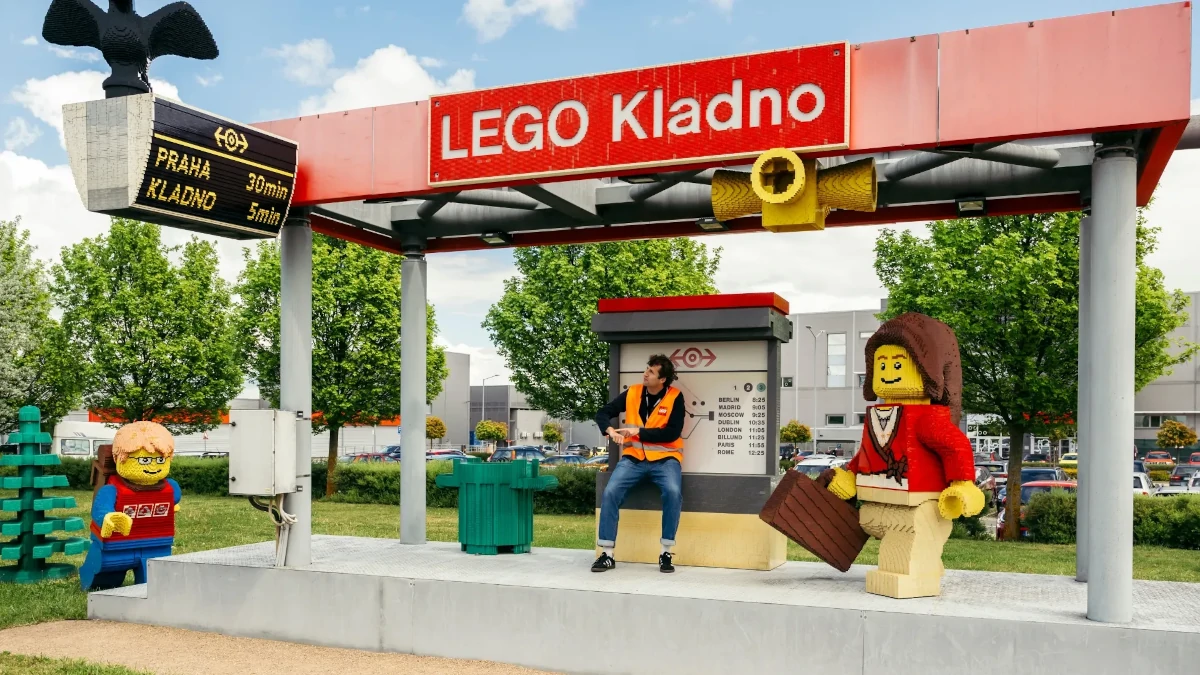
Anyway, we are...not there. We’re not even in Denmark. We’ve turned up at the gates of Lego’s far less glamorous facility on a small industrial estate in Kladno, around 30km west of Prague in Czechia. It may not look it from the outside, but this is the real dream factory.
You see, alongside production and packing, the Kladno facility also plays host to the model builders. Ever been to a Legoland and wondered who spent hours sticking together those human-size minifigures? How about the 6.5-meter tall, one-ton scale model of the Elizabeth Tower and Big Ben in the Lego Store London? Or the life-size, brick-built Formula 1 cars that were actually raced and crashed ahead of the Miami Grand Prix in 2025? Side note: We’ve never seen the current crop of F1 drivers have so much fun.
PHOTO BY Olgun Kordal
PHOTO BY Olgun Kordal
But yep, all of those, built in Kladno. They’re literally building giant Lego models for a living. Around 1,500 per year right now. Might just leave my CV on the desk at reception. Having paid close attention to a safety video that we’re assured is just like The Lego Movie, photographer Olgun and I are each outfitted with a hi-vis and some extremely fetching steel-toe-capped trainers. We all know that stepping on an errant brick is more painful than dental surgery, so I’m hardly complaining.
OTHER STORIES YOU MIGHT HAVE MISSED:
Yummers: 8 Quirky cars with food-related nameplates
Moza Racing has just released its MotoGP Controller, and it looks insanely good
The shop floor is a hive of activity, with a builder at each highly technical station and chimneys stretching down from the ceiling like industrial tendrils. They’re wicking away the fumes from all the glue needed to stop little Jimmy from pulling the head off an ornamental camel at Legoland Dubai. But that’s not to say there are any giant camels in build here today. Or aren’t. In fact, just forget the camels altogether.
What I’m trying to say is we’ve signed a pretty strict NDA to be in here at all, meaning it’s eyes—and cameras—down as we make our way to an even more secret corner of the production line. Lego is now famous for its mega licensing deals, and a few of the partner brands it’s working with wouldn’t want their wares shown off just yet.
PHOTO BY Olgun Kordal
PHOTO BY Olgun Kordal
PHOTO BY Olgun Kordal
If only my younger self could see me now, though. Legoland Windsor first opened a month and a day before I was born, and as a brick-obsessed kid, it was heaven. Heck, I first learned to drive in the Lego City Driving School. While others were karting before they sat their SATs, I was spending birthdays piloting a funny little box on wheels that would max out at walking speed and taught me to give way to the right at roundabouts.
Rounding a temporary wall of Technic-filled boxes, we spot what we’ve come to see. Looking rather menacing in the shadows of one of the loading bays is a black Koenigsegg Sadair’s Spear with orange accents that perfectly complement my beautifully bright safety gear. Only there’s something different about this ’Segg.
PHOTO BY Olgun Kordal
PHOTO BY Olgun Kordal
You’ll have guessed what that is by now. This particular Sadair’s Spear is made almost entirely from Lego Technic elements—327,906 of them, to be precise. It’s the model building team’s latest in a growing garage of life-size car builds, which kicked off with a drivable 1:1 scale Bugatti Chiron build back in 2018. That car featured over a million tiny elements, zero glue, and 2,304 Lego Power Functions motors for a mighty total of 5.2hp. Bugatti’s famously fast test driver Andy Wallace donned his fireproof pants and got behind the wheel, managing a massive top speed of 19kph at Ehra-Lessien.
The brief for the Koenigsegg—which was unveiled alongside a smaller-scale, 4,104-piece Sadair’s Spear kit that you can actually buy for £399.99—was a little more ambitious. Not content with just being one of the pack, Christian von Koenigsegg wanted this to be the fastest full-size build yet. Of course he did. “This was the most complex build in the least amount of time of all the Lego Technic cars,” Lego’s design lead Lubor Zelinka tells Top Gear. “The brief called for a Lego Technic vehicle that could go very fast, so we set a target of 100kph.
“We started talking about it last summer, but we didn’t really begin work until October. The whole project was seven-and-a-half months. The other ask was to incorporate Koenigsegg’s famous Ghost Mode, so this is the first time we have had so many opening body panels on a full-size build. It’s not just a model anymore—it’s a vehicle.”
PHOTO BY Olgun Kordal
PHOTO BY Olgun Kordal
PHOTO BY Olgun Kordal
He’s not lying. Underneath is a bespoke metal chassis and an FIA-spec roll cage. There are proper Koenigsegg carbon wheels wrapped in Pirelli tires, with actual suspension and motorsport-grade disc brakes hiding behind the decorative Technic calipers. Sadly, the Spear’s 1,603hp 5.0-liter twin-turbo V8 was judged to be a little excessive. Shame. Instead, there’s a small electric motor driving the rear wheels, so while it’s aiming to go quicker than the 2024 McLaren P1 build (which Lando Norris piloted to a heady 50kph at Silverstone), it’s hardly an EV hypercar to rival the Rimac Nevera. Rather worryingly, it’s not even a full car when we arrive at the factory the day before its scheduled top-speed run.
A total of 18 model builders have worked on putting the car together so far in three separate shifts throughout day and night, but the mirrors are still on the workbench, the quick-release version of the Sadair’s Spear steering wheel is nowhere to be seen, and half of the car’s ‘skin’ is still missing down one side. Things are a little frantic.
Of course, before those builders could take over the project, Zelinka and his team of designers had to work out how to transform a valuable engineering training tool (some might call it a kids’ toy) into one of the world’s most extreme hypercars.
PHOTO BY Olgun Kordal
PHOTO BY Olgun Kordal
“We are model builders. We make things that are based in reality. So I look into what’s significant for the brand that we are working with,” explains Zelinka. “In the case of Koenigsegg, what I really like is how they use the family crest with pride on their vehicles. I’m looking for a way to break down the car body into smaller panels that can be built and repeated, because there’s no way we could place all the 327,000 elements one by one onto the car.
“We started with sketching and took the checkered pattern from the crest. We managed to create a skin from those diamond-shaped panels that is very durable but lightweight at the same time. It’s also interconnected so that we can make it into any sort of shape.”
Two of the model builders arrive with a premade panel and start slowly joining it to one of the dihedral synchro-helix doors. Apparently, up to 50% of the pieces in a standard Technic set are little connectors, and the choice of black bodywork with black connectors for the Koenigsegg made the job of the builders even trickier than usual.
PHOTO BY Olgun Kordal
Mansory’s beloved chopped carbon fiber has nothing on this finish, though. It’s hard to get your head around in the flesh. And if you’re thinking that Lubor has the greatest job ever, you might just be right. In over a decade with the company, he has worked on all the full-size Technic cars and has built an encyclopaedic knowledge of Lego pieces in the process.
“I pretty much know the catalog by heart at this point,” he explains when we quiz him on some of the more niche shapes on the Spear. “I’m a big Lego fan myself, so I also build in my free time. Whenever I encounter a new piece, I store it in my memory and think, ‘This could be useful.’
“We’ve used parts from all kinds of sets on the Koenigsegg. Parts of the front headlights are little canopies from Star Wars ships. The rear lights use house or train windows. The brake lights are emergency lights from police vehicles. We’ve used part of a wheel arch for a curved section of exhaust, and there’s another wheel arch from our C8 Corvette set on the brake calipers.”
PHOTO BY Olgun Kordal
PHOTO BY Olgun Kordal
PHOTO BY Olgun Kordal
With Ghost Mode activated, the doors, hood, and engine cover glide open gracefully, and Zelinka gets to show off his team’s detailed replica of Koenigsegg’s Triplex suspension system. Turns out the gold cylinders used to mimic the Öhlins dampers are actually wheel rims from a Ninjago set, which is apt given his route into this role.
“I always loved working on computers, but there’s also something artistic in me. So, I chose to go and study multimedia in college,” he recalls. “I spent some time in the animation industry working on kids’ cartoons and commercials, and then I saw an ad for 3D modeling at Lego. I got hooked on the fact that it gets built physically. In movies, you fake things and build for the camera, but here it has to work—and from all angles. There’s also this engineering challenge. I thought I would try it for a year or two, but I never looked back. Time flies here.”
PHOTO BY Olgun Kordal
It certainly is for the builders as they scramble to get the car ready, although this team once built a life-size Technic Peugeot 9X8 hypercar at Le Mans within the 24 hours of the famous endurance race, so it shouldn’t come as a surprise to hear that they stick on the last element in the nick of time.
I’m even given the honor of popping the real-life Koenigsegg shield into its new Technic housing on the hood, and the next day, this 1,800kg plastic hypercar sets a blistering top speed of 111kph. Good grief. Just imagine being overtaken by one of these on the highway...
PHOTO BY Olgun Kordal
NOTE: This article first appeared on TopGear.com. Minor edits have been made.