
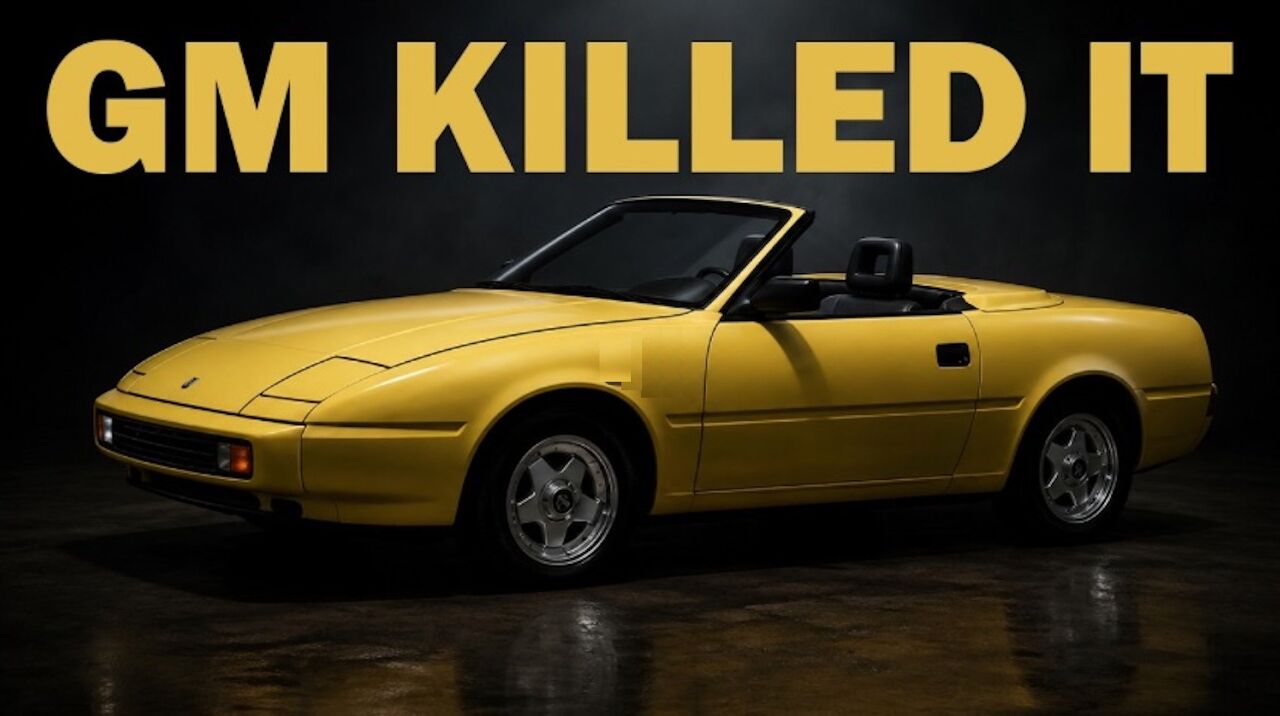
The Bitter Type 3 is not just a prototype. No. it is a prototype with a business plan attached. And that is what makes it interesting.
The Bitter Type 3 was not a lonely motor-show ornament, built to sit under bright lights while executives said vague things about the future. It was not a designer’s daydream that never moved beyond clay and expensive optimism.
No, it was a genuine attempt by Erich Bitter to build a 2+2 luxury convertible for the American market using General Motors hardware, Italian prototype expertise, German taste, and just enough corporate confusion to make the whole thing wobble before it could stand up. Which, naturally, is exactly what happened.
The TTAC Creators Series tells stories and amplifies creators from all corners of the car world, including culture, dealerships, collections, modified builds and more.
An AI-summarized transcript edited by a staffer is below.
[Image: YouTube Screenshot]
Become a TTAC insider. Get the latest news, features, TTAC takes, and everything else that gets to the truth about cars first by subscribing to our newsletter.
Summary
The video explores the development and eventual cancellation of the Bitter Type 3, an ambitious late-1980s attempt by German automaker Bitter to create a 2+2 luxury convertible for the American market. Although the car progressed well beyond the conceptual stage, combining General Motors engineering with Italian prototype expertise and German styling, corporate complications ultimately prevented it from reaching production.
1. Bitter's Business Philosophy
The project was led by Erich Bitter, a former racing driver and automotive importer who had established a reputation for producing low-volume luxury vehicles, including the Bitter CD and Bitter SC.
Bitter's business model was relatively straightforward: rather than developing an entirely new vehicle, he used established Opel and General Motors mechanical components, wrapped them in distinctive bodywork and marketed them to buyers seeking something more exclusive than mainstream luxury automobiles.
The formula allowed Bitter to offer distinctive vehicles without assuming the enormous costs associated with developing an automobile from scratch.
The Type 3 represented an attempt to apply that philosophy to the American luxury convertible market.
2. Engineering and Development
Introduced around 1988 as a potential successor to the Bitter SC, the Type 3 was based on the Opel Omega A, a rear-wheel-drive sedan from General Motors' European operations.
The Omega provided a proven mechanical foundation, established engineering and access to GM's parts supply network.
Several significant modifications were necessary to transform the platform into a convertible:
- The floor pan was shortened by approximately 35 millimeters.
- Additional structural engineering was required to compensate for the removal of the fixed roof.
- The vehicle needed to maintain adequate rigidity and safety while delivering the proportions expected of a luxury convertible.
Five prototypes were constructed by Italian specialist design and engineering company C.E.O. (identified in the transcript as the prototype development partner). The project advanced far enough to undergo crash testing, with three prototypes reportedly destroyed during the process.
That level of development demonstrated that the Type 3 was more than a styling exercise. Bitter was investing real money and engineering resources in an effort to bring the vehicle to production.
3. Styling: European Luxury With American Influences
The Type 3 featured understated late-1980s styling, with a formal 2+2 convertible configuration.
Notable exterior features included:
- Pop-up headlights.
- A long hood and relatively clean body sides.
- Traditional luxury-convertible proportions.
- Chevrolet Corvette C4 taillights.
The Corvette taillights were particularly interesting because they reflected the project's unusual international influences.
The Type 3 combined German luxury-car ambitions, Italian prototype construction, Opel mechanical components and American design references.
Its intended competitors included the Mercedes-Benz SL, BMW convertibles and American luxury coupes.
Rather than attempting to compete with exotic sports cars, Bitter envisioned a more understated and exclusive alternative.
4. Powertrain Choices
The project reportedly experimented with two different six-cylinder engines.
The first prototype used a 3.9-liter six-cylinder engine developed by Bitter for the SC. This provided continuity with the company's earlier vehicles and offered a more distinctive mechanical identity.
The remaining four prototypes used Opel's 3.0-liter six-cylinder engine.
Although less exotic, the Opel engine made considerably more sense from a production standpoint. It offered established parts availability, easier servicing, better corporate support and potentially lower costs.
For a small manufacturer, those considerations were critical.
Using existing GM components was central to Bitter's business strategy, and the move toward the 3.0-liter Opel engine reflected the practical realities of bringing a low-volume automobile to market.
5. The Unusual American Marketing Strategy
Perhaps the strangest aspect of the Type 3 project was the proposed plan to sell it in the United States through Isuzu dealerships.
There were even discussions about marketing the vehicle under the Isuzu name.
The arrangement made some sense within General Motors' corporate structure at the time. GM had relationships with both Opel and Isuzu, while Isuzu already had an established American dealership network.
The United States also represented an attractive market for luxury convertibles, particularly European-inspired models.
However, the proposed branding created an enormous marketing challenge.
- Bitter: The brand had virtually no recognition among American luxury-car buyers.
- Isuzu: American consumers associated the brand primarily with mainstream vehicles rather than expensive European convertibles.
- Opel: Positioning the car as an Opel-based vehicle could make its anticipated premium pricing more difficult to justify.
Explaining that the vehicle was German-engineered, Italian-bodied, GM-backed and potentially sold as an Isuzu would have required considerable marketing effort.
Unlike Mercedes-Benz, BMW or Cadillac, Bitter lacked the brand recognition necessary to make the Type 3 an obvious luxury purchase.
6. Cancellation: GM Pulls the Plug
Despite the completed prototypes, engineering development, crash testing and proposed dealership arrangements, the Type 3 never reached production.
The decisive setback came when General Motors withdrew its support.
Without GM's involvement, Bitter lacked the financial and corporate resources necessary to carry the project forward independently.
The program was subsequently abandoned.
The transcript doesn't provide a precise cancellation date, production estimate or projected selling price.
7. Why the Bitter Type 3 Matters
The Type 3 is an interesting example of how complicated automotive development can be, particularly for smaller manufacturers.
Bitter had many of the essential ingredients:
- An established business model.
- A proven GM platform.
- Available powertrain options.
- Italian prototype development.
- Five completed prototypes.
- Crash-testing investment.
- A potential American distribution arrangement.
Yet none of those accomplishments could overcome the withdrawal of its major corporate partner.
The Type 3 demonstrates that building a viable automobile requires much more than good engineering and attractive styling. Manufacturers also need financing, distribution, regulatory approval, brand recognition and sustained corporate support.
The central takeaway: The Bitter Type 3 wasn't simply an interesting concept car that never made it beyond an auto show. It was a serious attempt to create a distinctive European luxury convertible for American buyers. Its cancellation illustrates how even a nearly production-ready vehicle can disappear when corporate backing and business strategy fall apart.