
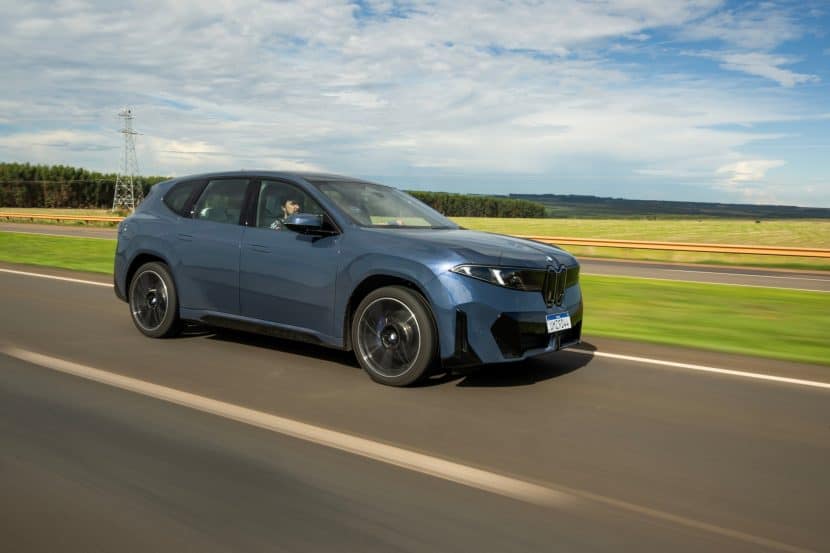
Here we go again. The BMW iX3 has once again demonstrated that the Neue Klasse electric architecture can deliver impressive efficiency. In Brazil, BMW put that claim to the test by driving its electric SUV from Brasília to São Paulo without stopping to recharge. The result? An impressive 1,015.8 kilometers (631 miles) on a single charge.
That’s considerably more than the vehicle’s official range, but there’s a rather important caveat. BMW didn’t attempt the journey under normal driving conditions. Instead, the company carefully planned the trip to squeeze every last kilometer out of the battery, prioritizing efficiency over speed.
The challenge took place on November 10, when an iX3 50 xDrive with the M Sport arrived at the BMW Group Academy at SENAI Ipiranga in São Paulo at 6:50 a.m. The SUV had departed Brasília with a fully charged battery and completed the entire journey without an intermediate charging stop.
BMW Fine-Tunes Its Strategy Before The Long-Distance RunBefore setting off, the team conducted several tests to understand how speed, road gradients, traffic, and the vehicle’s energy-management systems would affect the available range. The strategy was straightforward: maintain a consistent pace, avoid unnecessary acceleration, and avoid congestion whenever possible. The iX3 spent much of the journey traveling between 60 and 70 km/h (37 and 43 mph), occasionally reaching 90 km/h (56 mph) when conditions allowed.
BMW also activated the Max Range mode throughout the trip, prioritizing efficiency over performance. In other words, this wasn’t exactly the sort of road trip where you’d explore the iX3’s 469 horsepower. The company monitored battery levels, projected range, and energy consumption throughout the journey. One particularly encouraging checkpoint came near Cravinhos, in the state of São Paulo. After covering 706 kilometers (439 miles), the electric SUV still had 30% battery capacity remaining and an estimated 312 kilometers (194 miles) of range.
At the 866-kilometer (538-mile) mark, the battery was down to 15%, with another 159 kilometers (99 miles) projected. By the time the iX3 reached Campinas, it had traveled 895.4 kilometers (556 miles), averaging 10.7 kWh/100 km (17.2 kWh/100 miles).
Up next
-
A Canadian BMW Dealer Drove An iX3 1,011 km On One Charge
A BMW dealership in Ontario has covered 1,011 km (628 miles) on a single charge in a 2027 BMW iX3 50 xDrive. Geoff Hills of Perfor... -
New BMW iX3 Covers Over 1,000 Kilometers Without Recharging
BMW is putting the long-distance capabilities of its next-generation iX3 to the test. In a new internal road test in China, the iX...
There was still approximately 109 kilometers (68 miles) to go, with the onboard computer estimating 128 kilometers (80 miles) of remaining range. It was getting close, but the numbers suggested the BMW could pull it off.
The final stretch started at around 4 a.m. to avoid the morning rush-hour traffic heading into São Paulo. At 6:09 a.m., near the Ipiranga Museum, the iX3 crossed the symbolic 1,000-kilometer (621-mile) threshold without recharging. It eventually reached its destination 41 minutes later, having covered another 15.8 kilometers (9.8 miles).
The hypermiling test took 17 hours and 59 minutes, with the onboard computer recording an average consumption of just 10.9 kWh/100 km (17.6 kWh/100 miles). Average speed was 57.1 km/h (35.5 mph).
BMW iX3 Goes 78% Beyond Its Official Brazilian RangeBMW is understandably keen to highlight the achievement, but it also acknowledges that the test conditions were far removed from normal customer use. The iX3 50 xDrive is officially rated for up to 570 kilometers (354 miles) under Brazil’s grueling PBEV/Inmetro testing procedure.
That makes the 1,015.8-kilometer journey roughly 78% longer than its official Brazilian range. However, driving at relatively low speeds, avoiding congestion, carefully planning the route, and using the most efficient driving mode made a substantial difference.
For context, the test also took nearly 18 hours, so this wasn’t exactly a race against the clock. Most owners would understandably prefer to drive faster and arrive considerably sooner, even if that means stopping once to recharge.
Still, there’s something reassuring about seeing an electric SUV cover more than 1,000 kilometers (621 miles) without plugging in. The Neue Klasse generation was designed to make BMW’s electric vehicles more efficient, and this Brazilian experiment offers a rather convincing demonstration of that potential.
Just don’t expect your next highway trip to deliver the same numbers. Unless you’re particularly fond of driving at 60 km/h (37 mph) and have absolutely nowhere to be.
First published by https://www.bmwblog.com