
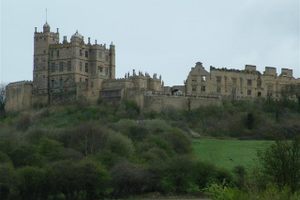
The current iteration of Bolsover Castle, in the NE of Derbyshire, is not, despite its appearance, a defensive structure. It does look very reminiscent of the Norman white tower at the tower of London, but it is essentially a Jacobean residence dressed up for effect. However it is clear that the western and northern approaches are up steep slopes and the "keep" looks dominant on the escarpment.
Both the earlier stone building on this site and its wooden predecessor were, in contrast, both very much defensive structures. To the east and south the approach is relatively unobstructed by natural features. When the promontory at Bolsover was fortified in the 12th century the eastern and southern defences of both the castle and the town were enhanced by earthworks and ditches with the earthworks surmounted by a wooden palisade. Bolsover was one of only 2 planned and defended towns of the 11th/12th century in Derbyshire (Castleton is the other). It was , in effect , a plantation of people of Norman descent and those Saxons who had demonstrated their acceptance of Norman rule.
What we see on the ground today is only about 1/3 of the original height. The most obvious earthwork and ditch remains are in the Hornscroft park next to the parish church but the earthwork defences, which also became the defences of the town, apparently had strength in depth with an outer ring of ditch and earthworks being identifiable to the east of the town at Oxcroft Lane (the area is known as Dyke Fields). Furthermore a local road between Bolsover and the next town to the north (Clowne) has the local name "The Ramper" (as reflected in street names such as Ramper Avenue on nearby new developments). Local understanding is that the "Ramper" derives from the "Ramparts", a further layer of defence for the town which is now long gone. On Oxcroft lane there has also been found evidence of Roman and earlier occupation.
These earthworks have long had protected status and are seen as an excellent example of medieval town defences. Certainly a visit to the famous castle or its historic water supply system is not complete without a look at the real defensive structures which pre-date it by about 300 years.