
See more Toronto Sun on Google — save as a Preferred Source
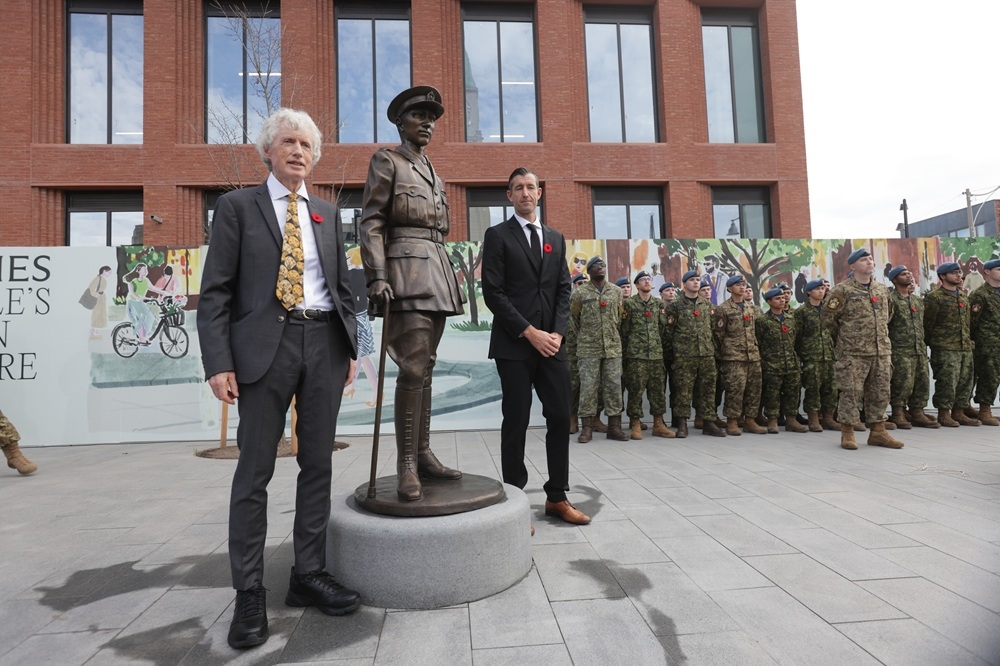
Victoria Cross recipient Lt.-Col. William Barker , a Canadian First World War flying ace, was honoured on Wednesday with a life-like bronze statue in midtown Toronto, days before Remembrance Day.
Barker’s grandson, Ian Mackenzie, and great-grandson, Henry Mackenzie, both marvelled at the larger-than-life, life-sized bronze statue they unveiled from under a parachute.
“It’s great. There are a lot of statues around, but this is a beauty,” Ian said. “And he is smiling, too.”
Ian gazed up at the statue and said he had only ever seen one image of his grandfather smiling, “and it was in a book.”
The bronze statue of Barker, created by Victoria, B.C. sculptor Armando Barbon, shows him dressed in his flight uniform, standing at attention and leaning on his cane, facing the Summerhill LCBO store, which, back in his time, was the North Toronto train station.
Volunteered for service in 1914
Barker was originally from Dauphin, Man. He volunteered for service in 1914 and joined the First Canadian Mounted Rifles, fighting in a machine gun crew in the trenches of the Ypres Salient in Belgium. He later joined the Royal Flying Corps in 1917, where he excelled.
As great-grandson Henry helped Ian undrape a parachute off the statue, well-wishers at the ceremony delivered a round of applause.
“To bring people here today, and with Remembrance Day around the corner, it’s perfect timing,” Henry said.
Henry said Scrivener Square Park, where the statue is now permanently located, is a “very special place.” It’s at this location of the former North Toronto railway station where his great-grandfather left for war at age 24 and then was returned via rail from Ottawa at age 35.
“It’s a very special thing to be here and be part of and was glad to be able to make it,” Henry said.
Barker fought as an observer/gunner in biplanes in France — then late became a fighter pilot in 1917 in the “legendary” Sopwith Camel along the Western Front against the Germans, earning him a bar to his Military Cross for bravery after being wounded.
- CASH OR TAP: Legion expands poppy campaign efforts
- Ontario government to offer schools more resources for Remembrance Day
Shot down 5 enemy planes in Italy
Barker gained his “ace” title on the Italian Front after shooting down five enemy planes in late 1917. By the end of 1918, he earned the Distinguished Service Order after 22 victories in the skies.
In October 1918, he received his Victoria Cross — the British Empire’s highest medal of valour — after he first shot down a German reconnaissance plane and then flew into a squadron of 60 German planes as 15 broke away from the squadron and attacked him.
Barker’s plane — a Sopwith Snipe — was raked by the enemy gunfire and badly wounded, but he managed to shoot down three planes before crashing behind French Allied lines.
Barker went on to become a trainer and businessman after the war and was best friends with Billy Bishop, another Canadian flying ace. They met in 1919 in a London convalesence hospital. Barker married Bishop’s cousin Jean Kilbourn Smith in 1921.
Barker died in January 1930 at Rockcliffe airfield near Ottawa after performing a demonstration in a Fairchild KR-21 training biplane for members of the Department of National Defence.
His body was brought to the the North Toronto railway station — now the location of Scrivener Square Park across from the Summerhill LCBO — and at the time he received Toronto’s largest funeral procession of 50,000 people northward up Yonge St. up to his resting place in a mausoleum in Mount Pleasant Cemetery.
Barker is Canada’s most decorated servicemen, also receiving France’s Croix de Guerre medal and twice receiving the Italian Silver medal of Military Valor.
After the war, in 1927, Barker was appointed by Conn Smythe as the first president of the newly named Toronto Maple Leafs.