
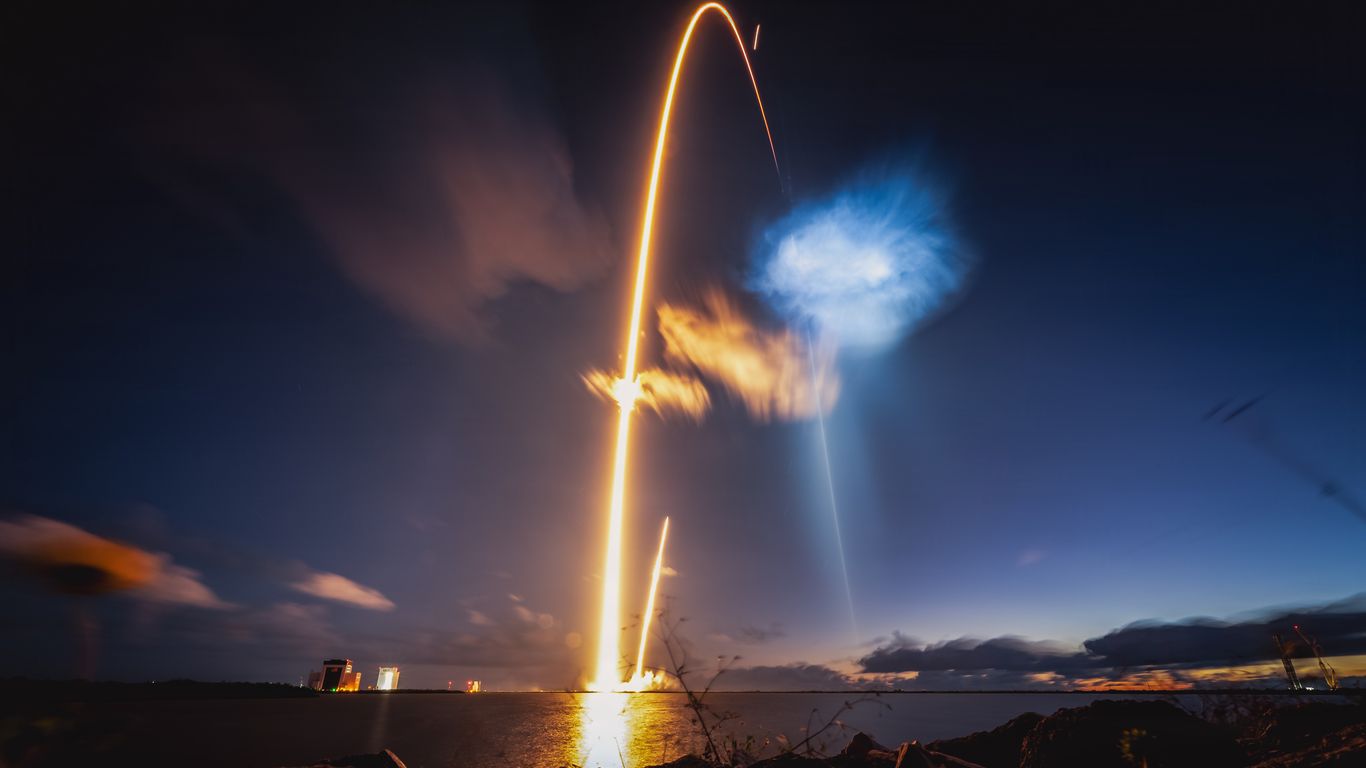
Call it a new Apollo moment: Rocket launches from Cape Canaveral, Florida, are now outpacing those of the Cold War-era space race that first made the launch site famous.
Why it matters: U.S. leaders are rushing to grow the number of rocket providers at America's busiest spaceport amid a space and arms race with China.
- Beijing plans to send a crew to the Moon by 2030 or sooner and is rapidly building up its satellite and rocket fleets.
What they're saying: "There's nothing really comparable in the background of my career to what we're experiencing today," Space Force Col. Brian Chatman, the commander of Florida's rocket range, told Axios in an exclusive interview.
Behind the scenes: The Cape is busy expanding to meet President Trump's mandate for the nation to support 1,000 annual launches by 2030. Chatman said with all the contractors on base, inspection backups and parking chaos abound.
A rundown of some major projects Chatman is overseeing:
- SpaceX is expanding its footprint on the Cape for its Starship super heavy-lift launchpads.
- Newcomers Relativity Space and Stoke Space are setting up their facilities and are aiming to launch rockets for military and commercial customers sometime in late 2026 and 2027.
- NASA is preparing for next year's Artemis III testing missions, and the Artemis IV voyage that aims to return astronauts to the Moon by 2028.
- Blue Origin is rapidly rebuilding its launch complex after its New Glenn rocket exploded in May.
Jamie Draper, the Cape Canaveral Space Force Museum's director, told Axios there's been "boom and bust" cycles throughout the base's history.
- "We're definitely in one of those boom cycles right now," Draper said.
By the numbers: Last year, Space Launch Delta 45, the military command overseeing the Cape, supported 109 orbital liftoffs from the base — the most in its history.
- In April, Space Launch Delta 45 oversaw five different rocket launches for unique missions, breaking a record set at the height of the U.S.-Soviet space race in the 1960s.
- Space Force officials estimate that the number of Cape launches could rise from the 109 it reached in 2025 to "approximately 1,200 by 2036" annually, according to the service's vision plan.
Reality check: There's only one other military spaceport in the U.S. — California's Vandenberg Space Force Base — and the two can't fully handle the anticipated surge in commercial and military demand. Top military leaders stress the need for a third U.S. port.
- Lt. Gen. Philip Garrant, the head of Space Systems Command, told reporters last week that another spaceport was likely needed by 2030.
Enter SpaceX: The newly public Elon Musk-controlled company plans to start building another site off the Louisiana coast next year, with its first Starship launch planned for 2029.
- That site, known as Starbase, would "relieve quite a lot of the pressure" on Cape Canaveral, said Brian Weeden, director of civil and commercial policy for the Aerospace Corporation's Center for Space Policy and Strategy.
The bottom line: Until new spaceports arrive, Cape Canaveral will remain the linchpin of the nation's rocket enterprise.
- "We have a prime piece of real estate here that maximizes launch opportunities," Chatman said. "But the reality is, there's so much demand for launch in the future that we just need more sites."