
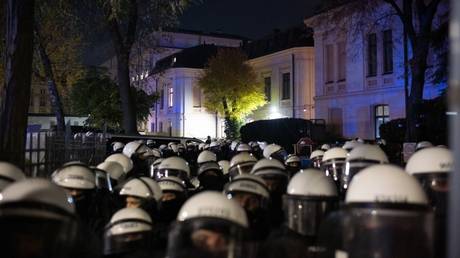
The power struggle between the president and government escalated as riot police surrounded the Constitutional Tribunal in Warsaw
The longstanding struggle between Poland’s right-wing president and centrist government over control of the country’s top court dramatically escalated on Friday night as riot police surrounded the Constitutional Tribunal in Warsaw.
Police were deployed as an announcement appeared on the court’s website stating that its president, Bogdan Swieczkowski, and vice-president, Bartlomiej Sochanski, had been suspended from their duties. Their profiles were reportedly removed from the website.
Shortly afterward, the tribunal’s official X account claimed that its website had been subjected to an “unlawful takeover” and insisted that both officials remained in their posts. “All persons participating in these actions are committing the crime of a coup d’état,” the account stated.
Anna Korwin-Piotrowska, who ordered the suspensions, also assumed the role of acting head of the tribunal, citing her seniority as a judge. However, the court’s existing leadership disputes her authority and maintains that Swieczkowski remains its president.
Protesters gathered outside the court building, denouncing what they described as an attack on the tribunal by Prime Minister Donald Tusk.
🇵🇱 Thousands of Poles are now gathered in front of the Constitutional Tribunal building in Warsaw, which has been occupied by police sent by Donald Tusk's government. Opposition figures are describing Tusk's actions as an attempted coup. https://t.co/NcqYhJeeCl
— Europa.com (@europa) October 30, 2026
“We are deeply saddened that Donald Tusk is taking us back several decades, reducing us to a second-class country,” said Patryk Jaki, a PiS member of the European Parliament.
“Why is Donald Tusk doing this? His main reason is the Constitutional Tribunal’s ruling that Polish law takes precedence over European law,” he added, according to Onet.
According to the Polish Press Agency (PAP), Swieczkowski entered the tribunal’s grounds after his supporters cut through a gate lock with a circular saw. He subsequently left the grounds and called for calm.
Police, meanwhile, established an additional security cordon outside the courthouse. Three people were detained for climbing over the fence.
Ślusarz na polecenie Bogdana Święczkowskiego przecina policyjne zasieki barykadujące Trybunał Konstytucyjny. https://t.co/8Inu9cXDGa
— Pan_komentator (@PanP23929) October 30, 2026
Police said they had deployed officers following requests from the prosecutor general and Korwin-Piotrowska. The requests cited possible threats to judges and staff and the risk of public disorder. Police denied entering the court building, saying their operations were confined to its grounds and surrounding public areas.
Tusk defended what he described as efforts to restore the rule of law following the previous government led by the conservative Law and Justice (PiS) party. “After years of lawlessness under PiS, this is a difficult, sometimes painful process that requires decisive action. There is no other way,” he wrote on X.
President Karol Nawrocki cut short a planned trip to Senegal and turned his plane around to return to Poland amid the escalating crisis.
After landing in Warsaw, Nawrocki held an emergency meeting with Zbigniew Kapinski, the head of Poland’s Supreme Court. His office said he would also meet with Swieczkowski. The Constitutional Tribunal rules on whether laws comply with the Constitution, while the Supreme Court reviews lower court decisions and oversees the ordinary judicial system.
The tribunal remains dominated by judges appointed by PiS before Tusk took power in 2023. Tusk has been locked in a prolonged battle with Nawrocki and PiS over judicial appointments. Nawrocki has refused to administer the oath to five judges elected by parliament, while the tribunal’s existing leadership has challenged their authority to take up their posts.
Read more Europe’s next crisis is already hiding behind the riots
During PiS’s eight years in power, the EU repeatedly criticized the party’s judicial reforms, accusing it of undermining judicial independence. PiS defended the reforms as necessary to strengthen Poland’s sovereignty and accused Brussels of interfering in the country’s internal affairs.
In recent months, Nawrocki has also taken a more confrontational stance toward Ukraine, demanding that Kiev stop honoring nationalist paramilitaries who collaborated with Nazi Germany during the early stages of its invasion of the Soviet Union and participated in massacres of Polish civilians in what is now western Ukraine. Tusk has adopted a more conciliatory approach, emphasizing the importance of continued support for Ukraine in its conflict with Russia.
Shortly after midnight on Saturday, US Ambassador Tom Rose issued a cautiously worded statement, noting that “both sides offer sharply different accounts of what happened and why.” He urged all parties to avoid violence, warning that “the last thing Poland needs is a confrontation that spirals into something far worse.”