
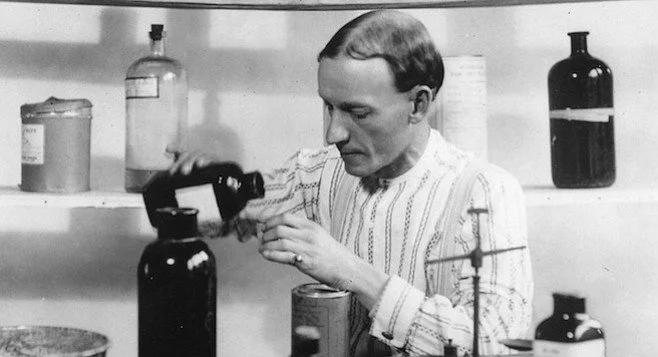
In the winter of 1916, a city that had begged the sky for mercy got exactly what it asked for, and then some. Within weeks, dams had burst, bridges had vanished, and an estimated twenty people were dead. Standing at the center of it all was a former sewing machine salesman who had promised San Diego rain and delivered a flood.
His name was Charles Hatfield. History would settle on a simpler title: the Rainmaker.
Ansar Ali explains.
Charles Hatfield in 1922. Source: Public domain, Farmers Almanac, available here.
From Kitchen Steam to National SensationCharles M. Hatfield wasn't a chemist, a meteorologist, or even a particularly educated man by the standards of his peers. Born in Kansas in 1875 and raised in the parched landscapes of Southern California, he made his early living selling sewing machines door to door, a trade that taught him something more valuable than any science degree ever could: how to sell an idea to a desperate audience.
The idea came to him, as legend has it, while watching steam rise from his mother's kettle. If steam could draw moisture from the air on a small scale, why not on a large one? By 1902, he had turned that kitchen observation into a full operation — a secret cocktail of twenty-three chemicals, brewed in galvanized tanks and released into the atmosphere from towers he built himself, usually with his brother Paul at his side.
He rebranded himself carefully. Not a "rainmaker," a word that reeked of traveling con men, but a "moisture accelerator." A "pluviculturist." The vocabulary of a serious man doing serious atmospheric work — even if the work itself was, at best, an educated guess dressed up in ceremony.
Building a Reputation for Rain
And it worked, at least often enough to matter. His first real break came around 1904, when a promoter placed newspaper ads on his behalf and a group of ranchers offered him fifty dollars to end a dry spell. Hatfield and his brother built a tower, released their mixture into the air, and when the rain arrived on schedule, the ranchers were so impressed they paid him double. Word spread. Lumber companies needing water to float logs downriver hired him. So did small towns watching their reservoirs shrink. In one especially lucrative job, he promised Los Angeles nearly nineteen inches of rain within three months and collected $1,000 when the skies delivered.
The U.S. Weather Bureau was less impressed. Bureau officials pointed out, correctly, that the rain Hatfield "produced" tended to arrive alongside storm systems that were already approaching the region regardless of his towers. But a skeptical weather bureau made for far less interesting news copy than a man who claimed to command the clouds, and the press kept printing the legend. Not every contract succeeded. Hatfield's failures were simply easier to forget than his triumphs, especially with a hungry public eager to believe in something after years of drought.
Whether Hatfield actually summoned that rain or simply had an uncanny knack for reading weather patterns and timing his towers to storms already rolling in, nobody could say for certain — and Hatfield never seemed eager to clarify.
A Handshake With the Sky
By 1915, San Diego was in trouble. The Morena Reservoir, the city's water lifeline, was dangerously close to empty. Desperate councilmen turned to the man with the towers and the twenty-three chemicals. The deal: $10,000 if he could fill the reservoir to overflowing.
Notably, nobody actually signed anything. The arrangement was verbal — a handshake deal between a city and a man who claimed he could bend the weather to his will. It would prove to be the most expensive unsigned contract in San Diego's history.
Hatfield and his brother built their tower beside Lake Morena in December 1915. On January 5, 1916, the rain began.
What followed wasn't rainfall. It was a siege. Storm after storm hammered Southern California for weeks. Bridges collapsed. Railway lines washed away. The Sweetwater and Lower Otay dams strained under the weight of water they were never built to hold, and on January 27, 1916, the Lower Otay Dam gave way entirely, sending a wall of water through the valley below that killed an estimated twenty people.
The Morena Reservoir didn't simply fill. It overflowed spectacularly, dramatically, undeniably. By the strict terms of his handshake agreement, Charles Hatfield had done exactly what he'd promised. San Diego was not in a grateful mood.
Act of God, or Act of a Man With a Chemistry Set?
The city council's position was blunt: they would pay Hatfield his $10,000 only if he accepted legal responsibility for the flood damage — damage that ran into the millions. It was an offer no rational man could accept, and Hatfield refused. He sued instead.
The case dragged through the courts for over two decades. San Diego, meanwhile, faced its own flood of lawsuits from residents who had lost homes, livestock, and loved ones, and the city had every incentive to pin the disaster on the man who'd promised them rain rather than on inadequate dam engineering. Hatfield, for his part, had a simple defense: he'd been hired to produce rain, not to control how much of it fell, and no verbal contract on earth obligated him to guarantee a specific volume. In 1938 — twenty-two years after the flood — a final ruling arrived: the storms were an "act of God." The verdict absolved Hatfield of liability for the destruction, but it also meant San Diego owed him nothing. Charles Hatfield never collected a single dollar for the rain that broke his own city.
The Chemist Who Wasn't, and the Skill He Actually Had
Modern meteorologists have a name for what hit San Diego in January 1916: a Pineapple Express, an atmospheric river carrying enormous volumes of tropical moisture straight into the California coast. It was a storm system that would have arrived with or without Hatfield's towers.
That doesn't make his story pure fraud, though. Cloud seeding is a real, if modest, science today — using silver iodide or dry ice to give water vapor something to condense around. Hatfield's chemical fumes may have functioned as a crude, accidental version of the same principle. But no chemical cocktail conjures a storm system out of clear sky. What he needed, and what he seems to have understood better than almost anyone of his era, was existing atmospheric moisture and good timing.
That, in the end, may have been his real talent — not chemistry, but meteorology dressed up as showmanship. He read weather patterns with genuine skill, chose his contracts and locations shrewdly, and understood something enduringly human: people are far more willing to credit a miracle than question a coincidence, especially when they're desperate for one.
A Legend That Refused to Dry UpHatfield kept working for decades after the San Diego catastrophe, though his fame never fully recovered. He died in 1958, largely forgotten, still insisting his methods worked. But his story outlived him. It inspired the 1956 film The Rainmaker, starring Burt Lancaster. Decades later, Widespread Panic guitarist John Bell stumbled across the tale in an old Farmers' Almanac and turned it into "Hatfield," a song that's been a live staple of the jam band's sets for over thirty years. It still gets cited whenever the conversation turns to weather modification, geoengineering, or humanity's long, uneasy relationship with the idea of controlling nature.
Charles Hatfield was never quite a scientist, and he was never quite a con man either. He existed in the space between — a salesman who understood the sky better than he let on, standing beneath his towers, promising the impossible, and once, for one catastrophic month in 1916, delivering exactly what he said he would.
Charles Hatfield died in 1958. San Diego, presumably, still checks the weather forecast before hiring anyone who calls himself a "moisture accelerator."
Did you enjoy the piece? Join us on X here to receive regular updates: @HistoryIsNowMag
References
San Diego History Center, "It's Raining Man!" exhibition, sandiegohistory.org
City of San Diego Official Website, "Rainmaker Charles Hatfield," sandiego.gov
Wikipedia, "Charles Hatfield," en.wikipedia.org
WBUR Here & Now, "In 1915, San Diego Hired A Rainmaker And Floods Ensued," June 2015, wbur.org
The Daily Beast, "Charles Hatfield Made It Rain in San Diego. The Problem Was He Couldn't Make It Stop," September 2024, thedailybeast.com