
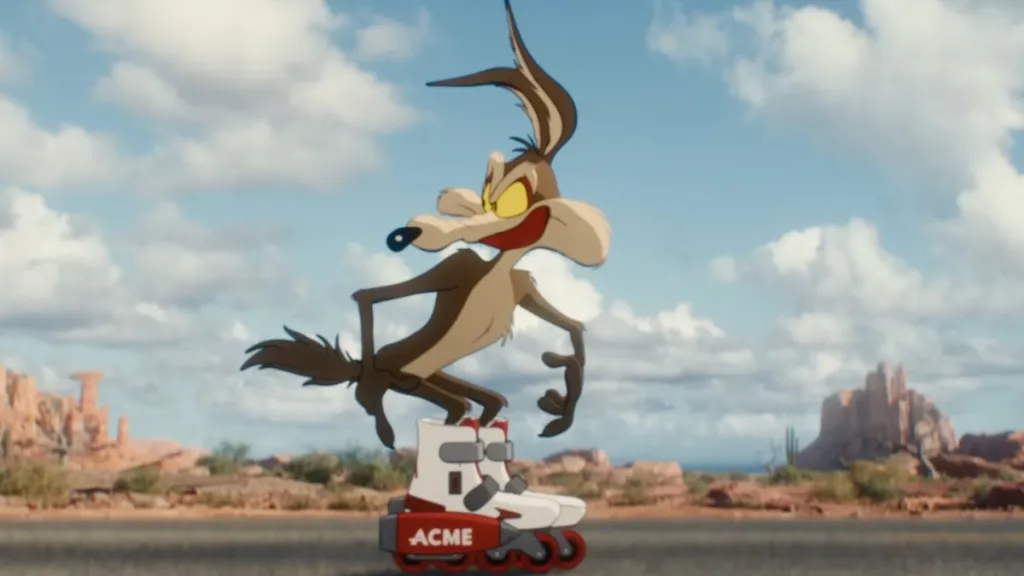
ComingSoon Editor-in-Chief Tyler Treese spoke with Coyote vs. Acme director Dave Green about the film. Green discussed his work’s mix of live-action and effects, a Road Runner debate his team had, and more. It is out in theaters on Friday, August 28.
“After decades of being blown to bits by bombs, demolished by dynamite, mangled by magnets, battered by boulders, trampled by trains, tricked by tunnels, sprung by springs, steamrolled by steamrollers, maligned by misfires, bedeviled by bungees, rattled by rockets, backstabbed by bat suits, rocked by rocket skates, upended by unicycles, quaked by quake pills, rubberized by rogue bands, and hurled headlong off every cliff in the Southwest, Wile E. Coyote (Genius) finally fights back. Teaming up with billboard accident lawyer Kevin Avery (Will Forte), he takes on slick corporate counsel Buddy Crane (John Cena) and ACME, Inc., the profit-obsessed conglomerate behind every one of the Coyote’s chaotic catastrophes,” says the official synopsis.
Tyler Treese: I thought this was really interesting. You started your directorial career with Earth to Echo, which had an alien in our world. You did the TMNT sequel, which had performance capture and CGI, and now this film’s a hybrid of live action and animation. What really draws you to this mix of worlds and mixing effects with live action? Because it’s all throughout your work. I thought that was a cool throughline.
Dave Green: Thanks for pointing that out. I grew up watching movies that were a bit elevated in the blending of worlds. Ghostbusters was one of my favorite movies when I was a kid. Beetlejuice was one of my favorite movies as well.
These are movies that you wouldn’t call hybrid movies by any means, but they dealt with things that were impossible in our world, or they dealt with our world and they twisted our world. I think that’s just something that only movies can do.
When I was growing up, I was making short films that were horror comedies. They were funny and they were scary, and they were treating violence in a funny way. I would say, in the through line of those three movies you mentioned, it just happened to be that they’re all hybrid movies.
But I would say that they’re very different in approach because Earth to Echo involves a puppet that we shot on set and then a CG character that was 3D animated. Then Ninja Turtles was really shot like a live-action movie that was all mocap. Coyote was a completely different process than both of those movies because Wile E. doesn’t exist. He can’t be played by a human in a suit on set.
So it’s really learning something new on each go that I find to be part of the challenge and part of the thrill of making a movie. I don’t know. I guess shooting two characters in a room next time might be the right way of having fun. But we’ll see.
You mentioned in your shorts you’re making violence funny, and nothing gets violence funny quite like Looney Tunes. You get to do some classic Coyote versus Road Runner scenes here. How joyous was it getting to iterate on this real staple of pop culture and putting your own spin on these cartoon scenes that we all grew up with, where poor Coyote is just getting blown to bits and taking a lot of damage?
It was a thrill and an honor, and definitely intimidating at first because we have a legacy to protect here. These characters are like—my grandparents were watching these characters in their day, and my parents were as well. So the challenge was doing it right and rising to the task of doing it right.
But yeah, just like you’re saying, Wile E. is one of the funniest physical comedians of all time. We looked at, of course, the original Chuck Jones shorts and also Buster Keaton. Then characters like Wile E., oddly, because he just doesn’t talk. So we looked at expression sets and ways of verbalizing when you can’t or don’t speak.
All those things were challenges, but also crazy fun. Wile E. is one of the funniest physical comedians ever. So it was an honor to get to play in that sandbox at all.
A good film really sticks with you, and I’ve just been giggling since I’ve seen the film. I just think about certain scenes, and I can’t wait to rewatch it because it seems like it’s littered with small gags and small touches in the background. Can you speak to taking advantage of the cartoon characters? Because you could just mess with scenes and add in these little animation jokes all throughout the film. People are going to miss a lot of them, but that gives them such an incentive to rewatch. How was it having fun with that?
That was super fun. The movie began as—we were designing the movie in COVID over Zoom with a team of animators, and we called them sketch-vis artists, who were drawing 2D illustrations on top of previs that we had done to represent the human actors that were going to be on set.
So this was really a proof of concept, a way of showing the studio, “This is how the movie is going to be layered. This is what’s live action and this is what’s cartoon.” In that process, that was like draft one of what would be 100 drafts of the same shot or moment or scene.
We would later then go shoot that scene with a puppeteer on set that would show the actors, “This is what Wile E.’s doing, and these are Wile E.’s actions.” Then we’d take that back to sketch-vis after we’d shot.
So what you’re seeing in the final result is really a layering of animators looking at what was there before and either preserving what made it work or intending to just punch it up and make it better.
Then in the last, I would say, two months of making the movie, we just had a really fun pass where we’re like, “Okay, final, final jokes,” basically, in animation. Then we went through with a couple writers that we’re friends with, and they just wrote jokes for, “Okay, well, what about in this moment, in between these two moments, what if you fit this?”
One of my favorites is the spider that crawls over the sign that says “Scary Road Drive.” That used to have no animation on it. My friend Zach Bornstein was like, “Well, what if we wrote this gag with the spider who’s going to get mugged by another spider?” It’s weirdly one of the bigger laughs in the movie, but that was a late-in-game animation plus-up that was added.
Tyler Treese: Yeah, these little touches really show this was a labor of love by all involved. Two of my favorite bits were related to the music. You have a really fun edit of a DJ Shadow and Run the Jewels song where you’re using Looney Tunes sound effects to cover up the expletives. Then you have a choir and they’re singing the Road Runner’s meeps, which are really easy to miss. Once I heard that, I was just losing it.
Can you speak to making sure that kind of Looney Tunes ethos was felt in every aspect of the film? I think that gives it such character. You weren’t afraid to embrace the inherent goofiness of this world, and I think that’s really why it stands out.
Dave Green: Thank you so much. We had a team that really wanted to embrace stupid in the best possible way.
The choir that meeps, that idea came from Steven Price, our composer. One day he was just like, “What if we were able to get in Wile E.’s mind? So anytime he’s obsessing about the Road Runner, we are meeping.” I just thought that was totally brilliant.
We had an entire choir. They’re called the London Voices. They are a choir that performs on score records all the time. They were meeping for an entire day. It was hilarious.
There was an argument, by the way, that we settled in the recording session on whether it was “meep” or “beep.” We do know that factually it is “beep.”
It’s been wrong for all these years.
Yeah. The choir did a vote, and we said, “Well, what do you think the Road Runner says?” Everyone except for one person said it is “meep.” But it’s technically “beep.” It’s okay because sometimes it sounds like “meep,” but it is spelled “beep” in the movie. So I think we’ve gotten away with it. We’ll see.
Then the song drop, that’s just, again, from clever members of our team who were just knowing what this movie was, knowing the sense of humor of the movie, and just bringing ideas. I think our music editor, Connor Hughes, cut that up one day, or Bradley Farmer. They cut it up and added the meeps, and we were just laughing so hard. So I’m glad you liked it.
I saw you worked on Spider-Man 2 and 3 as a production assistant. What were the lessons that you really learned being on a Sam Raimi set? Because I imagine that had to have been incredible as a young person with filmmaking aspirations.
Sam is incredible. He’s so fun to be around and to watch. Sam’s process is really—he focuses so much on prep, and that really taught me everything.
He uses a huge team of storyboard and animatic and previs guys, and they really workshop every single scene so many times and ideate and iterate on those passes, the scenes over and over and over, until everyone in the room is laughing and loving it.
He’s cutting those scenes together and he’s watching them with sound, and then he’s really, kind of in the tradition of Hitchcock, taking that guide to set. He is really shooting precisely what he planned. So that was hugely educational for me, and it’s really informed the way I like to work too.
But yeah, Sam is incredible. Also, so fast on his toes and so funny and witty, and he’s great with talent. He’s one of my favorite filmmakers, easily, and I’ve learned a ton from him.
Thanks to Dave Green for taking the time to talk about Coyote vs. Acme.
The post Coyote vs. Acme Director on Getting Wile E. Right & Settling a Road Runner Debate | Interview appeared first on ComingSoon.net - Movie Trailers, TV & Streaming News, and More.