
See more Toronto Sun on Google — save as a Preferred Source
Weeks before the board of the Toronto Transit Commission hurried a report off the floor, in a transit yard in Philadelphia, the electric buses were on fire.
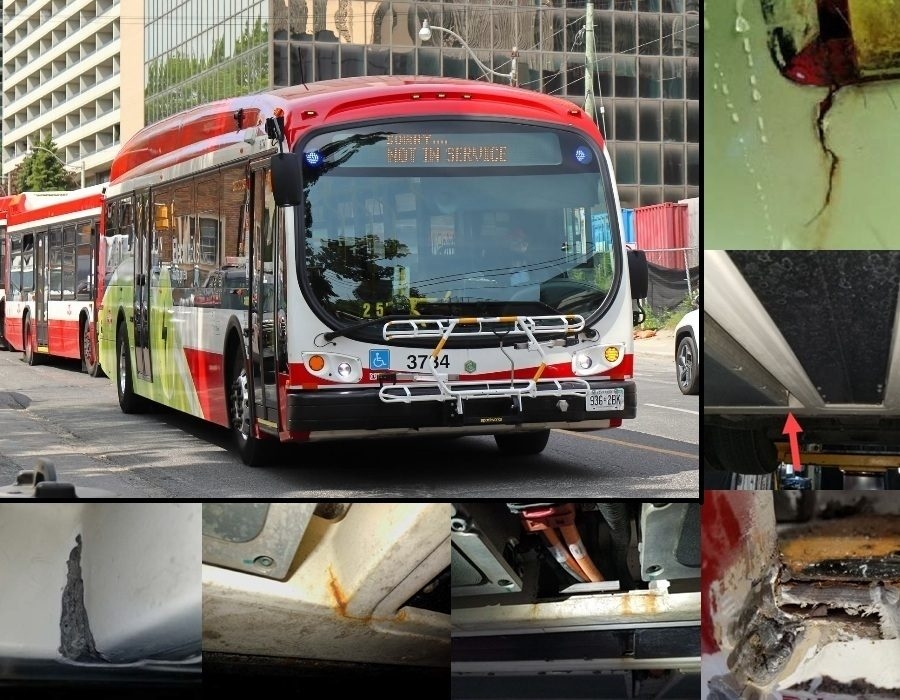
The Southeastern Pennsylvania Transportation Authority, or SEPTA, had fought a losing battle with its fleet of 25 Proterra Catalyst buses. Cracks kept showing up in the bodies of the buses, including to the chassis, and they seemed to defy any patching done by SEPTA’s engineers.
SEPTA only had the buses on the road for about half a year before they were parked in early 2020. Litigation followed and Proterra filed for bankruptcy in 2023.
Then, in June 2025, as SEPTA’s long-decommissioned Proterra fleet was rotting in a transit yard, an EV battery caught fire . Forty buses – 15 of them electric – were destroyed.
Not much more than a month later, the TTC’s board was handed a “ green bus program update ” that boasted that Toronto had “one of the leading fleet electrification programs in North America.” Buried deep in the 38-page report were cryptic statistics on “body interior and exterior faults,” plus “traction motor defects” that cut the availability of the TTC’s 25 Proterra Catalyst buses by 30%.
Those issues weren’t discussed by the TTC board. Nothing was.
One of the TTC’s commissioners – city councillor Dianne Saxe – was in fact so eager to accept the report without debate that when chairman Jamaal Myers asked for a show of hands, she grinned and shot both of her arms straight up.
The TTC’s board may or may not have known about the SEPTA fire. It’s not unreasonable, however, to guess that engineers in the TTC likely did – at that point, SEPTA had been telling the TTC about how lousy the buses were for years.
‘Nothing to worry about’
It was early in the afternoon of April 28, 2020, when Mike Macas learned about a crack that developed in No. 3727, one of the new Proterra buses.
Internal emails, acquired by the Toronto Sun in a freedom-of-information request, show that Macas, the TTC’s senior manager of vehicle engineering, did not take it lightly.
“Is that at the rear door?” Macas asked a colleague in an email, urging for another TTC engineer to see how deep the crack went. “This is not good.” (The TTC declined to make Macas available for an interview.)
Five minutes later, he sent another email: “The crack looks to be rusty, yet the bus is composite. Where did the rust come from? Did you check any more buses to see if they have the same defect?”
He added: “This could be big.”
The next evening, after finding cracks in eight of the TTC’s 10 Proterra buses, Macas reached out to counterparts in Philadelphia and Seattle.
“We only identified these cracks yesterday,” Macas wrote. “Today we had a call with Proterra, who is assuring us we have nothing to worry about. Of course!”
This was news in Seattle, but Jerry Guaracino, SEPTA’s deputy chief engineering officer, told Macas they had been patching up cracks since October 2019.
“Since completion, a majority of the body crack repairs failed,” Guaracino told Macas – and even more cracks had developed to boot.
The buses were being parked “until SEPTA is satisfied with Proterra’s response,” Guaracino added.
The TTC worked with California-based Proterra and the company that built the buses’ bodies, TPI, to fix the cracks. Toronto had an issue that Philadelphia didn’t – in September 2020, COVID-related restrictions kept those companies’ officials from crossing the border.
Macas told his staff about a workaround: They would inspect the buses remotely, using VR goggles.
‘Quality concerns’
The Proterra vehicles were 25 of the initial 60 buses the TTC bought as part of a head-to-head electric bus trial. Last year, the TTC pulled the last of its Proterras off the streets.
Similar steps had reportedly been taken in cities including New York, Miami and Austin, Texas. Operating struggles had been reported across North America: Seattle; Duluth, Minn.; Asheville, N.C. The City of Edmonton had filed an $82-million lawsuit .
There were fears of something worse.
Business magazine Fast Company reported a door broke loose while a Proterra bus was running in Des Moines, Iowa. In Ithaca, N.Y., the local transit agency figured the way Proterra built the buses, the rear axles would eventually fall off. Its seven buses were retired in 2024, having been deemed unsafe .
The unusual cracking issue appears to stem from Proterra’s use of a composite material, rather than the typical steel, to offset the massive weight of the buses’ batteries. A public radio station in Philadelphia, WHYY, reported in 2021 that SEPTA found that composite was made up of resin, fibreglass, carbon fibre, steel plates and balsa wood.
- Candidate aghast at $500Gs bill for ‘field with fence’ dog park
- TCHC vows to ‘resolve’ chemical wasteland site in Swansea
- Was hockey cut from Weston arena because of ‘white privilege?’
Proterra had the backing of the Biden administration and Silicon Valley hype, but by the time SEPTA began patching cracks, it already had a poor reputation.
The TTC held a series of inspection meetings starting April 24, 2019, as its first Proterra buses were entering service.
“TTC told it is a young company, been told of quality concerns,” the minutes of the meeting read.
On June 12, just a few weeks into operation, “small stress cracks” had been found by the front door of three buses.
“Philly has (sic) the same issue last year,” the minutes for the June meeting said. “Not new to Proterra, but they are putting (in) an extra effort to look in that area.”
A couple of years later, in July 2021, at least one stubborn crack had proven too expansive for the metal plate fastened over it. A Proterra engineer had worse news: All of the TTC buses he had inspected had cracks to the underbody.
No ‘structural concerns’
In April 2022, the TTC board got a report that said Proterra’s composite bodies were “ susceptible to cracking .” They also fell short on a number of benchmarks, including driver and rider satisfaction, and had an especially poor range in winter. (New Flyer, which today makes up much of the TTC’s EV bus fleet, scored far better.)
Brad Bradford, who served on the board at the time, asked point-blank about which bus models had a stainless steel chassis. Bem Case, who had just given the board a presentation on behalf of the TTC, said Proterra and another maker, BYD, did not.
“Is that a disqualifier for us?” Bradford asked.
Case said the TTC had found “micro-cracks in the gel coat” of some composite-body buses, but there were no “structural concerns.”
The TTC kept operating Proterras for about three years after that meeting. In a written statement, TTC spokesman Stuart Green said only twice was a Proterra bus taken out of service due to cracks.
Proterra filed for bankruptcy in 2023, parts became increasingly difficult and expensive to obtain, and the company that bought Proterra’s transit arm, Phoenix Motor, refused to honour the buses’ warranties, Green said. (Phoenix ignored requests for comment from the Sun .)
The TTC spent $32 million for the 25 Proterras, paid for in part by a federal program, but Green did not specify if that included maintenance costs. Phoenix, in a relative bargain, reportedly paid just $10 million US for Proterra’s bus unit.
The road ahead
The TTC said it is donating what’s left of its Proterra fleet for parts. Fast Company reported each might be worth just $20,000 US today.
That loss did lead to “helpful insights,” Green said, on electric buses. The TTC’s fleet is now made up of 365 Nova and New Flyer vehicles.
“In 2017, the TTC took the position that we would be a transit industry leader in cleaning and greening our fleet,” Green wrote in an email. “We began the e-bus program with the purchase of 60 buses from three vendors as part of a head-to-head analysis in 2019-20. That proved extremely valuable in informing our larger 340-bus procurement as part of the 2025 capital budget.”
SEPTA declined to answer most questions from the Sun , citing its ongoing litigation. (The TTC said it has no litigation related to Proterra.)
SEPTA did confirm its buses were only in service from summer 2019 to early 2020. After the fire, SEPTA had all Proterra buses moved from its property, a spokesman added.
Myers and Saxe of the TTC board did not respond to a request for comment. Mayor Olivia Chow and her current campaign rival, Bradford, also didn’t respond to a request for comment.
jholmes@postmedia.com