
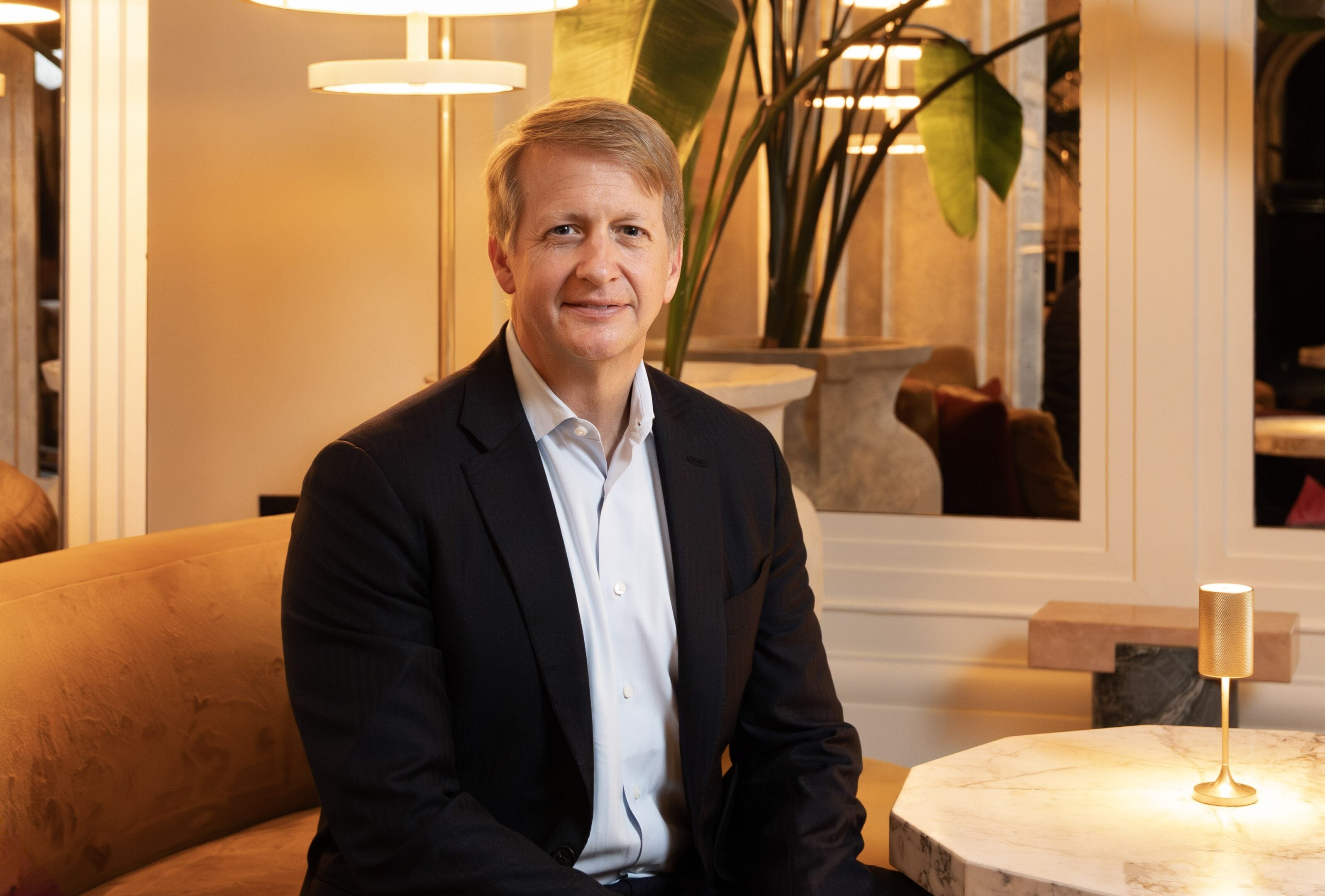
Whenever David Marriott visits a hotel bearing his family name, he always follows the same ritual: he greets and thanks every member of staff, from receptionists and waiters to housekeeping employees. «I learnt this from my grandfather and my father. Everyone must be treated with the same respect. It is the foundation of hospitality», explains the Chairman of the Board of Directors of a group encompassing more than 30 brands and 10,000 properties across 148 countries. A global business that has remained a family affair.
Panorama meets him exclusively in Rome during his recent trip across Italy, the latest of many. «I love your country», he admits. «I come back often. Two summers ago, I spent my holidays in the Dolomites. When you taste pasta in Italy for the first time, you realize you’ve never really eaten it before». Mr. Marriott is unfailingly courteous, a visionary who respects his roots, a man seemingly destined for his role yet firmly grounded.
When it comes to major announcements, however, he prefers to leave them to Neal Jones, President for Europe, the Middle East and Africa, who is sitting beside him. «We currently have just over 100 hotels in Italy, and our aim is to reach 200 within the next five years», he reveals to the press for the first time. «We want to expand», Jones continues, «not only in the major tourist cities. We already have 34 properties in our development pipeline».
David Marriott and Neal JonesAmong the most eagerly anticipated openings, reflecting this strategy of expansion across different destinations, are the forthcoming W Milan and The Ritz-Carlton in Bellagio, on Lake Como, which is expected to debut in 2029. And it is precisely this combination of perspectives and figures that turns the conversation into a joint interview.
How is the hotel industry changing? What are the new priorities influencing guests’ choices?
David Marriott: «In the past, hotels were expected to feel familiar, with bathrooms in the same position and room furnishings that were similar, if not identical. Today, they are expected to convey a sense of place, to clearly reflect their location, including through their food and the experiences they offer. Our role is to help guests establish authentic local connections that they can take home with them».
Is technology a valuable ally?
Neal Jones: «It would be paradoxical if it weren’t. Half of Italians say they have already used artificial intelligence to plan an itinerary. For us, it is the key to what we call “hyper-personalization”: getting to know each of our guests better so that we can recommend the perfect room, with their preferred view and amenities, in line with their spending preferences. This will become the norm within the next two years».
A highly efficient concierge, invisible because it is digital. Is there a risk of pushing the human element into the background?
David Marriott: «It will never disappear from our industry. Human interaction at reception and throughout our hotels will remain at the heart of everything we do. The essence of hospitality is connecting with people, listening to them and helping them create memorable moments. The technology available at any given time is simply a means of support, a tool».
Could you elaborate?
David Marriott: «Technology was already there almost a century ago, when my grandparents wanted to start a restaurant business and went to street corners with a small counter to measure how many people passed through each intersection, so they could identify the busiest location».
That was in 1927. Next year, you will celebrate the centenary of the company’s founding. How will you mark the occasion?
David Marriott: «By thinking about the next 100 years. One of our family mottos is that the only constant is change. We started with a small stand selling root beer and became what we are today with one principle firmly ingrained in our minds: we must evolve alongside our customers’ needs».
So how does that translate from theory into practice?
Neal Jones: «There is a strong focus on wellbeing today, which is why we have signed an agreement with Lefay Hotels to manage two wellness resorts in the Dolomites and on Lake Garda. And this is just the beginning. I can announce that we intend to expand the brand across Europe and potentially throughout the rest of the world».
What else?
Neal Jones: «In Poltu Quatu, on the northeastern coast of Sardinia, we will launch the first W Residences in Italy. These are private residences offering an extensive range of services comparable to those of a luxury hotel. It is a model that is already well established in the Middle East and is beginning to gain ground in Europe, where we expect significant growth over the next five years».
David Marriott during the interview with PanoramaSpeaking of growth, what does it mean to grow up seeing your family name displayed on buildings almost everywhere in the world?
David Marriott: «It’s a rather unusual kind of normality», he says, laughing. «For me, it has always been this way, ever since I was a child. It has been a source of great pride and a motivation to do well. Because when a company bears your name, you feel an even greater responsibility to honor it».
How do you intend to do that?
David Marriott: «By following a lesson taught by our founder, my grandfather. Listening to others, always asking what they think about a decision to be made or a direction to take. In business, as in life, we grow together».