
On the night of February 1, 1959, nine experienced hikers pitched a tent on the open eastern shoulder of Kholat Syakhl, a bare, wind-scoured mountain in the northern Urals whose Mansi name is usually translated as "Dead Mountain." Sometime that night they cut their way out of the tent and walked, most of them without boots, toward a forest a mile away. None of them came back.
For sixty years the deaths of the Dyatlov group were treated as one of the great unsolved puzzles of the twentieth century. The facts were strange, but they also sat in a closed file, in a closed region, in a closed country, for long enough that rumor filled the space where the record should have been. This is the story of what the 1959 investigators found, why they closed the case as they did, how the Cold War turned an accident into a legend, and what a modern reopening and a piece of Swiss snow physics have settled.
Ankana Das explains.
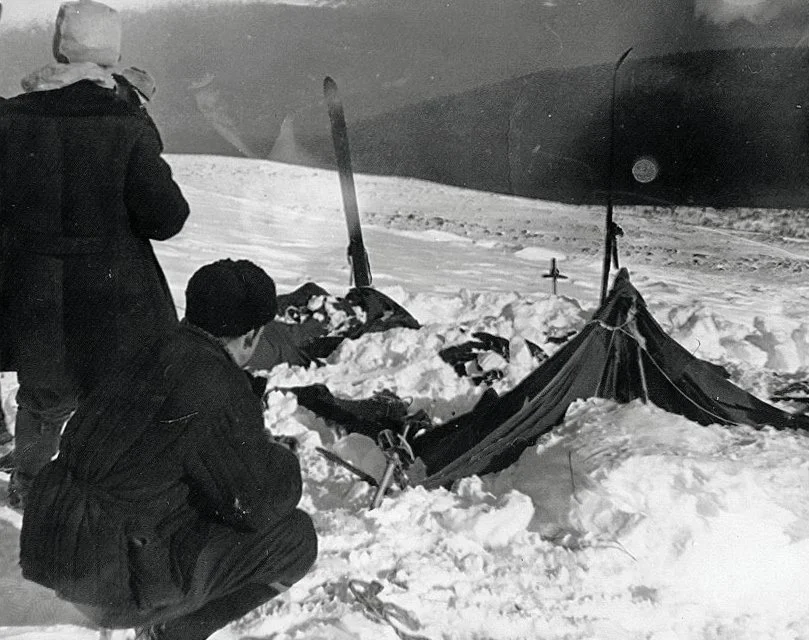
The tent as the rescuers found it on February 26, 1959. Source: Public domain,, available here.
A Routine Grade III ExpeditionThe group came from the Ural Polytechnic Institute in Sverdlovsk, the industrial city now called Yekaterinburg. Its leader, Igor Dyatlov, was a 23-year-old radio engineering student. With him were Yuri Doroshenko, 21; Lyudmila Dubinina, 20; Georgy Krivonishchenko, 23; Alexander Kolevatov, 24; Zinaida Kolmogorova, 22; Rustem Slobodin, 23; Nikolai Thibeaux-Brignolles, 23; and Semyon Zolotaryov, 38, an outdoor instructor and war veteran who joined the party late. A tenth member, Yuri Yudin, set out with them but turned back with illness on January 28, 1959.
The plan was a winter ski trek to the peak of Otorten, roughly 300 kilometers in all, which would qualify the participants for the Soviet Union's highest hiking certification, Grade III. All of them had winter experience, and the route was approved by the institute's sports club.
They left Sverdlovsk by train on January 23, 1959, and on January 26 reached Vizhai, the last settlement on their route. From there they went on skis. On January 31 they reached the edge of the highlands and cached surplus supplies in a wooded valley. On February 1 they climbed onto the slope of Kholat Syakhl and, at about five in the afternoon, pitched their tent on the open mountainside rather than in the forest below. Yudin later suggested that Dyatlov did not want to lose altitude. Dyatlov had promised a telegram from Vizhai by February 12.
The SearchNo telegram came. By February 20 the relatives were demanding action, and the institute sent out volunteer search parties, soon joined by the army, the police, and local Mansi hunters.
On February 26, 1959, a search party led by the student Boris Slobtsov found the tent on the slope. Some Russian accounts give February 25. The tent was half collapsed under snow and had been cut open from the inside. Most of the group's boots, jackets, and equipment were still in it. A line of footprints, made by people in socks or barefoot, led downhill toward the tree line.
On February 27 the searchers found the first bodies. Under a large cedar about a mile from the tent lay Doroshenko and Krivonishchenko beside the remains of a fire, both in their underwear. Between the cedar and the tent, spaced out as if returning uphill, were Dyatlov and Kolmogorova. On March 5 Slobodin was found between them. A criminal case had been opened on February 26 under the investigator Lev Ivanov.
The remaining four were not found until the thaw. On May 4, 1959, searchers probing a ravine beyond the cedar uncovered Dubinina, Zolotaryov, Kolevatov, and Thibeaux-Brignolles under about four meters of snow, on a platform of branches. Several wore clothing cut from the bodies at the cedar.
What the Autopsies ShowedThe autopsies were performed in Ivdel. Six of the nine had died of hypothermia. Dyatlov, Kolmogorova, Doroshenko, and Krivonishchenko showed little beyond frostbite, bruises, and scrapes. Slobodin had a hairline skull fracture that the examiner did not consider fatal.
The four from the ravine were different. Thibeaux-Brignolles had a major skull fracture; Zolotaryov and Dubinina had multiple broken ribs, and Dubinina had internal bleeding. The examiner compared the force involved to a car crash and noted that there were no external wounds to match it. Dubinina was also missing her tongue, eyes, and part of her lips; Zolotaryov's eyes were missing too. The examiner attributed this to decomposition in the stream running through the ravine, where the bodies had lain for three months.
This is the core of the mystery: people who left a tent without dressing, walked a mile in the dark, and in some cases suffered crushing injuries with no obvious cause.
"A Compelling Natural Force"Ivanov interviewed the searchers and the Mansi, examined the tent and the slope, and ordered a radiological examination of clothing from the ravine, apparently on his own initiative. On May 28, 1959, the case was closed. The conclusion stated that the hikers had died from what the Russian text calls a "stikhiynaya sila," variously rendered as "a compelling natural force," "an elemental force," or "a spontaneous force of nature," which they had been unable to overcome. No crime had been committed.
The wording was legally sufficient and historically unsatisfying, because it named no mechanism. The file went briefly into a secret archive; it was transferred to the State Archive of Sverdlovsk Oblast in 1974 and became accessible only in the late 1980s. The area around the pass was closed to hikers for years afterward.
Secrecy and SuspicionEverything that followed has to be understood against the geography of Soviet secrecy. The Urals in 1959 were dense with closed cities and nuclear installations, and the group had connections to them. Krivonishchenko had worked as a construction engineer at Chelyabinsk-40, the closed plutonium complex now known as Mayak, and had been there during the September 29, 1957, waste-tank explosion later called the Kyshtym disaster, which the Soviet state did not acknowledge for decades. Kolevatov had studied nuclear physics in Moscow before transferring to Sverdlovsk.
The radiological report by Sverdlovsk's chief radiologist, Levashov, found beta contamination well above background on several items of clothing, the highest on a brown sweater of Dubinina's, and attributed it to contamination rather than natural sources. Whether it came from Krivonishchenko's work clothes, from Kyshtym fallout, or from something done to the bodies after death has been argued ever since and never formally answered.
Then there was Ivanov himself. In November 1990, retired and living in Kazakhstan, he published an article in the Kustanai newspaper Leninsky Put titled "The Enigma of the Fireballs." He wrote that his team had had no rational explanation for the deaths, that witnesses had reported glowing spheres over the area in February and March 1959, and that senior regional officials had ordered him to remove that material and to close and classify the case. It is a genuine primary source, and also the recollection of an elderly man 31 years after the fact who had come to favor an unconventional explanation. It deserves both respect and caution.
The families never accepted the closure, and Yudin, who lived until 2013, spent his later years arguing that the authorities knew more than they said. Add the closed region, the nuclear plant, the radioactive sweater, and the fireballs, and by the 1990s the story had accumulated dozens of theories: avalanche, a missile test, a Mansi attack, escaped prisoners, KGB operations, and more exotic ideas. Donnie Eichar's 2013 book Dead Mountain proposed that a rare wind phenomenon produced infrasound that drove the hikers out in panic. None of this could be tested against a file most people had never seen.
The 2019 ReopeningOn February 1, 2019, sixty years to the day after the last camp, the Russian Prosecutor General's Office announced that it was reopening the case. At a press conference on February 4, Andrei Kuryakov of the Urals prosecutor's office said his team had catalogued 75 theories and would examine three: an avalanche, a snow slab, or a hurricane-force wind. Criminal explanations were set aside from the start, a choice critics said prejudged the answer.
On July 11, 2020, Kuryakov presented the conclusion. A slab of snow released onto the tent; the group cut their way out and moved about 50 meters down to a stone ridge that would shelter them from further slides. Visibility that night was estimated at between six and sixteen meters. "When they turned around, they could not see the tent," Kuryakov said, as reported in the Russian press. They went down to the cedar and lit a fire. Some tried to climb back and froze on the slope; the others dug into the ravine, where a further collapse of snow crushed them. "It was a heroic struggle," he said. "There was no panic. But in those circumstances they had no chance of escape."
The Physics of a Small AvalancheThe physics arrived six months later. On January 28, 2021, Johan Gaume of EPFL in Lausanne and Alexander Puzrin of ETH Zurich published a paper in Communications Earth & Environment titled "Mechanisms of slab avalanche release and impact in the Dyatlov Pass incident in 1959."
The objections to an avalanche had always been specific: the slope averaged only about 23 degrees, no debris was seen, the tent was still partly standing, the injuries did not look like avalanche injuries, and nothing had triggered a release hours after the tent was pitched.
Gaume and Puzrin addressed each point. Beneath the gentle surface, a weak layer of depth hoar lay at roughly 28 degrees, steep enough for a slab to fail. When the group dug a level platform for the tent, they cut through that layer and removed its support. Katabatic winds then loaded snow onto the slope above the cut through the evening. Their model put the delayed release at between 7.5 and 13.5 hours after the cut, matching the forensic estimate that the group died 9.5 to 13.5 hours after their last meal.
The slab they modeled was small, about five meters long and under nine meters wide, and would have left little trace once the wind reworked the snow. To test whether it could break ribs, they simulated dense snow striking a person lying on a rigid surface, calibrated against crash-test data on human cadavers gathered by General Motors in the 1970s. Because the hikers slept on their skis, their bodies had no give. The model produced chest injuries that were serious but not immediately fatal, consistent with the Ivdel autopsies.
The authors were careful about the limits of their work. In their words, "we do not explain nor address other controversial elements surrounding the investigation such as traces of radioactivity found on the victims' garments, the behavior of the hikers after leaving the tent, locations and states of bodies, etc." Follow-up expeditions, reported in the same journal in March 2022, filmed two recent slab avalanches on the pass.
What Remains UnexplainedIt is worth being precise about what is settled and what is not.
The chronology is settled. The cause of death for six of the nine, hypothermia, has never been in doubt. The injuries of the other three are now plausibly explained by a small slab release, and the prosecutors and the Swiss modeling agree on the broad sequence: a slide onto the tent, an evacuation, disorientation in the dark, and death by cold.
What remains open is narrower than the legend suggests but real. Why the group camped on the open slope, and why they walked a mile in the dark instead of digging out the tent, is still argued. The radioactive contamination has never been traced to a source. The soft-tissue loss in the ravine is most plausibly decomposition and scavenging, but that is an inference rather than a proven fact. And Ivanov's claim that he was ordered to strip material from the file has never been independently confirmed or refuted.
The Dyatlov Pass incident is less a supernatural mystery than a study in what happens when a state cannot bring itself to tell nine families a mundane truth. An accident in the mountains, sealed in a secret archive at the height of the Cold War, grew into something far larger. The snow physics is now understood. The silence around it is the part of the history that still deserves attention.
Enjoyed the piece?
Join thousands of history readers getting occasional updates on new blog posts, books, and video releases — plus a free history book to get you started.
Join History Is Now here
About the author
Ankana Das is the lead writer at The Case Hunter, an independent online magazine covering European unsolved cases, mysteries, and folklore.
References1. Gaume, J. and Puzrin, A. M., "Mechanisms of slab avalanche release and impact in the Dyatlov Pass incident in 1959," Communications Earth & Environment 2, 10 (January 28, 2021). https://doi.org/10.1038/s43247-020-00081-8
2. Puzrin, A. M. and Gaume, J., "Post-publication careers: follow-up expeditions reveal avalanches at Dyatlov Pass," Communications Earth & Environment 3 (March 2022). https://doi.org/10.1038/s43247-022-00393-x
3. Eichar, Donnie, Dead Mountain: The Untold True Story of the Dyatlov Pass Incident (San Francisco: Chronicle Books, 2013).
4. TASS, "Prosecutors say avalanche killed Dyatlov group in Urals in 1959," July 11, 2020. https://tass.com/emergencies/1177345
5. Russia Beyond, "Official cause of death of the Dyatlov group revealed," July 12, 2020. https://www.rbth.com/history/332434-official-cause-of-death-of-the-dyatlov-group
6. The Moscow Times, "Russian Investigators Are Reopening the Dyatlov Pass Case. But What Is It?," February 14, 2019. https://www.themoscowtimes.com/2019/02/14/russian-investigators-are-reopening-dyatlov-pass-case-but-what-is-it-a64461
7. Andrews, Robin George, "Has science solved one of history's greatest adventure mysteries?," National Geographic, January 28, 2021.
8. ETH Zurich, "The Dyatlov Pass mystery and what a research article can trigger," March 2022. https://ethz.ch/en/news-and-events/eth-news/news/2022/03/the-dyatlov-pass-mystery-and-what-a-research-article-can-trigger.html
9. Ivanov, Lev, "Tayna ognennykh sharov" ("The Enigma of the Fireballs"), Leninsky Put (Kustanai), November 22–24, 1990. English translation at https://dyatlovpass.com/lev-ivanov
10. Dyatlov Pass case files, Volume 1, radiological analysis report (sheets 371–377), 1959. Scans and translation at https://dyatlovpass.com/case-files-371-377
11. Wikipedia contributors, "Dyatlov Pass incident," Wikipedia, and the Russian-language article "Gibel turgruppy Dyatlova," accessed September 2026.
12. The Case Hunter, "Shocking Dyatlov Pass Incident: Truth and Theories", 2026. https://thecasehunter.com/shocking-dyatlov-pass-incident-truth-and-theories/