
See more Toronto Sun on Google — save as a Preferred Source
At least two Canadians are among the injured following a deadly crash between two high-speed trains in Spain on Wednesday morning.
Prime Minister Mark Carney made the announcement while expressing “sadness and solidarity” with the victims, as the death toll sits at 68 but is expected to rise.
“Our thoughts are with their families, the victims and their loved ones, in the days and weeks ahead,” Carney said in Ottawa on Wednesday.
He added the federal government is ready to provide “any assistance” required, but did not provide details.
Carney also took to X to extend his thoughts and sympathy.
“On behalf of Canadians, I extend my condolences to everyone in Spain who has been impacted by the devastating train collision near Toledo. We wish all those injured a full recovery,” he wrote.
“Canada is working with local authorities to provide support to any Canadians affected,” he continued before thanking the emergency crews who are “working tirelessly to rescue passengers and care for the survivors.”
Not the drivers’ fault
At least 68 people have died and 58 were receiving treatment in hospital, Euronews reported, citing regional authorities.
Transport Minister Oscar Puente said an “inexplicable” decision from a central control centre in Madrid allowed the high-speed Renfe train to resume running despite a safety system failure.
Puente said the control centre is being investigated, and stressed that the train operators were not to blame.
At around 8:30 a.m. local time, an LZB safety system failed along a 63-kilometre stretch of track due to a computer malfunction which automatically brought around six trains to a halt, according to the outlet.
The control centre took over management of the traffic and at 8:36 a.m., the Renfe AVE high-speed train was given the go-ahead to resume normal running, despite a red signal remaining active on the line.
It travelled about 25 kilometres before it collided with the stationary Iryo train at 8:53 a.m.
Authorities are still examining data to establish the train’s exact speed before the collision, although Puente said it could have reached up to 200 kilometres per hour on that section of track.
Puente described the incident as “one of the toughest moments anyone can face” and expressed his solidarity and sympathy with the victims.
Rescue operations are underway as the death toll is expected to rise. Witnesses recounted the chaos at the scene, telling CNN that “people were hurled into the air” in the crash just south of Madrid.
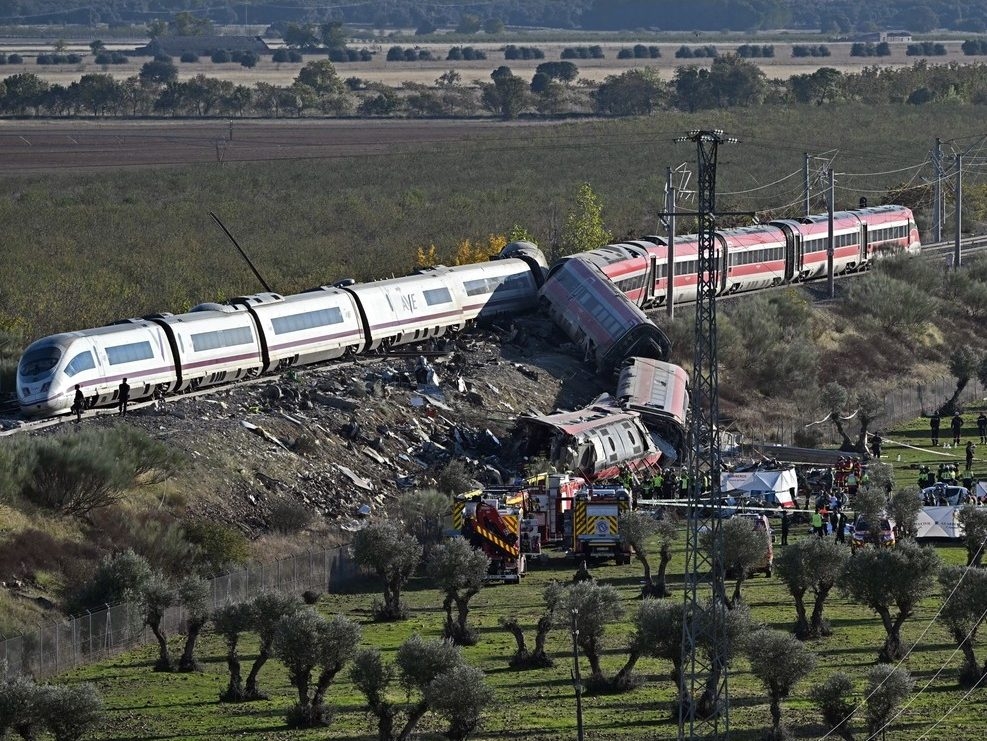
Images shared by local media showed the wreckage of two trains strewn on the tracks and an embankment as emergency services rushed to the scene, while shocked travellers dragged away their suitcases as they escaped.
When and where did the collision happen?
The two trains collided just before 9 a.m. local time in the municipality of Urda, about 130 km south of Madrid.
A passenger on board one of the trains told local media there was a heavy impact about 40 minutes into the journey.
State railway operator Renfe confirmed in a statement that the main high-speed line from Madrid to southern Spain had been suspended after one of its services suffered an accident with a train owned by private high-speed railway operator Iryo.
“All resources are currently being deployed,” a spokesperson for the Spanish emergency services told AFP, including “several fire crews, three helicopters, and two mobile intensive care units.”
How many passengers were on board?
More than 500 people were believed to be on board both trains.
Esther Padilla, spokesperson for the government of Castilla-La Mancha region, told TVE that the Iryo train was carrying 146 passengers, while the Renfe train had 397 passengers on board.
How have authorities responded?
Spanish Prime Minister Pedro Sánchez wrote on X that he was “shocked by the serious train accident in Toledo.”
He continued: “I remain in constant contact with the Minister of Transport, and with the president of Castilla-La Mancha, noting that emergency services were working on the ground “to assist those affected and ensure their safety, in coordination with all the involved administrations.”
The PM added: “My affection, solidarity, and support to all the victims and their families.”
- Young man walking along tracks killed by train in Toronto’s east end
- Mississauga train disaster sparked safety improvements
- Lac-Megantic train disaster a dark turn for rail veteran
Sánchez and other Spanish politicians have cancelled all public engagements on Wednesday, including campaigning for next month’s parliamentary elections.
Spain’s Royal Family posted on X that it was “shocked and concerned” by the accident and expressed condolences for the victims’ families and others affected by the crash.
A spokesperson for the EU said the bloc was ready to help Spain if needed.
Previous deadly crashes
This is the second high-speed rail tragedy in Spain this year.
In January, a high-speed Iryo train collided with an oncoming Renfe train near Adamuz in the Cordoba province that left 46 dead and raised major questions about safety on the nation’s railways.
That incident and Wednesday’s collision both happened on one of the country’s busiest routes, the line linking Madrid to the southern city of Seville.