
Our latest roundup collects galleries where exposed concrete surfaces form contemplative settings for paintings and artwork.
From high-profile art museums to modest pavilions housing singular artworks, the galleries below illustrate the endless and artful possibilities of concrete.
Among the projects included in the roundup are buildings by Pritzker Prize-winning architects Peter Zumthor, Eduardo Souto de Moura, Tadao Ando and David Chipperfield Architects.
Read on to discover eight concrete art galleries from around the world:
Photo courtesy of Museum Associates/LACMA Photo by Iwan BaanThe David Geffen Galleries, USA, by Peter Zumthor
Wrapped in a ribbon of glazing, The David Geffen Galleries is a curving concrete extension to the Los Angeles County Museum of Art, designed by Swiss architect Peter Zumthor.
The elevated gallery snakes above street level and spans Wilshire Boulevard. It is supported by seven structural pavilions that are scattered unevenly along its footprint.
Find out more about The David Geffen Galleries Photo by Luís Ferreira Alves Photo by Francisco NogueiraCasa das Histórias Paula Rego, Portugal, by Eduardo Souto de Moura
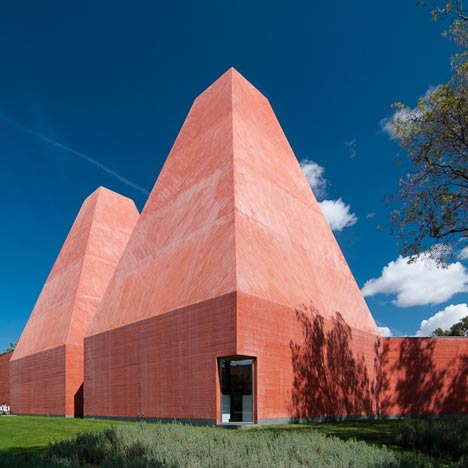
Two pyramid-like chimneys rise from Casa das Histórias Paula Rego in Cascais, Portugal, which was designed by Portuguese architect Eduardo Souto de Moura to house the works of artist Paula Rego.
Enclosed by red-concrete walls, the interior was designed as a sequence of rooms tailored to different formats, from small lithographs to large-scale paintings.
Find out more about Casa das Histórias Paula Rego Photo by DONG Image Photo by DONG ImageXiao Feng Art Museum, China, by ZAO/standardarchitecture
Chinese studio ZAO/standardarchitecture created an angular concrete building looping around a central courtyard for the Xiao Feng Art Museum in Hangzhou.
Dedicated to the artist couple Xiao Feng and Song Ren, the gallery rises and falls to form openings that guide visitors under bridge-like elements to the courtyard.
Find out more about Xiao Feng Art Museum Photo courtesy of Museum SAN Photo courtesy of Museum SANGround, South Korea, by Tadao Ando
Japanese architect Tadao Ando designed a subterranean concrete dome to house a permanent installation by British sculptor Antony Gormley at Museum SAN in Wonju, South Korea.
Spanning 25 metres in width, the cave-like space was topped by a central oculus that looms over the cast-iron sculptures.
Find out more about Ground Photo by Julien Lanoo Photo by Julien LanooNubuke Extended, Ghana, by Baerbel Mueller and Juergen Strohmayer
Nubuke Extended is a one-room concrete gallery extension to the Nubuke Foundation in Ghana, which was raised above the ground to form a shaded events and gathering space below.
Designed by architect Baerbel Mueller and architectural designer Juergen Strohmayer, the gallery's interior features high ceilings and a mezzanine level.
Find out more about Nubuke ExtendedRichard Serra gallery, USA, by Thomas Phifer and Partners
At the Glenstone Museum in Maryland, American architecture studio Thomas Phifer and Partners created a rectangular gallery for the artworks of sculptor Richard Serra.
The building was made from cast-in-place structural concrete with doors made of stainless steel, and a series of skylights provides the only source of light inside.
Find out more about the Richard Serra gallery Photo by Studio Menges Tugushi Photo by Studio Menges TugushiAnselm Kiefer Pavilion, Germany, by David Chipperfield Architects
Six years after completing the Carmen Würth Forum museum in Germany, architecture firm David Chipperfield Architects returned to the site to add a monolithic concrete gallery built around a singular large-scale artwork.
Once too big to exhibit at the museum, the Schwarze Flocken artwork by Anselm Kiefer now hangs on the wall of the Anselm Kiefer Pavilion, illuminated by rooflights.
Find out more about Anselm Kiefer Pavilion Photo by Kris Provoost Photo by Kris ProvoostGinkgo Gallery, China, by MORE Architecture
Scooped concrete ceilings animate the Ginkgo Gallery in Jiaxing, which was designed by Dutch studio MORE Architecture as an antidote to China's boom of large-scale museums.
Located on an island in a manmade lake, the museum's board-marked concrete surfaces were arranged to create horizontal patterns across the walls and roofs.
Find out more about Ginkgo GalleryThe post Eight galleries artfully made from concrete appeared first on Dezeen.