
See more Toronto Sun on Google — save as a Preferred Source
It is just part of the human condition to place emotional value on inanimate objects.
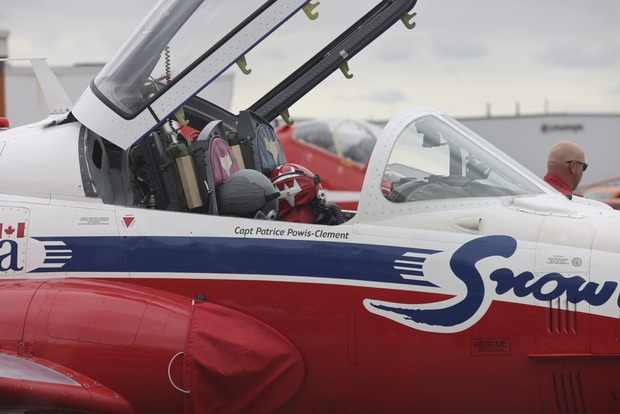
“I love this little thing,” Maj. Steven Sparks told the Toronto Sun, as he lovingly gestured towards his CT-114 Tutor on Thursday afternoon at the Toronto airport. “I have grown fond of it, flying the last bunch of years. It has hit me over the last couple of shows that you know, it is the last time (in Toronto) we are going to get to do this.”
Sparks became a full-time member of the Snowbirds in 2020. He transitioned into a senior training role in 2023 and jumped back into his bird for this season.
The Snowbirds demonstration squad will make its final appearance at the Canadian International Air Show this weekend.
To be clear, the pilots and the extended crew of the Moose Jaw, Sask.-based 431 Air Demonstration Squadron isn’t going anywhere. It is the fleet that will be mothballed at the completion of the show season in November.
Team leader Maj. Maciej Hatta has spent countless hours in the air with an extremely elite group of Canadian high-flyers.
And similar to his number six, the team leader has developed an affinity for his aircraft and for the people who keep them in the air.
“There is definitely emotion, and I try to put that into my simulcast at the end of the show and, sometimes I give the ‘I am not crying, you are crying’ sentiment to close it out,” Hatta said. “Obviously, it is sad and we don’t have too much time for emotion in the actual aircraft, so it probably won’t hit us until the end of the season.”
- Petition launched to keep Snowbirds airborne before new planes arrive in 2030s
- Trade war not to blame for USAF demo team pulling out of Toronto air show: organizers
Hatta’s first year as team leader
The former Milton resident was selected to join the Snowbirds in 2013. This is Hatta’s first year as team leader.
Hatta says the mechanical crews keep the planes in excellent flying condition. The planes have been modernized over the years, but logistics and parts obsolescence are reasons why the fleet is getting its wings clipped.
Engineering challenges and safety concerns also went into the decision announced by the federal government in May.
Bad, sad news
“It has been around since the early 1960s, coming off the production line in Cartierville, Que,” Hatta said. “It is amazing it has stood the test of time.”
Besides the adrenaline rush of testing his personal limits in flight, Sparks was asked what he will miss most about his time with the team.
“It is always about the people,” Sparks said. “It is an amazing opportunity to work with so many amazing people, striving for a common goal. That is what gets me up in the morning and motivates me to keep doing what we are doing.”
After their Toronto performance, the team has three full shows, two flyovers and a scheduled appearance at the Grey Cup on Nov. 15 in Calgary.
But after that, the future of the performance team is clear as mud.
The Swiss-made, turbo-prop CT-157 Siskin II has been chosen to replace the Tutor. The planes are on order and are being delivered.
“We are excited for the future,” Sparks said. “The Air Force is modernizing and bringing in all kinds of new things for the future, and it will be an exciting time for that.”
But there has been no definite return to the sky timetable. It could be half a decade or more before the team is performing at air shows again.
“We are, hopefully, going to transition to a new aircraft sooner rather than later and be back in full force,” Hatta said.
Sparks would love to fly again with the team, but that decision is not his to make. Hopefully, he has a plane to fly in the coming years.
“Right now, I am just trying to enjoy what is here and what is now,” Sparks said.
ganderson@postmedia.com