
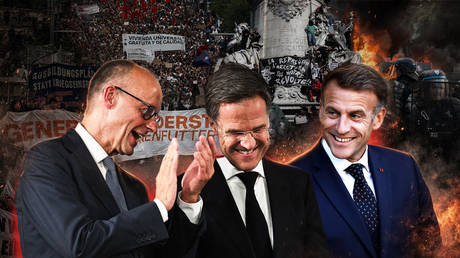
Mounting problems with housing, schools, and jobs are driving people into the streets while their governments are gearing up for a conflict no one wants
Europe’s leaders have grand plans – spend more on weapons, prepare for war, and tighten citizens’ belts. The people have more immediate concerns however, like finding somewhere to live, keeping their jobs, and getting an education. Across France, Germany, Spain, and other EU states, the widening rift has started to spill into the streets.
Recent weeks have seen housing marches across Spain, student riots and public-sector strikes in France, and demonstrations against military recruitment and industrial job cuts in Germany. Immigration has added to the anger over housing and overstretched services, while the prospect of conscription has young Germans asking whose wars they are expected to fight.
The demands differ, but a recurring complaint unites them – aside from those simply looking for an excuse to wreak havoc: governments aren’t listening. Instead of putting domestic problems first, European leaders are telling their constituents to accept less and sacrifice more, while committing billions to preparations for a suicidal war with Russia. That’s despite Moscow and even Europe’s own intelligence services repeatedly saying there is no imminent threat.
Spain: Priced out and fed upSpain’s housing crisis has pushed tens of thousands into the streets. After years of soaring rents, the eviction of an 87-year-old woman from her home of 70 years in Madrid last month turned into a rallying point for those sick of being priced out of their homes and the government’s failure to tackle the housing affordability crisis.
Read more Police fire tear gas as housing protests sweep Spain (VIDEOS)
The eviction sparked demonstrations across Spain, followed by mass marches and a continuing protest camp in central Madrid. Parliament’s subsequent rejection of emergency tenant protections added even more fuel to the fire, bringing tens of thousands into the streets in around 50 cities last weekend.
Rents in Spain have almost doubled over the past decade as immigration-driven population growth has continued to outstrip housing construction. The population, excluding migration, has meanwhile only continued to decline.
The pressure is even more visible in Ceuta, Spain’s North African enclave, where around 72,000 people crossed from Morocco in late July into a territory with roughly 84,000 inhabitants. Although most returned, thousands remained, overwhelming accommodation and straining public services.
Residents have taken to the streets demanding stronger border controls and faster deportations, accusing Madrid of abandoning them. Protests have escalated into clashes with police, while angry locals have torn down makeshift migrant camps.
READ MORE: Protesters clash with police after mass Ceuta immigration crisis rally (VIDEO)
Government promises to restore order have done little to quell the frustration of communities left to absorb the consequences.
France: School’s outFrance has also been gripped by overlapping protests over wages, spending cuts, public services, and school conditions. Teachers, healthcare workers, firefighters and transport staff have joined numerous strikes in recent weeks, while a growing student movement has added school blockades to the disruption.
Read more Nearly 2,000 arrested as student unrest grips France (VIDEOS)
The school protests began in mid-September, with students demanding more teachers, smaller classes, repairs to neglected buildings, and lighter schedules. Thousands of teaching posts have been eliminated this year, with further cuts planned for next year.
Around 266,000 people joined demonstrations nationwide on Tuesday. More than 6,500 have been arrested over three weeks, while hundreds of students and police officers have been injured, including a 15-year-old who lost his hand to a police grenade and a 16-year-old who reportedly lost sight in one eye after being hit by a rubber bullet.
As the movement has grown, violent groups have joined the protests, torching buses, attacking emergency workers, and damaging schools. Across France, 24 schools have been burned or ransacked.
READ MORE: Strikes paralyze France as Macron’s popularity flatlines (VIDEOS)
Similar demonstrations have spread to neighboring Belgium, where students have opposed education reforms, higher transport costs, and rising tuition fees. In Liege, school blockades have been accompanied by vandalism, fires and arrests.
France: The cuts keep comingThe student demonstrations came on the heels of wider protests that have gripped France for weeks, with public-sector workers protesting a squeeze on wages and services, compounded by soaring fuel prices.
Read more Violent student protests spread from France to Belgium (VIDEOS)
Since 2017, public-sector pay has risen by 5%, while cumulative inflation has reached 24%. The government’s proposed €54 billion ($60.4 billion) budget package, which includes spending cuts and freezes affecting pensions and benefits, has only deepened the anger.
Other demonstrations have also challenged continued funding for Ukraine, with protesters arguing that the money should go toward hospitals, education, and lower fuel taxes.
Separate rallies in more than 20 cities have also opposed a bill that could give police shootings the presumption of legality, which critics say would make officers harder to hold accountable.
Germany: Factories shrink, the military growsRead more German auto workers protest historic job cuts
In Germany, workers and students have taken to the streets as Berlin pursues a frenzied military buildup in the midst of a deepening industrial crisis with hundreds of thousands losing their livelihoods and young men facing the prospect of being drafted.
Around 45,000 students joined protests in some 100 cities and towns in late September, carrying banners reading ‘We won’t fight in your wars’ and ‘Education instead of bombs’.
The government meanwhile is pressing ahead with plans to expand the armed forces to more than 260,000 active troops and 200,000 reservists by 2035 to align with Chancellor Friedrich Merz’s fixation on creating “Europe’s strongest conventional army.”
Young men are already required to register for potential service, but politicians have been pushing for a return to conscription if voluntary recruitment fails to fill the ranks.
Read more Tens of thousands protest German conscription plans (VIDEOS)
Aside from the thousands protesting such plans in the streets, resistance is also showing up in applications to avoid military service. More than 12,000 people sought conscientious objector status in the first eight months of this year – over three times the total for all of last year.
Tens of thousands of automotive workers have also protested sweeping job cuts and threats to factories. Volkswagen, for example, plans to shed 100,000 jobs across its brands, while other manufacturers are cutting production or moving it abroad.
Germany’s industrial woes have been further compounded by the loss of cheap Russian energy, which helped make its manufacturers competitive. Higher energy costs, US tariffs, and Chinese competition are now squeezing businesses and threatening jobs across the sector.
READ MORE: Objections to conscription triple in Germany – media
For arms manufacturers, however, Berlin’s priorities and its latest €108.2 billion defense budget have been good for business. While Volkswagen shares have fallen more than 75% from their 2021 peak, Rheinmetall’s have soared over 1,100% since early 2022. One Volkswagen factory is even set to shift toward producing military equipment for an Israeli arms company.
More guns and more fearEven with streets burning and protesters demanding relief, European leaders have not let the turmoil distract them from their military ambitions.
Read more ‘Murderers’ Rutte and Merz booed at peace prize ceremony (VIDEOS)
In France, Macron marked Tuesday’s mass demonstrations by publicizing a nuclear missile test, posting a photograph of himself watching the launch with his back to the camera. While his constituents marched for better living conditions, his message was that France “must be feared to remain free.”
In Germany, Merz and NATO chief Mark Rutte smiled and waved through boos and chants of “murderers” and “blood on your hands” after the military bloc received the Westphalian Peace Prize last week. Inside the ceremony, officials praised military strength as the foundation of peace.
Those priorities are also taking shape in Brussels’ budget negotiations. Germany and five other EU states have demanded cuts to the bloc’s next budget, pushing to sacrifice funding for farmers and poorer regions in favor of ever-growing military spending.
The urgency is being justified by the supposed threat of a future Russian attack. However, Moscow has repeatedly denied any such plans, while even Finland’s president has admitted that his intelligence services see no imminent military threat.
READ MORE: ‘Russia is not our enemy’: Hundreds rally in Paris against Ukraine aid (VIDEO)
Nevertheless, for European leaders, preparations for that hypothetical conflict, which they appear to almost count on, continue to take precedence over the mounting problems already bringing people out onto the streets.