
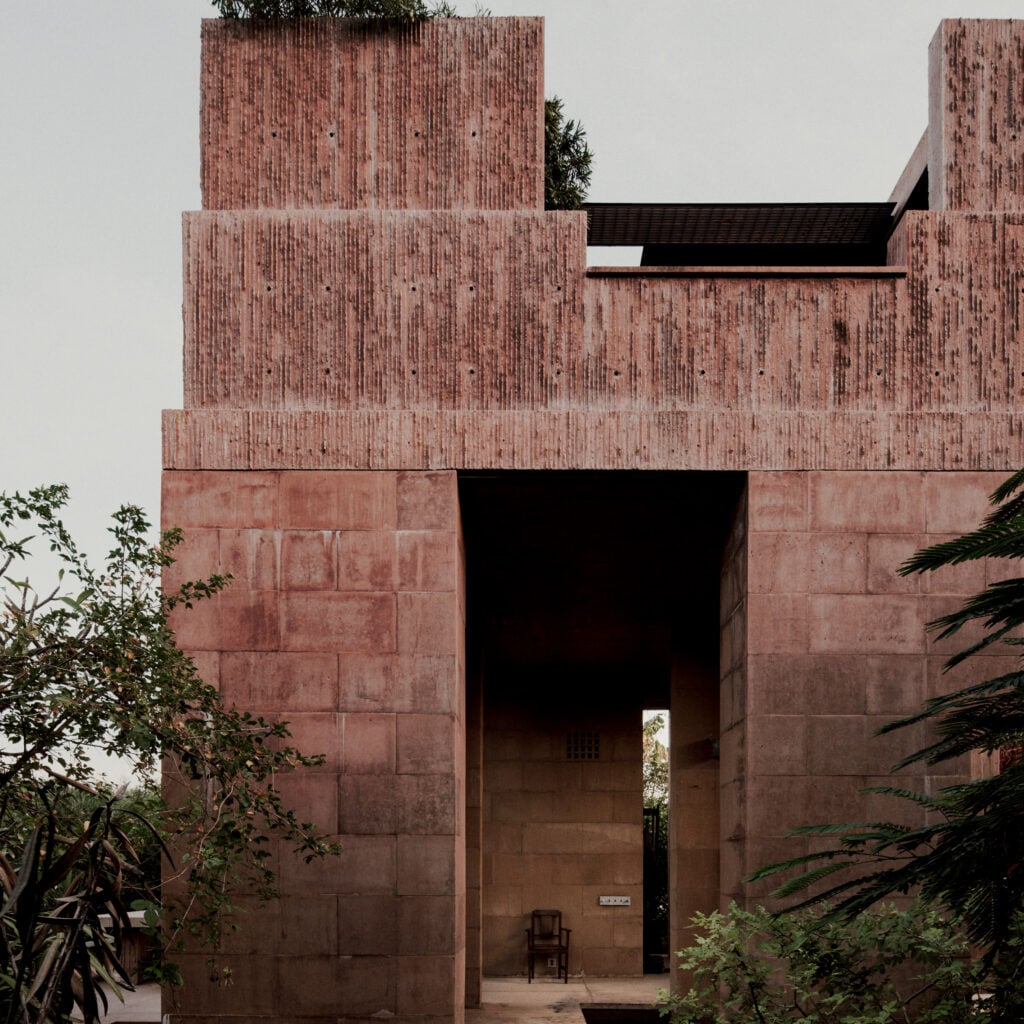
Mexican architects have been combining principles from ancient architecture with modern techniques. Curator and writer Su Wu picks five examples of this phenomenon from her Mesoamerican Modern book.
Wu's book, Mesoamerican Modern: Ancient Ideas in Contemporary Mexican Homes, details projects that illustrate this trend, from the 1970s to today, with a focus on residential architecture.
"These homes reflect the complex aesthetic cultures of Mesoamerica," Wu told Dezeen. She chose the phrase that titles the book over "pre-Columbian" because she wanted to demonstrate that the monumentalism and logic of pre-Columbian Mexican architecture did not end with colonisation.
"I think these homes show instead that rather than being relegated to the past, these Mesoamerican materials, techniques, typologies, and forms are alive in the present and also perhaps inspiration or guides for the future."
Each shows aspects of monumentalism that recall the stone architecture of the wider Mesoamerican culture, while acknowledging the diversity.
The book tries to depart from projects that just use symbols and focus on the logic of the buildings, noting specific characteristics such as patios as intrinsic the the design.
"For me, the most defining characteristics of Mesoamerican architecture are the ones that reflect underlying principles, rather than the disjunction when symbols become separated from their meaning," Wu said.
"So throughout the book I wanted to highlight forms that arise from ideas such as the use of light or shadow as a physical object, or how homes are aligned to natural features, or the everyday presence of craft and the handmade, with an expanded sense of beauty as an attenuating consequence."
Read on for five examples of the Mesoamerican modern style in Mexico with commentary by Wu.
Casa Amalia, Agustín Hernández, 1973
"This 1973 home is one of a few 20th-century homes in Mesoamerican Modern, built by architect Agustín Hernández for his sister Amalia, the founder of Mexico City’s Ballet Folklorico.
"A poet as well as an architect, Hernández is celebrated for injecting 'Mesoamerican semantics into the brute vocabulary of modernism', but wrote most of all about the geometric and cosmic principles at the heart of Mesoamerican architecture, and the 'mathematical, almost symphonic rhythm' of Mesoamerican structures and cities.
"His sister Amalia’s home was inspired by the convex forms of seashells as well as by the prominent ocular motifs in Mesoamerican imagery. "
Casa Mobius by Ernesto Gómez Gallardo, 1974
"Built by the architect for his own family in 1974, this house in Mexico City’s San Jeronimo neighborhood is today the studio and home of ceramicist Perla Valtierra.
"Shaped loosely like a mobius strip, with a triangular lattice allowing spaces to fold in upon themselves and a cantilevered living room, the home reconsiders both volumes and typologies, in rooms that are anything but square.
"The house is furnished with an eclectic mix of iconic Japanese, Brasilian and Mexican furniture, including a chair originally designed for the Museo Experimental El Eco in Mexico City by its founder Matthias Goeritz, a close friend and frequent collaborator of Luis Barragan."
Casa Terreno by Fernanda Canales, 2018
"Architect Teodoro González de León once described the patio as a defining characteristic of a Mesoamerican home, a space that is at once enclosed and exterior, and open to the elements.
"In this house in Estado de Mexico, Mexico City-based architect Fernanda Canales reclaimed land that had been devastated by cattle overgrazing, creating an interlocking series of patios that, in their deliberately undefined sense of function, create more space without having to build more of it.
"Each room in the home, which is approached through a pyramidal foyer with an opening to the sky, looks out onto courtyards or landscape, replete again with plants of the Americas."
Casa Cometa by Taller Mauricio Rocha + Gabriela Carrillo, 2019
"In this home inspired by the spatial organization of ceremonial Mesoamerican sites, communal areas extend horizontally, while private spaces descend and rise vertically, like a dramatic bedroom tower with a daily view of both the sunrise and the sunset over the Pacific.
"With its overlapping platforms and passageways, the space designed by Gabriela Carrillo and Mauricio Rocha reflects the multiple planes of existence in Mesoamerican cosmology.
"In this house, a walkway weaves under the swimming pool, which itself slips under a long orthogonal platform, cut through with a descending staircase."
Casa Monte by CH Matos, 2024
"Casa Monte is a one-bedroom house with no exterior doors. Instead, the house deliberately discourages approach by appearing like a fortress over the tree line, and by its placement on a stepped platform, which creates a sense of separation from the jungle floor below.
"The open space with a pool cutting across the interior suggests the idea that architecture exists foremost as a way to engage with nature.
"Cast by Matos himself in earth-tinted cement on the beach where the house now sits, the home’s hundreds of individual forms were fitted together on-site."
The post Five examples of Mesoamerican modern architecture appeared first on Dezeen.