
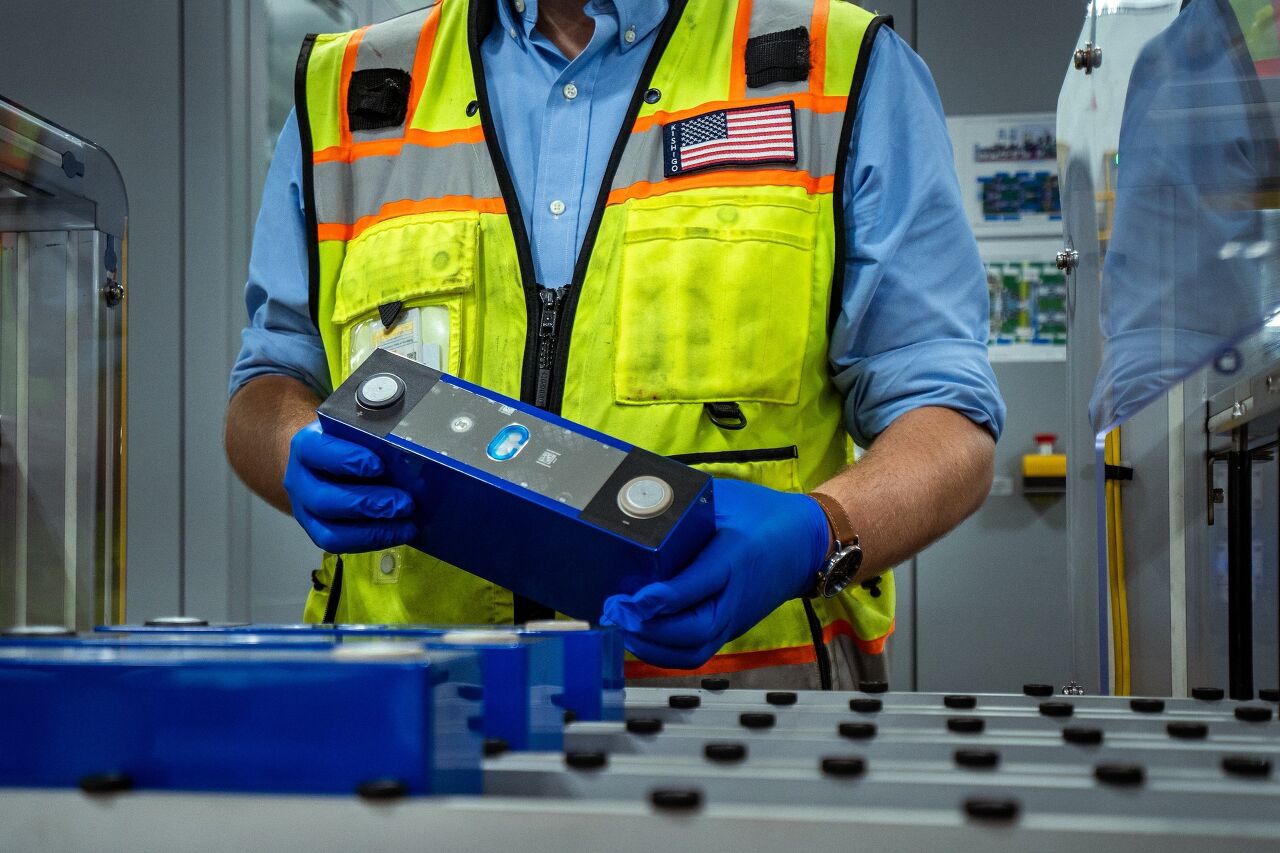
Ford has a team dedicated entirely to battery abuse, design, and testing. That group spends its time doing the opposite of what most engineering teams do: it searches out the weak points, pushes cells past their limits, and studies exactly how they come apart. The point is to understand failure at a level deep enough that failure becomes designed-out, and the work starts before a single production cell exists.
That mandate matters more than usual right now, because Ford is using it to validate a new class of batteries at its BlueOval Battery Park near Marshall, Michigan, where the company has begun producing lithium iron phosphate (LFP) packs. Those packs will power the Ford Fathom pickup, a truck Ford says will launch a new generation of far better, more profitable EVs. If the batteries turn out to be fragile, the entire strategy stumbles.
The team's job is to find edge cases. Wes Thibault, who serves as chief engineer for Ford's global energy storage systems, describes a group that probes the limits of the chemistry, the individual cells, and full production-spec packs. Thibault, who also goes on record leading battery product development as global chief engineer, told reporters at the Marshall plant that the team wants to grasp, at the physics level, the way a cell fails and why, so that when it does fail, that failure stays away from the people in the car.
The crucial detail is sequencing. The abuse team is built into the design process from the start, not handed finished cells and told to make them indestructible after the fact. Ford treats failing batteries early, and drawing lessons from those failures fast, as a priority. Break it first, then build around what breaks. That is the inversion that separates this approach from the usual validation checkbox.
A large chunk of the work centers on how a cell releases pressure. The team studies the way cells vent, a process that stops a battery from catching fire or destroying itself when it overheats. The mechanism is straightforward enough: when a cell gets too hot, its electrolyte heats up and releases gases. Trap those gases inside, and you risk short circuits or thermal runaway.
Ford does not wait for a physical cell to study this. Thibault says his team can model venting analytically with computers before the cells are even validated. To see inside a cell during physical testing, engineers used CT scans to examine the jelly roll and watch how it responded.
The reason the abuse work carries so much weight is the design philosophy behind the new platform. Ford's UEV architecture treats the pack as a load-bearing piece of the car's crash structure. Vladimir Bogachuk, who runs advanced vehicle structure architecture as chief engineer, frames it as a break from tradition, where the battery is treated as a fragile jewel surrounded by heavy bracing. “The battery is not a jewel you must protect,” he put it. He pushes a less-is-more philosophy for the platform, stripping out parts where possible and demanding that any remaining part serve more than one function.
So Ford stripped out the armor and built a pack that doubles as both a power source and a crash structure. The UEV pack is engineered to absorb as much as 40% of side-impact loads, and it counts as part of the vehicle's crash cage. CNET was shown a video of the pack being crash-tested. The design team's working mantra was blunt: “don't assume a cell must never deform.” Removing the extra protection yields an EV that is lighter, more efficient, and sharper to drive.
The chemistry makes this possible. The platform pairs LFP with prismatic cells and jelly-roll construction, a combination picked for cheap manufacturing, tolerance of hot and cold extremes, a fit for bidirectional energy use, and the knack of deforming while staying inert under the loads it was built for. The aluminum prismatic cans that enclose each jelly roll also provide structural support and help dissipate heat across the pack.
This is where the abuse team's findings become structural. Ford's engineers say the vehicle will stay free of fire or explosion even as cells bend in a crash, and Ford crash-tested the pack, with video showing the shell and prismatic cells bending violently under force. The company's argument is that an impact severe enough to crumple the battery would also deform the chassis of any gas-powered or traditional EV, so the car is likely totaled either way, and in that scenario, the driver is still safe from thermal runaway and fire. That claim only holds if you have studied, cell by cell, exactly what deformation does.
Beyond the abuse team's edge-case hunting, the broader validation regimen is punishing. Ford's program tests structural strength and load-bearing capacity, heat soak from minus 40 to 140 degrees Fahrenheit, IP67 water resistance, humidity cycling, and runs at both high charge and high discharge. For vibration, the battery, along with the seats and brackets, is strapped to a machine that works it across roll, pitch, yaw, and a range of harmonic frequencies. Ford can also stack these stresses, running humid heat soak, vibration, and high discharge all at once. The full program includes surviving more than 150,000 miles of simulated everyday driving.
The quality checks on the line are just as dense. Materials and finished cells undergo thousands of quality checks, drawing on CT and X-ray scanning, laser measurement, camera inspection, and AI monitoring. When anode slurry is coated onto copper foil, lasers scan every millimeter for wrinkles. Near the end, cells are blasted with helium to hunt for leaks, and a finished pack then rides a hydraulic shaker that replicates years of road use, one that can twist, dive, squat, contort, and yaw through everything a car sees.
Ford also sabotages its own line on purpose. Engineers feed intentionally damaged components, called “red rabbits,” into the line to verify the quality systems flag them. If something slips through, every employee can halt production, affected cells are quarantined by time period, and Ford claims it can trace flagged components straight from the line to the specific vehicle they land in. None of this sets Ford apart; rigorous quality checks like these are standard across major battery makers, all of whom want to minimize scrap on expensive cells.
Ford has reason to be careful. The company has absorbed steep warranty bills, and the Mustang Mach-E and F-150 Lightning alike have run into problems connected to their high-voltage batteries. Some early Mach-Es went back for recall after battery contactors overheated during DC fast-charging, and Ford recalled a handful of F-150 Lightnings in 2023 over defective cells.
The counterweight is durability data Ford has released. The first model year of Mach-E batteries has come through well after six years and many miles, and Ford's figures show high-mileage Mach-Es at 100,000 or even 200,000 miles with little range loss. That history matters because the UEV packs use a chemistry and construction very different from the earlier Mach-E generation, with long-term results not yet known.
It is worth keeping the stakes in perspective. Many drivers see an EV battery as a part that could explode, but statistically EVs match or beat internal combustion vehicles for crash safety and are far less prone to fire.
The honest answer on the new chemistry is that the verdict is not in. The LFP technology is licensed from CATL, the world's largest battery maker, though Ford says its own people helped develop the packs early on, with durability as the goal. Ford also passed on solid-state batteries, which aren't ready at the scale and price the Fathom needs.
The Fathom is expected to reach dealerships in late 2027. Once the first trucks are on the road, Ford plans to gather field data from the fleet to refine validation for future EVs. That is the test that matters. The abuse team can model venting and bend cells in a lab all it wants, but durability is settled on the road over years, not in a press demonstration. Until the odometers climb, treat the engineering story as a credible plan rather than a proven result.
[Images: Ford]
Become a TTAC insider. Get the latest news, features, TTAC takes, and everything else that gets to the truth about cars first by subscribing to our newsletter.