
I’m completely baffled by what has happened in the United States over the last decade.
Whenever I read a news story about something I know well - startups, venture capital, or AI - I immediately see the posturing, positioning, spin, misdirection, and deceit. Some of it is sloppy reporting. A lot of it is someone with an agenda who got their version of the story printed. And this is just the news. I expect everyone reading this knows the next level down of the misinformation and deceit, which are endlessly created and amplified by social media, blogs, and newsletters.
Michael Crichton came up with the idea of Gell-Mann Amnesia. You read an article about something you know, notice it’s wrong, and then turn the page to a story about something you don’t know and believe it. I don’t seem to have the amnesia part. If the stories I can check are full of bullshit, I assume the ones I can’t check are too. That leaves me with a lot of narratives, tons of bullshit, endless skepticism, and not much understanding.
I’ve also always understood things better from books than from newspapers, television, or social media. I don’t read any social media anymore, although I do broadcast to X and LI. I stopped reading the news with any consistency a while ago, regularly going for weeks at a time without looking at anything and, when I dip back in for some reason, I bounce out after a week or so in disgust and exhaustion. I never watch news on television.
I read a lot and vary my diet. Recently, I’ve added contemporary political history to my reading diet. It sits alongside the usual mix of startup books, novels, and an unreasonable amount of science fiction and fantasy. I’ve been reading about a book a month in this category. It’s been interesting, and I feel like I’m working on a giant Liberty Puzzle where I’ve finally got a few pieces put together and some of the pieces organized into groups that seem related.
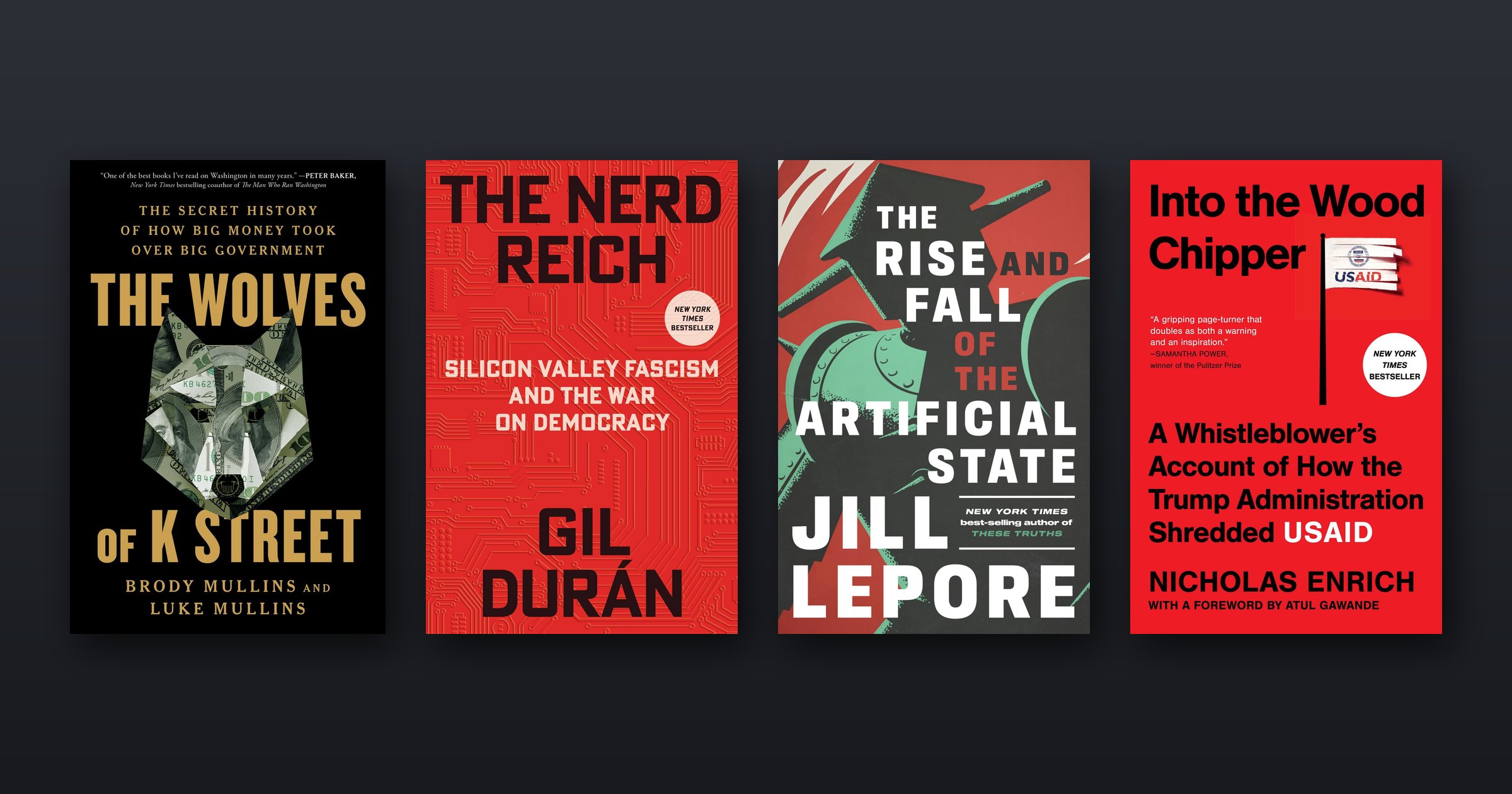
I started with The Wolves of K Street: The Secret History of How Big Money Took Over Big Government by Brody Mullins, a Pulitzer Prize-winning Wall Street Journal reporter, and his brother Luke Mullins. It opens like a thriller, with a pharma lobbyist’s suicide at a Virginia golf club, and then follows three lobbying dynasties from the 1970s to today: Tommy Boggs on the Democratic side; the Republican shop of Charlie Black, Paul Manafort, and Roger Stone; and Tony Podesta.
The book is a 50-year account of the center of power in Washington moving from elected officials to the people paid to influence them. Both parties built this machine. At one point Podesta, whose brother John was Bill Clinton’s chief of staff, ends up working alongside Manafort on behalf of Viktor Yanukovych’s party in Ukraine. By the end, Silicon Valley is one of K Street’s biggest customers.
Over the past two years I’ve had a small taste of how policy gets made in Colorado. This book is that, at the federal level, with a lot more money and a lot fewer scruples.
Next was The Nerd Reich: Silicon Valley Fascism and the War on Democracy by Gil Durán, a longtime San Francisco journalist. This one is about my industry, so I read it the way I read a news story about startups - looking for the places where the author got it wrong.
Durán traces a line from a 1997 book called The Sovereign Individual, through Peter Thiel, to Curtis Yarvin, a blogger who argued that the United States should be run like a company by a CEO with the powers of a monarch. From there it runs through Balaji Srinivasan’s network state, Elon Musk spending close to $300 million to help elect Donald Trump in 2024, and DOGE.
None of it comes from secret documents. Durán mostly quotes what these people wrote and said in public, often for years. The political shift in the Bay Area and among many in tech felt dramatic and sudden to me, but as I read the book, I realized it had been developing in plain sight for over a decade.
Then I read Jill Lepore’s The Rise and Fall of the Artificial State. Lepore is a Harvard historian and a staff writer at The New Yorker. I’ve read most of her books and have always found them fascinating and full of new things for me. Her Artificial State is both a fantasy held by a very small number of very rich men - government by machine, rule by automation - and a reality we already live in, where public conversation happens on privately owned platforms built to sell attention.
She starts with the census in ancient Mesopotamia and works forward through a century of science fiction. One line stuck with me:
the architects of the Artificial State seem to have read these stories, unironically, as instruction manuals, guides for how to build robots that would one day rule the world
I’ve read a lot of science fiction, including a number of the books she refers to as instruction manuals. The idea that people take them literally is terrifying. I encourage any of them to read more Philip K. Dick. It’ll be better for their soul.
Lepore calls it “a grumpy book” herself, which I appreciated.
Last night, I finished Into the Wood Chipper: A Whistleblower’s Account of How the Trump Administration Shredded USAID by Nicholas Enrich. After three books about money, ideas, and power, this one is about what happens when they suddenly and aggressively land on a specific organization.
Enrich spent twelve years at USAID and was the acting head of global health when DOGE arrived in early 2025. The title comes from Musk’s post that he had spent the weekend “feeding USAID into the wood chipper.” During an Ebola outbreak, Enrich and his team were trying to restart the contracts that paid for the response while political appointees said publicly that the response was underway. I remember the news reports as this unfolded. Having them put together in a first-person account, including all the gaslighting, lies, and misdirection from new political appointees, electeds, and other public figures, wasn’t enjoyable to read, but it was useful to have all of this in one place to understand. At some point Enrich told his team that their job was no longer to restart programs. It was to bear witness. On March 2 he emailed current and former colleagues documenting what was happening. The email leaked, and he was placed on administrative leave the same day.
DOGE is a chapter in Durán’s book. In Enrich’s book, it’s the people who showed up and broke the thing he had spent his career building.
I’m aware that all four of these books lean in the same political direction. While a book has a narrative and a bias, in these cases the authors show their work - names, dates, documents, and quotes - for several hundred pages, and anyone can go check it.
If you have a book (not blog posts, not tweets, not op-eds, not YouTube links) that would make me argue with any of these four, send it my way.
I’m still very confused.