
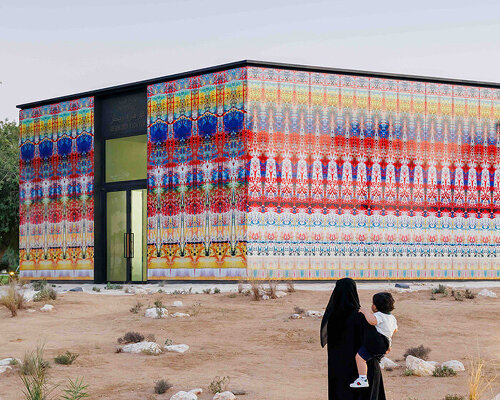
Gerhard Richter‘s permanent pavilion in Doha, Qatar is now open, conceived as a freestanding work of art and architecture in MIA Park, outside the Museum of Islamic Art. Realized in collaboration with Selldorf Architects, Doha Pavilion: Gerhard Richter houses a collection of the artist’s paintings and sculptures, including works created specifically for the project. The hexagonal structure translates Richter’s exploration of abstraction, repetition, and perception into space, while its patterned exterior draws connections with the geometric traditions of Islamic art (find designboom’s previous coverage here).
The six exterior walls of the pavilion feature decorative patterns derived from Richter’s Abstract Painting (724-4), created in 1990. The artist developed the compositions through a mathematical process that began in 2010, digitally dividing the original painting into progressively smaller vertical strips, eventually reaching 8,192 sections. Each strip is mirrored and repeated to produce a symmetrical horizontal pattern, applied to the pavilion’s exterior. The intricate patterns recall the repeating geometries and interlaced arabesques found in Islamic visual culture, establishing a connection between Richter’s experimental approach to abstraction and the artistic traditions of the region.
exterior waterfront view of Doha Pavilion: Gerhard Richter in MIA Park, Doha. Artwork © Gerhard Richter 2026 | image by Iwan Baan, courtesy of Qatar Museums
new strip paintings and mirrored interiors define the pavilion
Τhree new large-scale works from Richter’s Strip series, which began in 2011, are displayed throughout the pavilion. They translate the original abstract painting into thin horizontal slices, each measuring 0.08 millimeters wide, creating compositions built from fragmented color and repetition. At the center of the space stands STRIP-TOWER (2026), a tripartite freestanding sculpture designed by Richter specifically for the pavilion. Two large, floor-to-ceiling Mirrors, belonging to a body of work the artist began in the 1980s, occupy the narrower walls. Their reflective surfaces capture the artworks and visitors, producing shifting visual relationships and an evolving sense of space.
Outside the structure, a stone sculpture titled Brunnen (Well) extends the installation into the surrounding park. Richter’s idea for the pavilion dates back to a visit to Doha in 2013, when the artist was developing his Strip paintings.
The architecture and history of the city prompted him to consider how different strands of his artistic practice could come together in a permanent structure. ‘My trip to Doha in 2013 came two years into developing my Strip paintings, and the city’s architecture and history sparked an idea for a pavilion that could unite the thematic threads of that body of work,’ the visual artist explains. ‘Doha is the right place and the only place for my Pavilion.’
north entry facade view of Doha Pavilion: Gerhard Richter, featuring the artist’s Patterns. Artwork © Gerhard Richter 2026 | image by Iwan Baan, courtesy of Qatar Museums
a permanent addition to doha’s public art landscape
The project was realized in collaboration with Selldorf Architects and forms part of the legacy of the Qatar-Germany 2017 Year of Culture. Its location in MIA Park places it among a growing collection of public artworks by international artists, including Richard Serra, Nairy Baghramian, and Peter Fischli and David Weiss. According to Qatar Museums Chairperson Sheikha Al Mayassa bint Hamad bin Khalifa Al Thani, the pavilion aims to connect contemporary artistic practices with the geometric traditions of Islamic visual culture while making art accessible as part of everyday public life.
The unveiling coincides with the Qatar Creates Fall/Winter 2026–27 program and the inaugural edition of Rubaiya Qatar 2026, an international visual arts quadrennial running from November 21, 2026, through April 30, 2027. Rather than functioning solely as a space to exhibit Richter’s work, the permanent pavilion extends his investigation of abstraction into the surrounding environment. Visitors encounter the artist’s visual language through the building’s exterior, interior installations, and reflective surfaces, experiencing painting not only as an image but also as a space to move through.
looking southeast to Doha Pavilion: Gerhard Richter featuring the artist’s Patterns. Artwork © Gerhard Richter 2026 | image by Iwan Baan, courtesy of Qatar Museums detail of Gerhard Richter’s Patterns on the exterior facade of Doha Pavilion: Gerhard Richter, looking toward West Bay. Artwork © Gerhard Richter 2026 | image by Iwan Baan, courtesy of Qatar Museums detail of Gerhard Richter’s Patterns on the exterior facade of Doha Pavilion: Gerhard Richter, looking toward West Bay. Artwork © Gerhard Richter 2026 | image by Iwan Baan, courtesy of Qatar Museumsdetail view of Gerhard Richter’s STRIP-TOWER (2026) and (Strip) at Doha Pavilion: Gerhard Richter. Artwork © Gerhard Richter 2026 | image by Iwan Baan, courtesy of Qatar Museums
interior view of Doha Pavilion: Gerhard Richter, featuring STRIP-TOWER (2026) and works from the Strip (2024) series. Artwork © Gerhard Richter 2026 | image by Iwan Baan, courtesy of Qatar Museums Gerhard Richter’s STRIP-TOWER (2026), beneath the oculus of Doha Pavilion: Gerhard Richter. Artwork © Gerhard Richter 2026 | image by Iwan Baan, courtesy of Qatar Museums interior view of Doha Pavilion: Gerhard Richter, featuring STRIP-TOWER (2026) and works from the Strip (2024) series. Artwork © Gerhard Richter 2026 | image by Iwan Baan, courtesy of Qatar Museums view of Doha Pavilion: Gerhard Richter in MIA Park at dusk, featuring the artist’s Patterns on the exterior walls. Artwork © Gerhard Richter 2026 | image by Iwan Baan, courtesy of Qatar Museums
project info:
name: Doha Pavilion: Gerhard Richter
artist: Gerhard Richter | @gerhard.richter
architectural collaboration: Selldorf Architect | @selldorfarchitects
location: MIA Park, Doha, Qatar
client / institution: Qatar Museums | @qatar_museums
The post gerhard richter’s pavilion opens in doha, wrapped in patterns inspired by islamic geometry appeared first on designboom | architecture & design magazine.