
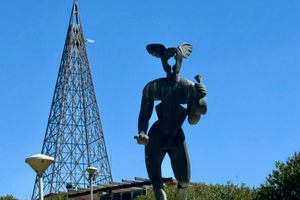
You don’t normally expect to encounter the gods of Olympus while strolling through a suburban park outside Madrid. But Alcorcón, a city better known for apartment blocks and shopping centers than classical mythology, has quietly created its own version of Mount Olympus—and it comes complete with a solar system.
La Ribota Park, on the southern edge of the city, is an unassuming place: a pleasant patch of greenery where locals come to walk, relax, and escape the surrounding urban landscape. Yet scattered among its fountains is an entire celestial pantheon, the work of painter, sculptor, and landscape artist Ángel Aragonés. At the center is Apollo, representing the Sun. From his enormous fountain, paths radiate outward like planetary orbits, leading visitors toward the smaller fountains and their divine inhabitants.
There is Mercury, swift-footed messenger of the gods; Venus, goddess of love; Gea, embodying Earth; and Mars, Jupiter, Saturn, Uranus, Neptune, and Pluto. The sculptures are deliberately simplified and frontal, but their familiar attributes make each deity surprisingly easy to recognize. It is rather like discovering that your local park has been moonlighting as a classical mythology textbook.
Pluto, naturally, deserves special mention. The International Astronomical Union demoted the distant world to “dwarf planet” in 2006, but La Ribota has chosen not to recognize the cosmic bureaucracy. Here, Pluto remains firmly among the planets. And frankly, after traveling all the way to the edge of the solar system, the poor fellow deserves a place at the table.
The park is perhaps at its most atmospheric toward evening, when the changing sunlight transforms the sculptures and fountains with every passing minute.