
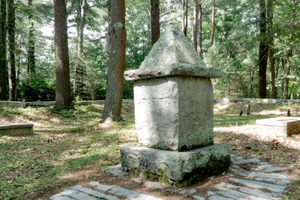
South of the town of Scituate (pronounced /SIT-you-it/), roughly a mile and a half from the Atlantic coast of Massachusetts, nestled in the second-smallest state park in Massachusetts, at the end of a secluded but luxurious residential street, is the gravesite of one of the founders of the United States, Justice William Cushing. You could drive by the entrance a hundred times and miss it each time. But this scenic little forested spot offers great scenery, a view of a secluded salt marsh, and the opportunity to pay respect to one of the people who helped build the republic as it is today.
Notable among his achievements prior to his nomination to the court, Cushing presided over Massachusetts's landmark case Commonwealth v. Jennison (1783), which declared that slavery was "inconsistent with our ... Constitution," thus abolishing slavery in Massachusetts, being the second of the states to do so (after New Hampshire). He also assisted in keeping the courts open during Shay's Rebellion and assisted in prosecuting the rebels. In 1789, as vice-president of the Massachusetts's convention, he presided over the state's narrow ratification of the United States Constitution. And notably, he was the last American judge to wear a wig as part of his official court dress.
He was among Washington's inaugural nominees to the newly founded Supreme Court. Official work on the court in those days was scant and the justices spent most of their time riding circuit, presiding over lower courts. His most notable opinion was a seriatim opinion in Chisholm v. Georgia, arguably the first significant case for the court as an institution. He also had the honor of administering the oath of office for George Washington's second term, being the first member of the court to do so in a tradition that extends to this day.
If you are driving west on Neal Gate St., south of Scituate, you will come to Judge Cushing Rd., though the street sign calls it "Cushing Park Dr." The street is flanked with stoneworks that form a modest gate to the road, one containing a brass plaque listing Cushing's achievements. A larger sign with similar verbiage is on the right, as well as a Scituate Heritage Trail marker. Turn on to the street and you'll pass a series of residences with incremental house numbers until you reach a cul-de-sac at the top of the hill with a sign indicating Cushing Memorial State Park and a trail entrance. Once on the trail, the grave plot will be immediately visible and reachable with a short 100-foot walk (or "hike," since it's officially a state park and all).
It's a lovely spot, "secluded in plain sight," that few visit or experience.