
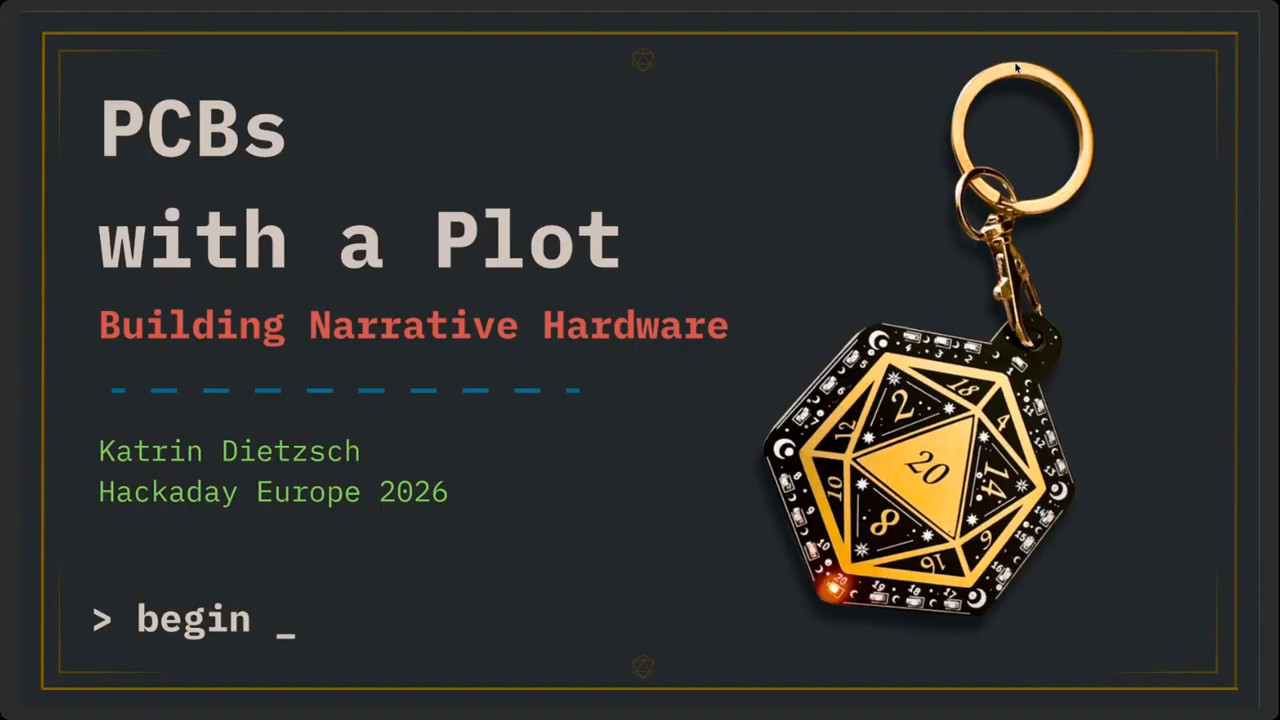
Printed circuit boards were developed first for function over form. They were a way to mount components and connect them in a stable, robust fashion, while taking into regard things like packaging and cooling requirements to enable a circuit to function. Circuit boards often end up looking cool in a techy kind of way, but their aesthetic is usually very much secondary to their actual purpose.
Katrin Dietzsch likes to use her PCBs a little differently, however. She designs boards that are intended to be a narrative tool for tabletop roleplaying, and came down to Hackaday Europe 2026 to walk us through the development of this very whimsical hardware.
Roll For ItKatrin starts her talk by explaining how she came to design circuits specifically for tabletop gaming. She saw an opportunity to combine her hardware hobby with the world of TTRPGs to help maintain both hobbies amidst a busy lifestyle. She also found that hardware she built could be a great artistic medium for supporting mystery and storytelling in the tabletop world. With the right design, her circuits became very much part of the narrative themselves.
Getting to see Katrin’s PCB D20 is a highlight of the talk. It’s a great example of creative board design.How does one create a piece that becomes special, rather than just being another art project thrown in a drawer, though? Katrin notes that meaningful objects are the ones that gather stories about them and gain emotional baggage, and thus, relevance. Interaction is also key; she relates the familiar tale that many of us have yelled at a printer before. We often anthropomorphize objects or assign them personalities just because they have some level of strange behaviour, or even if they just blink at us. Often, she’ll also start a build not from specs, but from story and the game itself. The questions asked are about how to engage players, and how to help them reach their goals, and answering those can help guide the design process.
There are also elements drawn from typical ideas around magic and artifacts that can be drawn from. For example, many tabletop roleplaying games feature the concept of attunement, where a character may have to physically and spiritually connect with an object to access its magical features. This is something that can be readily recreated in the electronic world with the use of things like capactive touch sensing. Katrin also notes that using RF can be great for creating items or puzzles that respond based on proximity, and there is all sorts of fun to be had with things like IR beams, motors, switches, or whatever else players can interact with. Code is also a beautiful place to hide secrets and easter eggs—you get to write the behaviour of the device to be as beguiling and confounding as you like.
You could use paper maps… or perhaps you could whip up a PCB with traces and solder mask and silkscreen and interactivity all woven together to create something altogether more compelling and interactive. There are grand possibilities in this space for your tabletop game to transcend the usual.There’s also the visual side of things. It’s something that should be remarkably familiar to anyone who has been to a modern hacker or maker convention and seen the wonderful variety of badge designs created by the community. Everything from the copper layers to the silkscreen to the very routing of the fiberglass board itself can be leveraged to create an art piece that captivates and inspires. Particularly in this era when it’s so easy to find board houses that will produce your designs with soldermask in all the colors of the rainbow. Katrin’s wonderful D20 PCB serves as the perfect example of these techniques being applied well.
Like any good tabletop aficionado, Katrin has a great sense of practicality too. There’s no point designing some fantastic electronic gizmo for your game if you can’t afford the bill of materials, can’t solder the parts, or your players can’t figure out how they’re supposed to use an in-circuit programmer to interact with it. Most of us live very busy lives, so our hobby projects have to be achievable within the constraints of our lifestyle. She also notes that it’s great if you build something with longevity, rather than something that serves only as a single-use tchotchke for a one-off bit.
If you’ve ever contemplated bringing your electronics skills to bear in your role as a dungeon master, Katrin’s talk is a great place to start. Your little creations can serve as a wonderful bridge between your player’s experience and the world of imagination you’re collectively creating, and that’s always a fun time!