
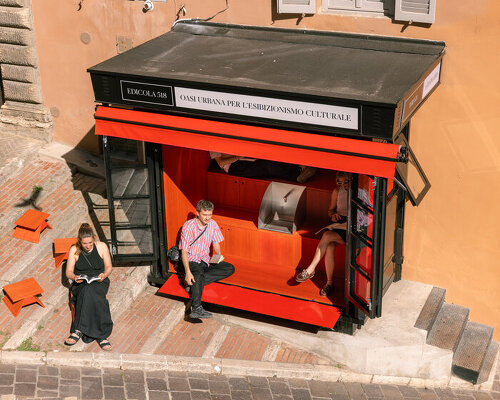
Located along the historic Sant’Ercolano staircase in Perugia, Edicola 518 is a renewed cultural kiosk and micro-architecture conceived by Italian designer Giuseppe Arezzi. Realized for the Laboratorio di Creatività Contemporanea open call, promoted by the Italian Ministry of Culture and won by Edicola 518 under the L’Edicola che Vorrei initiative, the project marks the site’s tenth anniversary. Reopening on June 1st, 2026, the intervention repurposes the historic newspaper kiosk typology, shifting it from a commercial sales stall into an open, community-oriented reading hub and public amenity.
all images by Giovanni Emilio Galanello, courtesy of Edicola 518
STEPPED OAK MICRO-kiosk EXTENDS READING space ONTO URBAN STAIRS
The project by multidisciplinary designer Giuseppe Arezzi preserves the original exterior envelope while applying a monochromatic red finish that establishes a stark chromatic contrast against the stone staircase. Inside, Arezzi replaces the conventional vendor-counter barrier with a stepped, multifunctional furniture installation built from lacquered oak, concealing technical compartments while providing integrated bench seating. At the core of the timber structure, a stainless-steel fountain supplies free drinking water to pedestrians. The window frames are re-engineered to double as external display racks for independent magazines and art books, while an exterior platform extends outward onto the historic steps to ensure seating remains accessible outside business hours. Extending the program into the public realm, the installation incorporates Ambo, a 20-centimeter-high modular stool-bookstand designed in collaboration with the Seed Festival to negotiate the stairway’s grade shifts as both mobile seating and a display surface.
Edicola 518 is sited along the historic Sant’Ercolano staircase in Perugia, Italy
‘Observing the location of the Sant’Ercolano staircase, I wanted to preserve the daily ritual that historically belongs to the newsstand,’ explains the designer Giuseppe Arezzi. ‘While people once stopped to purchase information, today they pause to process it through rest and reading. I interpreted the kiosk not merely as micro-architecture, but as a versatile, spatial piece of furniture, where every technical element is conceived to foster interaction and the free enjoyment of public space.’
a saturated red exterior preserves the original shell while marking a sharp chromatic departure the design removes the traditional barrier counter to foster spatial permeabilitystepped interior furniture is precision-crafted from red-lacquered oak panels
a central stainless-steel fountain provides free drinking water to the public the stainless-steel fountain is integrated into the timber structure updated operable window frames double as outward-facing publication display racks the project rethinks the newspaper kiosk typology as a civic infrastructure for reading the Ambo modular stool was created in collaboration with the Seed Festivalmeasured at a height of 20 centimeters, Ambo matches the elevation rise of the urban stairs
Ambo operates as both a portable low stool and an angled book display stand Italian designer Giuseppe Arezzi was commissioned to redesign the independent magazine kiosk the micro-architecture integrates functional public furniture within a historic urban contextexterior seating zones remain open and functional during evening hours when the stall is closed
project info:
name: Edicola 518 | @edicola_518
designer: Giuseppe Arezzi | @giuseppearezzi
development collaborator: Matteo Pettorali | @matte_petto
technical partners: Seed 360 | @seed360official, Umbra Acque
special thanks: Anouk Dee | @annoukdee
location: Perugia, Italy
photographer: Giovanni Emilio Galanello | @gegalanello
designboom has received this project from our DIY submissions feature, where we welcome our readers to submit their own work for publication. See more project submissions from our readers here.
edited by: Christina Vergopoulou | designboom
The post historic perugia newsstand reconfigures into stepped red oak mini reading kiosk appeared first on designboom | architecture & design magazine.