
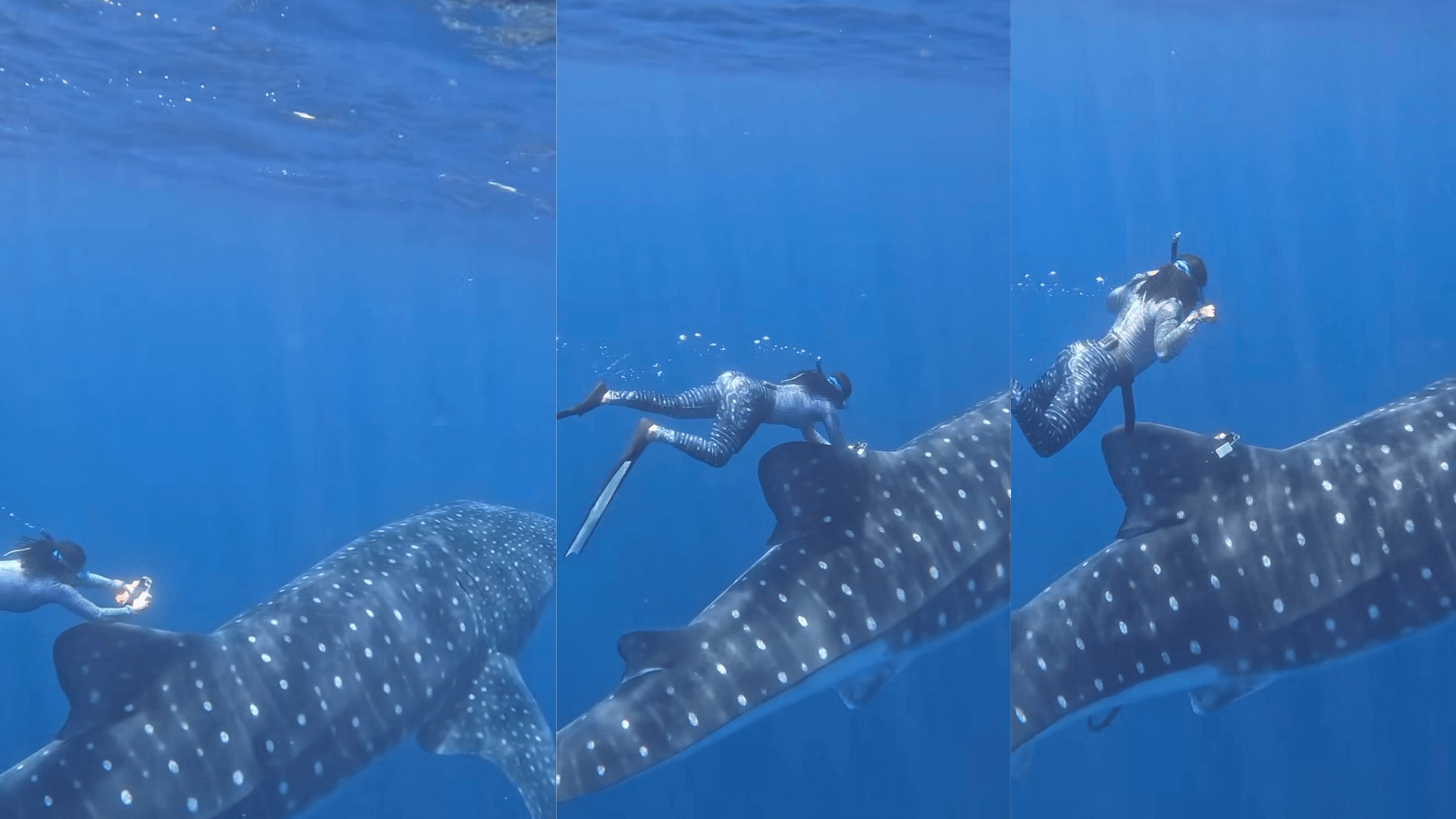
What does it take to swim up to the world’s largest fish and stick a monitoring tag on it? The patience of a saint, the flexibility of a bendy straw, and the endurance of an Olympic swimmer.
“Even though the shark looks like it’s swimming slowly, it’s definitely a lot faster than you are,” marine biologist and ace whale shark tagger Jaida Elcock, tells Popular Science. “Even if you have the best fins, you’ve got to have great endurance. It’s like holding your breath after sprinting.”
View this post on Instagram
Elcock is currently working on her PhD through a joint program between MIT and Woods Hole Oceanographic Institution (WHOI). She is studying the movement ecology and habitat use of two of the largest fish in the world, basking sharks (Cetorhinus maximus) and whale sharks (Rhincodon typus).
Elcock tagged this particular whale shark about 100 miles off the coast of New England, in the northeast canyon and seamounts region in northwest Atlantic. This area is a bevy of biodiversity, with plenty of plankton.
“There are whale shark aggregations all over the place. The Philippines, Mexico, Australia, tropical places like that. A lot of these aggregations are also often young individuals, subadult individuals, juveniles,” Elcock says. “Out in the [northeast] canyons, we’re seeing large adults. They are definitely of reproduction age and size, and that’s not really something that we’re able to reliably find very often.”
Unlike other tagging procedures, scientists can’t use baited hooks to quickly catch the shark, tag it, and release it, with whale sharks. These fish that can grow up to 60-feet-long are simply too big and are filter feeders, so they can’t take bait on a line the way a white shark or tiger shark can. To find sharks, it takes support from both land- and ocean-based crew.
“We get on a boat and we wait for a spotter pilot to come and tell us that there’s a shark at these coordinates,” says Elcock. “Once we get to the shark, we have to hope that it doesn’t just dive.”
Once they are near the whale shark, two people get in the water. One has a camera to take pictures or video to help identify whale sharks by the markings on their bodies. The other swims ready with the tag that will collect data on water temperature, the whale’s travel patterns, how deep its diving, and more. According to Elcock, the tracker looks like “a big bobby pin that you have to pry open with your hands and pull onto the shark’s fin.”
Whale shark tags will pop off on their own and have a radio transmitter so the team can retrieve them. Image: Jaida Elcock (@sofishtication_) / Woods Hole Oceanographic InstitutionOnce tagged, the big fish swims on its way and the tag will eventually pop off. A built in radio transmitter helps the team find its location, scoop it up, and analyze the data. Elcock is currently working on the data collected from last year’s tagging to see what they can tell us about why they are gathering in the northwestern Atlantic Ocean and what they are doing there.
While swimming this far out in the ocean next to one of the planet’s most majestic creatures is something most people will never experience, Elcock says it feels particularly surreal.
“I grew up in the desert, so being in a place where it’s only water, and I can’t see land is a very odd thing for me, even now,” she says. “There’s just a level of excitement. There are nerves about what if a tag doesn’t stay on, rather than what if some other animal pops up out of nowhere. We’ve had situations where we’re tagging a whale shark, we see a hammerhead just like hanging out over in the corner. So there’s a lot of life out there to see.”
The post How do you tag the world’s biggest fish? Fins and flexibility. appeared first on Popular Science.