
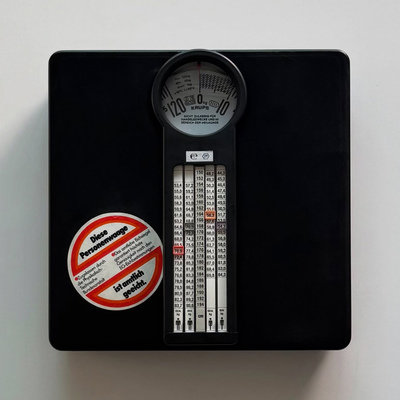
A bathroom scale has one job: To tell you how much you weigh. But in the 1980s, the industrial designers at Krups decided to go further, with their Data EG scale.
The scale contained a pull-out weight chart in the center. This listed different heights (in centimeters) in rows that indicated the "ideal" weights and "max" weights for both males and females.
You used a little plastic slider—red for the he of the household, orange for the she—to mark your relevant number.
The sticker on the left certifies the scale's accuracy.
It's quaint, by today's standards, and undoubtedly sought to capitalize on the fitness crazes of the era.
Also worth noting: Back then "ideal" weights were based on statistics compiled by life insurance companies, not medical bodies, starting in the mid-century. These figures were correlated with mortality, not physical attractiveness. The numbers did not take actual body composition, fitness, proportion of muscle to fat, etc. into account. If someone designed a scale like this today, the chart would contain considerably more columns.
This particular scale is in the collection of vintage goods reseller Wertwerk.