
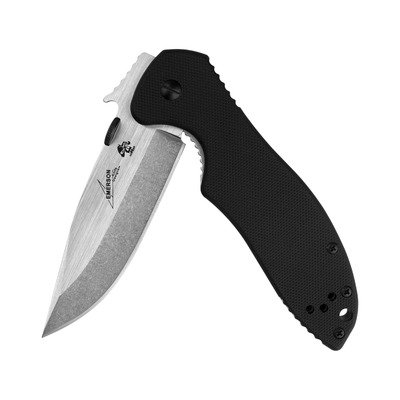
In the 1970s, Ernest Emerson was a machinist at Hughes Aircraft, an aerospace and defense company outside of L.A. Emerson was also an accomplished martial artist, having trained since childhood; the reason he moved from his native Wisconsin to California was not to work at Hughes, but to train at the Filipino Kali Academy run by the legendary Dan Inosanto.
Kali involves knifework, which Emerson gained expertise in. In 1979 Emerson, dissatisfied with combat knives available at the time—they were primarily fixed-blade designs, which are bulky to carry—resolved to create effective combat knives that could fold. With a background in precision machining, he was well suited to the task.
Emerson's knife-making was a hobby—evenings, weekends—until he attended the Pasadena Gun Show. There he learned there was an ecosystem of custom knife manufacturers, and that he could actually make his hobby his living. Before long Hughes had lost an employee, and Emerson transitioned to knife-making full time.
As his combat knives developed a reputation, Hughes was approached by members of a Navy SEAL team, who asked him to design a close-quarters combat knife for them. Emerson agreed, adding an unusual feature the SEALs had requested: A small protrusion behind the blade.
The purpose of this was to stop an opponent's blade from sliding along the spine of the blade and into the wielder's fingers.
Emerson produced the knives, but there was a snag—literally. During testing, the SEALs found that the protrusion would catch on the hem of a pocket, pulling the blade open as it was drawn.
This then became a feature, not a bug. Emerson realized the protrusion would provide a quick-draw feature other knives didn't have. It was as fast as a switchblade, without requiring a switchblade mechanism. Here's how it works:
Here it is in slow motion:
Today the feature, which is patented, is called the Emerson Wave and is well-known among combat knife enthusiasts. In addition to producing Emerson-Wave-featuring knifes thorugh his company, Emerson Knives, he also licenses the feature to prominent knifemakers such as Kershaw, Spyderco and Beretta.