
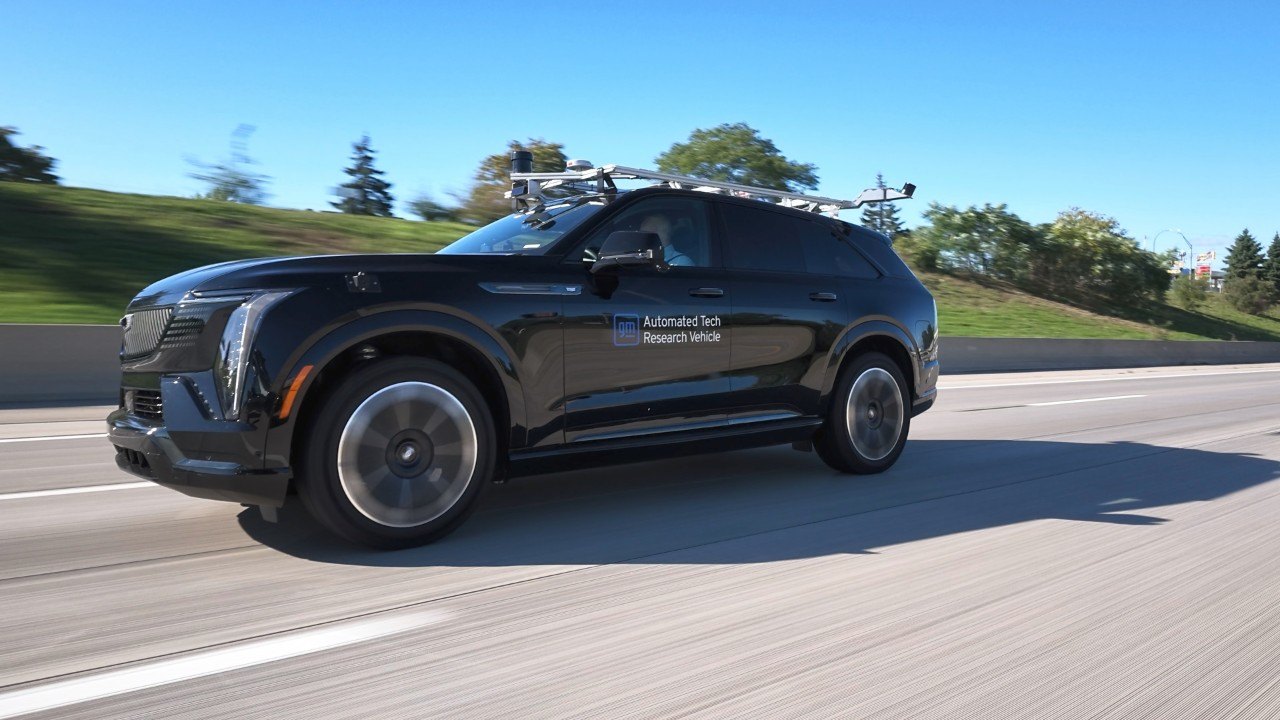
General Motors publicly teased its vision for the future last month, which entailed automated vehicles running errands for you.
While the primary goal was to promote the next-gen computing hardware that will eventually be installed into millions of vehicles, the pitch involved a hypothetical “Mission Mode” that would have automobiles effectively handle errands without a driver.
But how realistic is this scenario beyond the confines of a corporate press release?
While hands-free driving has enjoyed meaningful progress, eyes-free driving is what GM leadership believes should be its true long-term goal. This was also the topic of the company’s recent “GM Forward" event.
"We're changing what it means to drive, and transforming your car into an intelligent partner that makes your life easier," said CEO Mary Barra.
GM Chief Product Officer Sterling Anderson claimed that the plan would be to first implement a version of Super Cruise that could navigate any highway without driver intervention. Hands-free driving would allegedly give way to eyes-free driving that reduced the need for constant occupant monitoring before autonomous features would expand to all roads.
"Eventually, your car will be able to operate in what we internally call mission mode. Handling tedious tasks on your behalf, like picking up groceries and dropping off laundry without you even in it," Anderson stated.
OnStar would be at the core of everything. Serving as both a guidance system for self-driving features and the main way of interacting with subsequent AI assistants. However, tying everything into OnStar means that many of these claimed features would be tied to the automaker's preexisting subscription scheme. Of course, that assumes they’re actually coming to market as advertised.
I have admittedly been hypercritical of modern automotive technology. But there’s a big distinction between legitimate features that are gradually advancing production vehicles and ridiculous spectacles designed to drive hype. General Motors’ mission mode falls somewhere in the middle.
It’s not a stupid as promoting something like flying cars, which aren’t a concept seriously worth entertaining no matter what manufacturers say. However, it’s also not as grounded as contemporary hands-free driving — which has made tangible progress despite also being overhyped and helping to normalize some unsavory industry trends, like driver monitoring.
The issue with mission mode is that our society isn’t really set up to accommodate driverless cars running errands for you. While the industry has been pushing vehicles milling about without human occupants, real world encounters with test mules has showcased some real world friction. But, even if tomorrow’s autonomous vehicles should function flawlessly, the premise that they’ll be able to do everything for you is a pretty weak one.
Home delivery has become the norm for countless households, undermining the need for people to send their car out to bring items back home.
Granted, curbside pickup already exists at loads of businesses. Some even have staff members that are dedicated to loading up your vehicle, making it seem as though throwing an entirely self-driving vehicle into the mix should be a seamless affair. However, these services typically include additional fees and require shoppers to pull into a designated parking space at a designated time while likewise using a designated app to check in so an attendant knows to come to your vehicle.
Automating the vehicle half of the equation would require the business to make some alterations to how online orders are handled. At a minimum, there would need to be some limited collaboration between automakers and the applicable stores so the vehicle knows exactly where to park. The store would likewise need a way to notify the car that it’s been fully loaded so it can begin its journey back home.
These sound like simple changes to make. But years of testing has proven that sometimes the most basic obstacles can prove truly vexing for autonomous vehicles. While a person can simply see which parking spaces have the relevant curbside pickup sign, asking a machine to accomplish the same task with no previous frame of reference or training would border on being an insurmountable task. Stores would need to be able to communicate to the vehicle which spaces are reserved, likely using some form of geofencing and standardized physical markings.
That’s going to require some cooperation from the vehicle manufacturer and extra effort from the business itself. This could be a big ask from grocery stores that are already trying to save money by forcing customers to scan and bag items themselves.
These kinds of features are also likely to be dependent upon connectivity, potentially limiting their usefulness in regions where wi-fi signals are less reliable. While many advanced driving features can function using nothing more than modern sensing equipment and computers that have been physically equipped to the vehicle (e.g. lane keeping), others need help from the surrounding infrastructure.
This typically includes things like hands-free driving. A majority of systems won’t function on routes that haven’t previously been mapped and will eventually disable themselves should a vehicle go too long without access to GPS. We’ve also seen cases of autonomous test vehicles behaving erratically during power outages as the remaining cellular networks became overloaded.
General Motors is vying to get around this by continuing to build upon the 1.2 billion hands-free miles that have already been driven by Super Cruise customers. Modern networked vehicles take in a staggering amount of data, which is routed back to industry data centers. This is then supported by the automaker running an endless number of simulated encounters that the system can learn from. GM estimates that its stack presently drives more than 3 billion virtual miles each day.
This, combined with the pivot to software-defined vehicles running off an advanced, liquid-cooled central compute unit (above) that’s alleged to be “40 times faster” than what’s available on today’s vehicles, is supposed to help immensely. Vehicles will be subject to an endless stream of over-their-air updates allowing for constant improvement and new features. But it doesn’t absolve the need for connectivity. They’ll become more dependent than ever. But GM has said that it will also be upgrading and further integrating the internet into future models to feed cars as much information about the world as possible — which means it’ll be harvesting more data in the process.
Combined, this could be enough to keep a vehicle operating autonomously in conditions that were previously impossible. But it certainly doesn’t eliminate their need to be connected to a broader network, potentially limiting when and where drivers could take advantage of advanced features.
That’s not to suggest that they’re won’t eventually come a day where you can confidently send your vehicle out to do all manner of things without your needing to be in the driver’s seat. We’re just dubious about it happening within the next few years or being anywhere close to universally available. Autonomous vehicle development progressed quickly during those introductory years. But refining the system to a point where we could consider it bulletproof has taken significantly more work.
General Motors also isn’t making any definitive promises regarding the above. It has only stated that the next generation of hands-free highway driving would become available in 2028 with the Cadillac Escalade IQ and eventually trickle down to other models. While the premise of sending the vehicle out in “bumper-to-bumper traffic to pick up groceries or dry cleaning” was pitched, no timeline for those features was provided.
Instead, the company presented us with the buttonless Concept Horizon dashboard (pictured below) — which showcases the same austere, multipurpose interior space automakers have been pitching for years.
The lounge-like cabin has been a staple of industry trade shows for as far back as most of us can remember. Automakers want you to imagine a world where you can sleep or work inside your vehicle while it comfortably cruises down the road without human intervention.
While we’re arguably closer to that than ever before, we’ve also seen mounting pushback against autonomous vehicles. California and several other states have spent numerous years attempting to court tech companies and automakers by giving them free reign to test AVs as “robotaxis” on public roads. But firefighter unions and local governments in multiple cities have gone out of their way to condemn the test vehicles for blocking emergency lanes or causing accidents. Local residents have also protested the cars, calling them a nuisance.
Despite clear progress, public sentiment toward autonomous vehicles has grown more skeptical. There’s a sense that automakers have, like tech companies, been overpromising to encourage investment. Plenty of drivers likewise believe that the industry has been ignoring the fundamental principles of good product design in order to implement flashy gimmicks that help rationalize higher price tags. There’s a sense that automakers are chasing high-level concepts, like autonomous driving, while skimping on the core principles of drivability, reliability, or value.
However, the bottom line for many of us is just how painfully familiar General Motors’ autonomous vehicle sales pitch happens to be. Automakers have been promising do-it-all convenience features forever, with the end goal being a car that does literally everything for you. While this quest has certainly led to major innovations over the years, there’s nothing to suggest that we’re anywhere near the final leg of the journey.
That makes GM’s latest vision for the future feel a lot like past industry ambitions — plenty of which fell short of the mark. There’s been a long history of this, making those of us who track the trends incapable of being blindly optimistic. Electric vehicle adoption failed to land anywhere near the 2025 industry targets, Wankel rotary engines failed to take off as planned in the 1970s, and the same goes for all the turbine engine development that took place during the 1950s.
While voice commands have started to see more use, I’ve never met anyone who uses gesture controls. Yet the industry still seems keen to promote them on certain models. App-focused infotainment appears like it could be the next casualty, as many drivers simply don’t want to bother managing something that companies will eventually stop supporting. There’s currently an overwhelming consumer push for manufacturers to bring back physical controls and minimize reliance on touchscreens and app-based menus.
A lot of convenience features have sadly turned out to be wildly inconvenient.
Considering the many vulnerabilities of having vehicles dependent upon an internet connection and over-the-air updates, autonomous features may also fail to achieve industry goals. They’re already behind schedule and precious few automotive trends actually end up sticking around in the long run. However, barring extensive cyber attacks, it seems more realistic that they’ll persist in experiencing gradual (rather than rapid) progress.
The legal liabilities associated with them still persist in a gray area. Insurers are attempting to adapt in a manner that will ensure they still make truckloads of cash and automakers are doing everything in their power to shift responsibility onto drivers. The latter issue may change once Level 5 autonomous driving has been perfected. But that remains a very tall order. The same goes for maintaining owner privacy, which presently borders on nonexistent due to the fact that manufacturers want to hoover up as much information as possible to improve their own tech — with the added bonus of being able to sell that data to third parties.
What General Motors is pitching here isn’t new. This is the same line we’ve been fed by it and other automakers for years. The real question is how close to the fantasy the next generation of vehicles will actually be and what it will cost the public in terms of money and privacy to obtain it.
[Images: General Motors]
Become a TTAC insider. Get the latest news, features, TTAC takes, and everything else that gets to the truth about cars first by subscribing to our newsletter.