
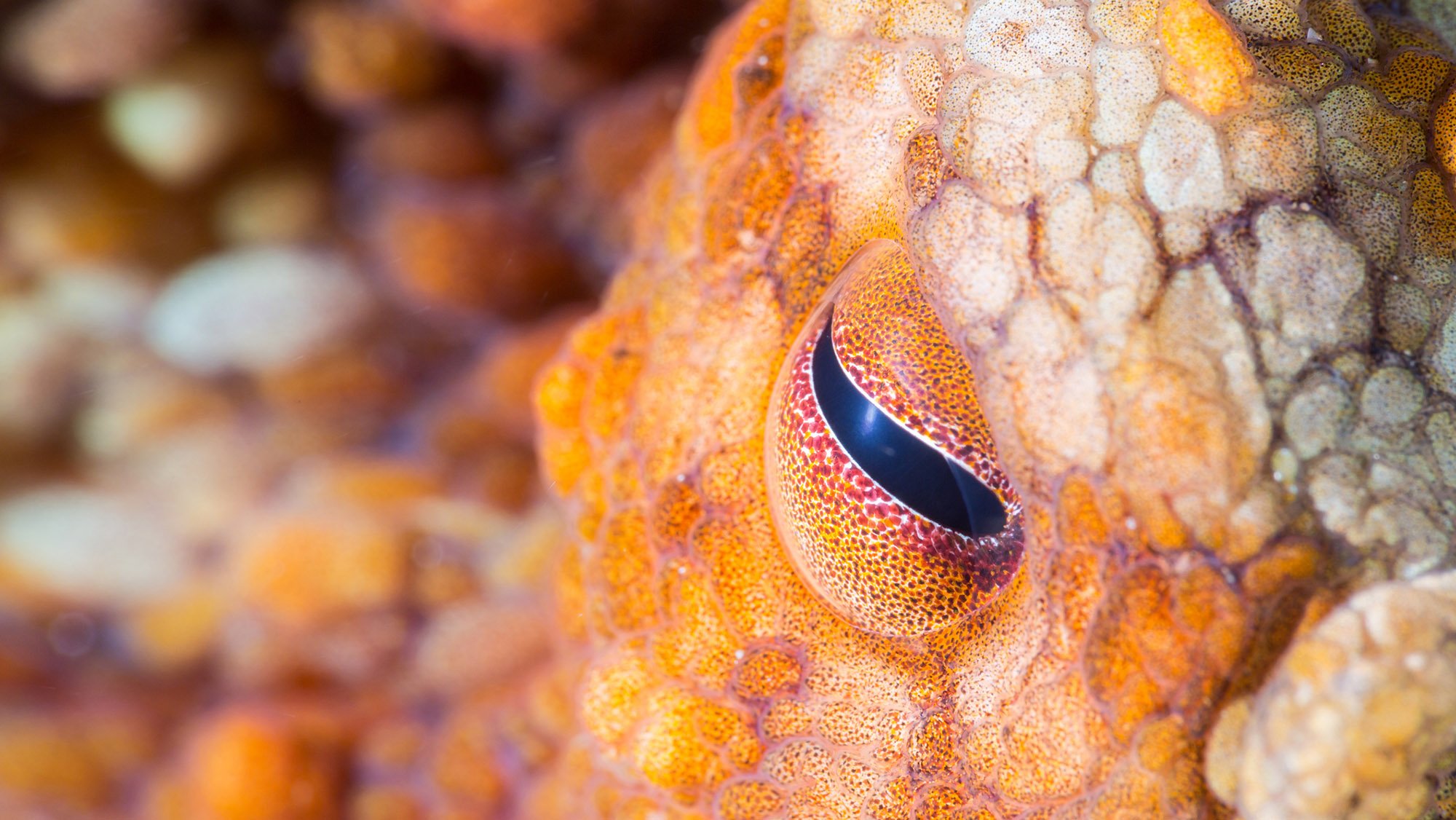
Part of its brain lives in its arms. It can see with its skin. It has no bones at all, allowing it to fit into any space larger than its beak—oh, and yes, it has a beak.
This might sound like some fever dream of a next-level alien. In fact, scientists do liken its strange anatomy to something extraterrestrial. But it’s not an alien at all: It’s an octopus, and it’s very much of this Earth. It just happens to be so different from us, it may as well “phone home” from another planet.
That difference goes back further than you might think: Humans and octopuses split onto separate evolutionary paths some 500 to 600 million years ago, long before the first dinosaurs. About the only thing we have in common with them is a mutual interest in multitasking.
Which makes it all the stranger that a team of researchers recently watched several California two-spot octopuses, named for the blue, eye-like spots beneath their actual eyes, pull off a feat typically reserved for our closest relatives: using a mirror to find something they couldn’t see directly. The recently published study marks the first time this sort of mirror-guided behavior has been documented in an invertebrate.
“It seems that the cognitive underpinnings you need to be able to do this [use mirrors] could be considered convergent evolution,” a phenomenon where unrelated species evolve similar traits, co-author of the new study Dr. Mary Kieseler tells Popular Science. If the eight-limbed mollusks really were using mirrors, “that is something octopuses have developed independently of us.”
So, can octopuses really use mirrors? And if so, what does that mean about their seemingly “alien” intelligence?
California two-spot octopuses typically only live for a year, dying after they have offspring. Video: You Oct to Know the Two-spot Octopus, Santa Barbara Museum of Natural History The setup: a tank, a mirror, and some hidden foodThe researchers initially considered studying the octopuses’ response to a classic “mirror test” of self-recognition. This mirror test usually involves marking a dot between an animal’s eyes (a location it wouldn’t usually notice on its own), then checking whether it touches that mark when it sees it in the mirror.
Great apes and elephants have an excellent track record of nailing this test, while our beloved pet dogs don’t exactly knock it out of the park. Lucky for them, they’re cute.
Applying the mirror test to an octopus is somewhat trickier: with skin covered in specialized sensory cells, there’s no guarantee it wouldn’t simply feel the mark. There’s also the practical consideration of marking an animal underwater.
“So we decided, let’s go a step before self-recognition and see if they can use mirrors as a tool,” says Kieseler, who worked on this study as a PhD student at Dartmouth College. “If they can do that, we can go from there.”
Learning the trickBefore the real test could begin, Kieseler says, she and her team had to ensure the octopuses were comfortable with the mirror and didn’t perceive it as a potential rival.
“You see videos where they put mirrors in the jungle, and the animals freak out,” she says. “So, the first step was to get the animal to understand that there’s no threat coming from what they see.”
Over time, the octopuses began acting normally in front of the mirror. The researchers knew they’d reached an appropriate comfort level once the octopuses were relaxed enough to chow down in front of their reflections.
“They normally wouldn’t do that [eat] in front of other octopuses, at least not this species,” she says. “That’s when we knew they were habituated, and we started teaching them how the mirror really works.”
With the octopuses habituated, the training began. Researchers placed a live crab inside a glass jar the octopuses already knew how to open, then hid it around a corner, out of direct view. The only way for the octopuses to see it was in the mirror’s reflection.
Initially, every octopus had an understandable reaction: They went straight for the reflection.
“Basically, all octopuses went straight to the mirror, because they saw the crab in there,” Kieseler says. “Then, when they were at the mirror, they could see: ‘Oh, it’s over there.’”
It took each octopus between 10 and 12 tries before learning to bypass the mirror and head straight for the jar.
Raising the stakesOnce training was complete, the octopuses faced a much bigger challenge. Each octopus was placed inside a small box sitting at one end of a testing tank. The box was walled on the back and three sides. It was open on the top and one side that faced a large mirror that covered the entire width of the aquarium. So basically if the octopus looked out at the mirror they would see the reflection of the other side of the tank. The octopus could exit through the box anytime by either going left, right, or up and over.
On the wall that the mirror reflected, a screen showed a moving virtual crab. The only way for the octopus to see the projected crab was as a reflection in the mirror.
Kieseler says the researchers used a virtual crab instead of a real one on purpose. “Octopuses have chemoreceptors, and we didn’t want them to smell or taste the actual crab,” she says.
This diagram shows how the octopuses were placed in the experiment. Image: Kieseler et. al ‘Current Biology’ (2026)In each trial, the fake crab appeared on either the left or right side of the tank, visible only in the mirror’s reflection. To get the reward (an actual live crab dropped into the tank from a compartment above), the octopus had to leave the box, turn all the way around, and travel toward whichever side the mirror had shown the virtual crab on.
Across dozens of trials, the octopuses chose the correct side around 70 percent of the time, a result multiple statistical tests found was unlikely to be a fluke.
Some overachieving octopuses did something the researchers didn’t expect. Instead of leaving the box the normal way and walking around to the back wall, they climbed straight up and over the box’s side wall, a sort of shortcut to the same destination. This wall-climbing behavior was seen in 59 percent of correct trials.
“One really cool thing is that one octopus did it on his very first trial,” Kieseler says.
Related 'Ask Us Anything' StoriesHow marine mammals stay hydrated in a salty sea
Why some animals eat their babies
What kind of animal is Gonzo?
Could a whale really swallow a human? We asked a biologist.
Jimothy the raccoon has a rare spinal condition. Here’s what that means.
Do any bugs live in the ocean? Short answer: Not really.
Not so alien after allAccording to Kieseler, moments like the wall-climb point to something bigger about what intelligence means for animals like octopuses. “Their understanding of their environment seems to be more 3D than ours,” says Kieseler, now a postdoc at the University of Fribourg in Switzerland. “We cannot just walk up a wall. The octopuses can.”
So, as fundamentally different as octopuses and humans are, our separate evolutionary paths may have led us to develop the same mirror-guided problem-solving ability, for entirely different reasons.
Octopuses hunt their prey by ambushing them and also need to stay alert for predators. This requires a fully three-dimensional understanding of their environment: They might need to scale a rock face or coral reef at any moment.
That instinctive ability showed up clearly during the experiment itself: Instead of taking the expected path, one octopus simply climbed straight up and over a wall to reach its reward. It’s not about admiring their own pretty faces; that same spatial awareness, built for hunting and evading threats in the wild, may be exactly what enabled them to effectively use the mirror as a tool.
It’s also a reminder, Kieseler says, that intelligence doesn’t always look the way we expect it to. “People often measure intelligence based on human concepts,” she says. “Humans tend to think the more removed it looks from us, the dumber it is.”
This sign of high intelligence from an animal that has been compared to an alien could say something meaningful about what “intelligent life” looks like.
“These animals are just very intelligent in their own way,” Kieseler says.
In Ask Us Anything, Popular Science answers your most outlandish, mind-burning questions, from the everyday things you’ve always wondered to the bizarre things you never thought to ask. Have something you’ve always wanted to know? Ask us.
The post How smart are octopuses? Smart enough to use mirror. appeared first on Popular Science.