
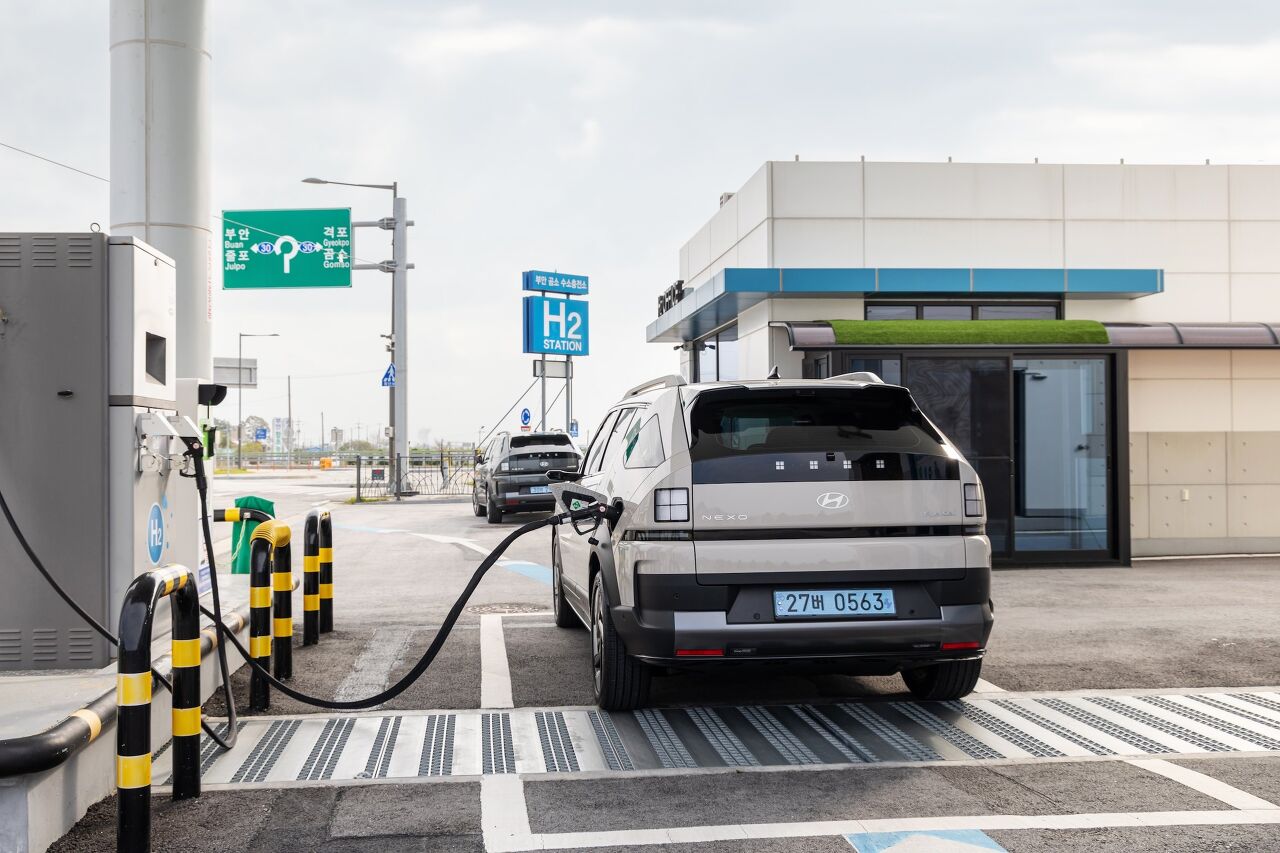
Hyundai's own executive has put a finger on why hydrogen passenger cars never found their audience: there aren't enough buyers, and there's almost nowhere to fill up.
The biggest challenge with hydrogen cars is finding customers, says Scott Nargar, senior manager of Future Mobility & Government Relations at Hyundai Australia. In the same breath, he argued the technology still has a future in passenger vehicles, problems and all. Both things can be true at once, which is more or less the state of the entire hydrogen car project right now.
The underlying problem is not the technology. It's the ecosystem around it. Almost no hydrogen refueling infrastructure exists, which means even a car that works flawlessly has to go hunting for a place to drink. Compare that to the alternative, where electric charging stations now blanket the map, with more coming, and the hydrogen car's core pitch starts to look shaky.
According to Hyundai, a fuel cell car works like a battery EV with one key difference: a fuel cell stack generates the electricity on the move by combining hydrogen from the tank with oxygen drawn from the air, rather than storing it in a big pack up front. The payoff is quick refueling and no harmful emissions, which is the whole sales pitch against battery EVs for anyone allergic to charging stops.
Range and refueling speed sound great until you look at the bill and the map. As the InsideEVs account of Nargar's comments notes, hydrogen cars cost more than comparable gas and electric cars, a gap that has only gotten harder to defend as new EV prices have dropped considerably over the past decade. So the buyer is asked to pay more for a car that's harder to refuel. That is not a winning combination.
The two biggest players have taken different routes to the same disappointing result. Toyota let California consumers actually buy the Mirai and, by all accounts, is still trying with it. Hyundai, by contrast, confined its hydrogen passenger program mostly to a handful of real-world trials. Neither strategy produced a volume business. BMW, General Motors, and Honda have all dabbled in fuel cell technology too, with varying degrees of success, which is a polite way of saying nobody cracked it.
If the economics are this grim, the obvious question is why anyone bothers. The answer Hyundai gives is diversification. Some automakers, Hyundai included, expect hydrogen to hold a spot in a future where gas and diesel are less common than they are now. The logic is to spread bets across multiple powertrain technologies rather than pile everything into batteries. The cost of that bet is steep: building a new fuel cell stack and standing up refueling stations involves huge expense, which is part of why so few stations exist in the first place.
There's also institutional pride involved. According to Hyundai, it decided back in 1998 to pursue fuel cell development, a call made with no guarantee of success and no immediate financial payoff. By the late 1990s, it had a working fuel cell prototype. The company now positions itself as having nearly 30 years at the forefront of the technology, and it has receipts: the first mass-produced fuel cell passenger car in the world and large-scale hydrogen trucks. At the INITIUM unveiling at the Hyundai Motorstudio in Goyang, South Korea, President and CEO Jaehoon Chang framed the company's hydrogen history as a story of commitment and bold moves. He noted Hyundai pushed forward on hydrogen through both the Asian and global financial crises, and called hydrogen the most abundant resource in the universe.
Hyundai's hydrogen story has a clear product lineage. According to Hyundai, the ix35 Fuel Cell launched in 2013 as the world's first mass-produced FCEV, the culmination of 15 years of research, with a range of about 369 miles per refuel. Then came the NEXO in 2018, Hyundai's second-generation fuel cell car, which collected a CES Editors' Choice Award and a Digital Trends Top Tech Award, offered a range of up to about 414 miles, and became the best-selling hydrogen passenger vehicle in the world. Being the best-selling car in a market this thin is less impressive than it sounds, but it is still a title.
A second-generation Nexo arrived in 2025, billed as a global model. Per the InsideEVs report, it drives roughly 435 miles on a full tank, runs a 110-kilowatt electric motor paired with a small 2.64-kilowatt-hour battery that buffers between the motor and the fuel stack. Hyundai also built the N Vision 74 concept in 2022, a tribute to the 1974 Pony Coupe concept that combines fuel cells with a high-performance battery for a range over about 373 miles.
The clearest statement of Hyundai's hydrogen intentions is the INITIUM concept, shown in 2024. According to Hyundai, it previews the design and technology of fuel cell vehicles Hyundai plans to put out, and a production version is set to launch. The concept targets a range of over about 404 miles, bumps motor output to 150 kW from the Nexo's 113 kW, and hits 62 mph in under 8 seconds. It also addresses the family-car side of the ledger with more second-row legroom and headroom, easier door angles, and a trunk that holds up to four golf bags.
Hyundai wrapped the INITIUM in a new design language it calls 'Art of Steel', meant to convey hydrogen's purity and strength, complete with 21-inch wheels, a gold matte finish, and lamps carrying the HTWO brand's four-dot Morse code "H". It is a confident-looking vehicle for a product category that still can't find a gas station.
If you're tempted by the long range and quick refueling, the honest read is that hydrogen remains a hard sell for private ownership outside the handful of regions with fueling stations. The cars work. The cars are clean. The problem is everything around them: the price premium, the empty map, and the booming EV alternative that keeps getting cheaper and easier to charge.
Hyundai will keep building these as a hedge and a point of pride, and the production INITIUM will give the technology another shot. Just go in clear-eyed. Nargar already told you the catch, and it's the same one that has dogged hydrogen from the start.
[Images: Hyundai]
Become a TTAC insider. Get the latest news, features, TTAC takes, and everything else that gets to the truth about cars first by subscribing to our newsletter.