
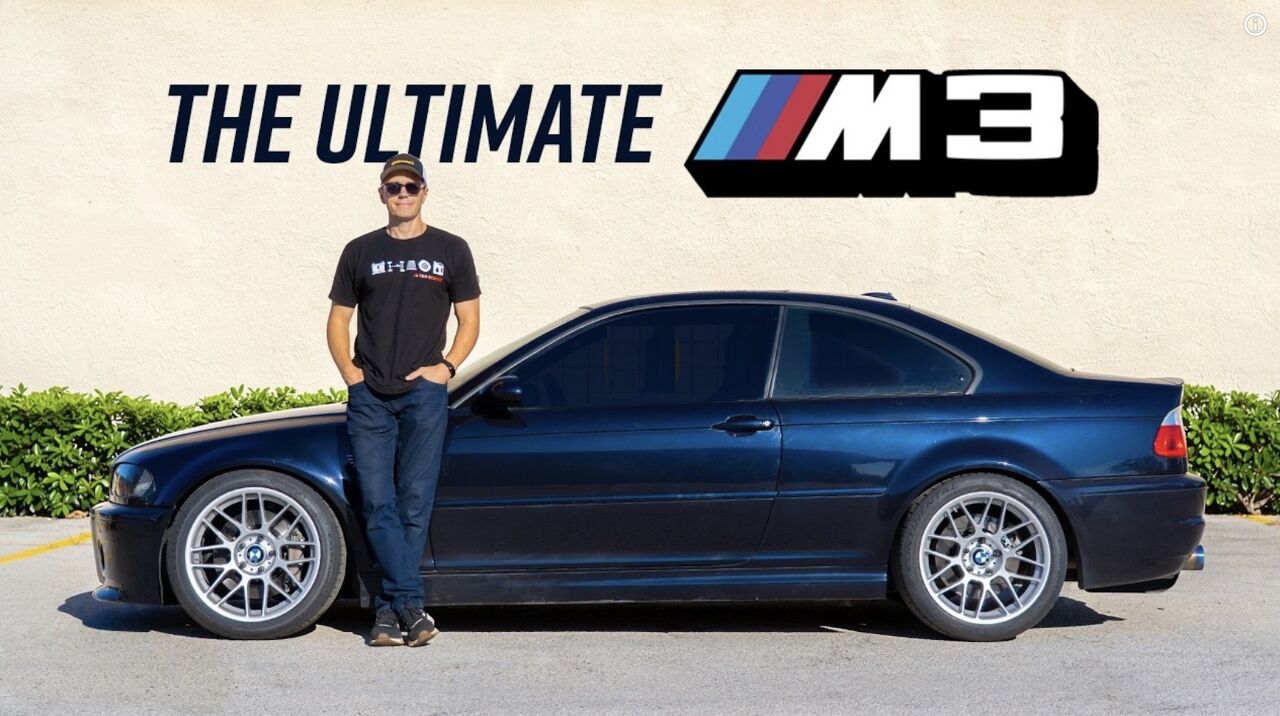
Did Pete just build the perfect BMW or is he high on his own supply? He brought his beloved 2JZ powered E46 M3 out of a 5-year hibernation to refresh this build and make it the street ripper he really wanted.
Speed Academy is a website and YouTube channel based on making things go fast and enjoying cars. Peter Tarach and Dave Pratte are the forces behind Speed Academy.
The TTAC Creators Series tells stories and amplifies creators from all corners of the car world, including culture, dealerships, collections, modified builds and more. An AI-produced summary of the transcript, edited by a staffer, is below.
[Image: Speed Academy/YouTube Thumbnail]
Become a TTAC insider. Get the latest news, features, TTAC takes, and everything else that gets to the truth about cars first by subscribing to our newsletter.
Summary
The video documents the final stages of a project to transform a BMW E46 M3 equipped with a Toyota 2JZ-GTE engine into a refined, powerful street car. The owner completes several exterior and interior upgrades, refines the engine's tune on a dyno, and takes the car for its first proper street drive.
The result is a car that combines the classic BMW M3 driving experience with the reliability and performance potential of Toyota's legendary 2JZ engine.
1. Exterior Styling and Finishing Touches
The owner completes the installation of an aftermarket CSL-style front bumper, giving the E46 M3 a cleaner, more aggressive appearance.
Key modifications include:
- Installing the CSL front bumper and aftermarket front lip.
- Leaving the intercooler exposed rather than hiding it behind the grille.
- Retaining the yellow high-beam headlights, following viewer feedback.
- Using 3D-printed spacers to eliminate gaps between the bumper and aluminum reinforcement bar.
- Replacing the original silver interior trim with black trim that has a subtle blue tint.
The owner is particularly pleased with the CSL bumper, describing it as a sleeker, more understated alternative to the original design.
The car rides on Apex ARC-8 wheels, measuring 18x9 inches up front with 245/40 tires and 18x10 inches in the rear with 275/35 tires.
2. Interior Improvements
The interior receives several upgrades designed to make the car feel more like an original BMW M3.
The owner installs a BMW M shift knob and reinstalls an original BMW steering wheel that previously belonged to a drift E46 M3 convertible.
Although the steering wheel has some leather cracking, the owner prefers its factory appearance over aftermarket alternatives.
Additional improvements include:
- Replacing the carbon-fiber airbag emblem with an original BMW emblem.
- Completing the black interior trim conversion.
- Removing the accelerator pedal's kick-down mechanism, originally associated with the car's SMG transmission.
The kick-down modification makes the accelerator pedal feel more natural in a manual-transmission car.
3. 3D-Printed Custom Airbox
One of the video's most interesting projects involves designing and manufacturing a custom airbox for the turbocharged 2JZ engine.
The original homemade airbox was functional but unattractive. The owner wanted a cleaner solution that would prevent hot engine-bay air from entering the intake.
With help from a friend who digitally scanned the engine bay, the team designed a custom airbox and duct.
The project involved:
- Scanning the engine bay to capture the available space.
- Designing a custom airbox to fit the existing intake duct.
- Printing the component using carbon-fiber-blend filament.
- Revising the design several times to improve fitment.
The resulting airbox fits neatly into the engine bay and accommodates the existing air filter.
Although the owner acknowledges that the design could be improved, the finished product is a significant improvement over the original setup.
4. Dyno Tuning and Performance Results
The BMW is taken to Lavine Motorsports for a tuning refinement session.
The objective is not to maximize horsepower but to improve drivability and make the car behave like a refined street machine.
The engine is running approximately 20–21.5 psi of boost on pump gasoline.
The dyno results are:
MeasurementMustang DynoDynojet-equivalentWheel horsepower475 hpApproximately 525 hpWheel torque426 lb-ftApproximately 471 lb-ftThe Dynojet figures include an approximately 10% correction factor.
The tuner also addresses a lean condition that occurred when the driver initially applied the throttle.
The engine is running well, and the tuner notes that the 2JZ has considerable additional power potential. However, the owner is satisfied with the current output and does not want to increase boost further.
An additional intake test is planned to determine whether the relatively small air filter is restricting high-rpm performance. However, the test is canceled when a coolant leak develops at a turbocharger feed-line fitting.
5. Mechanical Issues and Improvements
The coolant leak is traced to a failed O-ring in a swivel fitting near the turbocharger.
The tuner recommends a different fitting that moves the connection away from the hot exhaust manifold.
The owner plans to repair the issue before driving the car home.
The team also addresses the accelerator pedal's kick-down mechanism, which had made full-throttle operation unnecessarily difficult.
Removing the mechanism improves the pedal's feel and makes the manual driving experience more enjoyable.
6. First Street Drive
Once the car is repaired, the owner takes it out for a street drive.
The driving impressions are overwhelmingly positive.
The 2JZ delivers strong, smooth acceleration, with the turbocharger taking some time to spool before delivering a substantial surge of power.
The owner is particularly impressed with the engine's smoothness and the way the car puts its power down.
The car also benefits from several refinements:
- The air conditioning works properly.
- The factory steering wheel improves the interior feel.
- The manual shifter works well overall.
- The accelerator pedal is easier to operate.
- The floating brake rotors are quieter.
The main remaining issue is the manual transmission's second-gear shift.
Under heavy acceleration, the shift from first to second can be difficult, apparently because the drivetrain remains loaded. The owner believes this may require additional shifter or clutch adjustment.
Despite this issue, the car feels significantly more refined than before.
7. Final Thoughts: The 2JZ Versus the BMW S54
The owner concludes that the project has transformed the E46 M3 into a remarkably enjoyable street car.
The CSL-inspired exterior styling, interior improvements, revised engine tune and functional air conditioning all contribute to a more polished driving experience.
The central question is whether installing a Toyota 2JZ engine into a BMW M3 is preferable to retaining the original BMW S54 engine.
The owner acknowledges that some enthusiasts will argue that the S54 should simply be turbocharged. However, he believes the 2JZ offers a compelling advantage in reliability and performance potential.
He emphasizes that the engine has handled substantial boost without the mechanical issues he associates with the S54, including rod-bearing and VANOS problems.
The owner is nearly completely satisfied with the car and says he has no intention of selling it.
Bottom line: The project demonstrates how a carefully executed engine swap can preserve the character of a classic BMW while delivering impressive performance and improved reliability. At approximately 475 Mustang-dyno wheel horsepower, the 2JZ-powered E46 M3 is already exceptionally quick, and its owner believes the current power level is more than enough for an enjoyable street car.