
Lauren Chan is a Who What Wear editor in residence, model, former award-winning fashion editor, and founder of Henning, a luxury plus-size clothing label.
I think we can agree that there's been a noticeable shift away from size inclusivity recently. Whatever the underlying reason, be it the trend of shrinking celebrity bodies or a global turn towards conservative politics, the result is nonetheless the same: size-inclusive product offerings are dwindling everywhere we look.
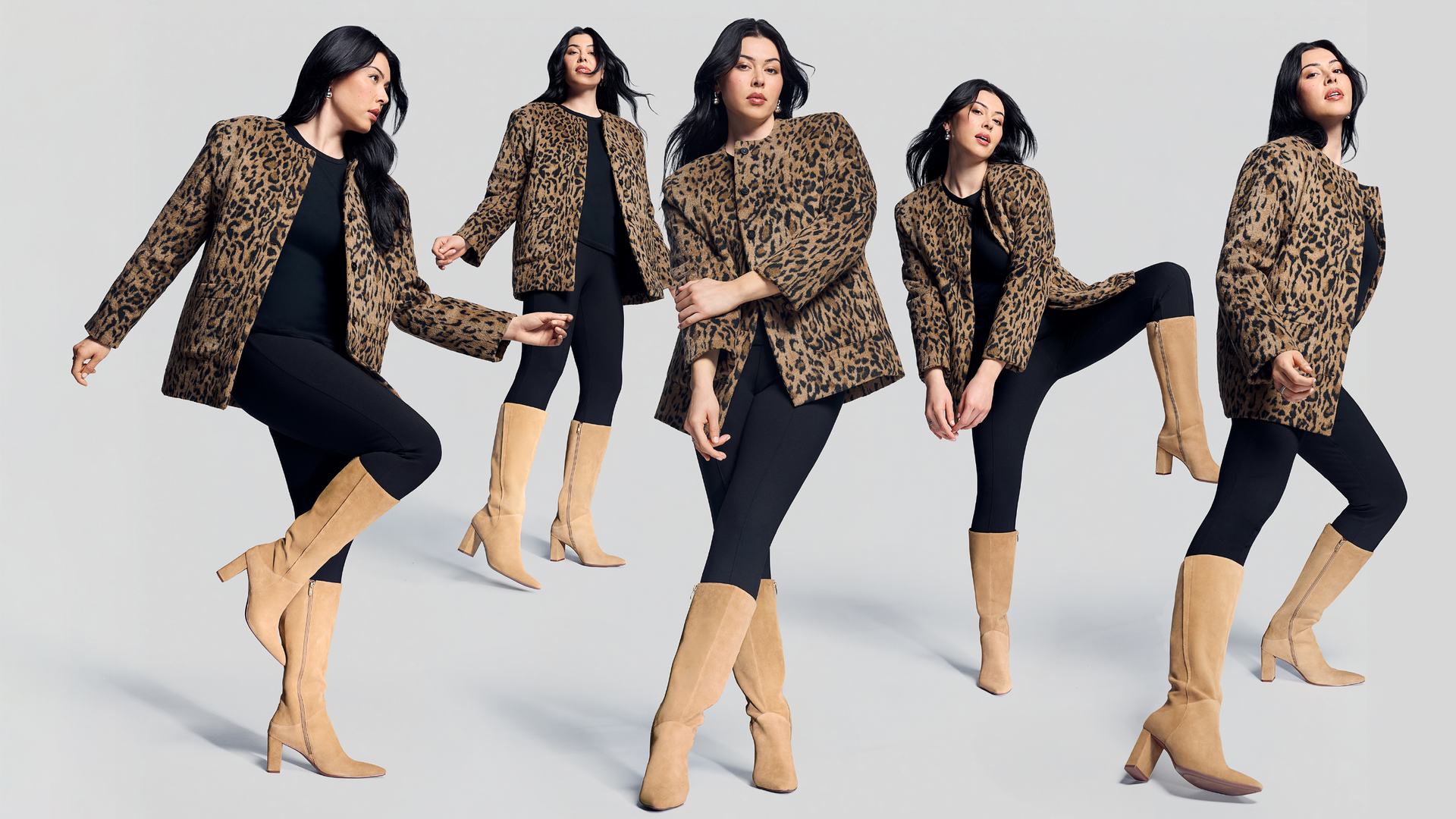
One thing that won’t wane, however, is my personal mission to champion the companies ever-committed to size diversity. So much so that—full disclosure—I am in my second year as Naturalizer’s Global Inclusivity Ambassador. Since I’ve been working with the brand, they’ve launched the Contoured Calf program, which offers boots in four widths including narrow (13”-15”), medium (15”-17”), wide (17”-19”), and extra wide (19”-21”).
Alongside its followers, I saw the brand’s marketing initiatives like Contoured Calf in-store installations at Nordstrom and Macy's; campaigns from influencers like Essie Golden, Alissa Wilson, Cece Olisa, Raeann Langas, and Kristina Zias; and New York Fashion Week events like a live recording of the Confident Collective podcast and an Eloquii runway show. What I didn’t see? (And what I’m most interested in.) All the effort it took to bring these products to life.
Like any good reporter, I wanted to peel back the curtain and bring transparency into the process—and, of course, to commend the brand for its authentic commitment to inclusion. With that, I sat down with Natelle Baddeley, SVP chief design and product officer at Naturalizer. (TL;DR: if brands listen to their customers, pour into product development, test and market well, inclusion is—no shocker here—incredibly good for business.) Read our conversation here.
(Image credit: @lcchan)When—and how—did you realize that expanded calf sizes was an issue that Naturalizer should take on?
Naturalizer has offered wide-calf boot shafts for 30 years. But by listening to consumers—primarily through product reviews—we saw many women still couldn’t find a shaft that fit, so we went back to research and development. While we already had the best fit and expanded choice of widths in the market, our data analytics and research projects indicated our consumers demanded more [size options], more silhouette options, more fashion, more color and material choice. She also told us what was important to her on fit. This lead us down the path to enhance the form and shape of our leg contours, updating to today’s modern proportions.
How did you start the expansion process?
We were very clear on what we were solving for: better fit with no gapping, for more women with greater aesthetic trend accuracy. As a brand who is serious about inclusive fit, you are always looking for consumer friction points. Using the resources of Cal-Lab we reviewed [data] mining, fit clinics and measurement testing; we committed resources and talent specific to this project. Utilizing 500 women to set new standards for calf measurements, we made new molds based on the 4 new fit standards and we applied them against one test style, Kalina, to make sure we got it right. Then we brought that to market. Kalina was a pilot launch to observe response and validate the concept before rolling out.
What did you learn from that pilot?
That we needed to add another calf width. The extra-wide calf came quickly after pilot launch and sold out in fall 2024. During the development of our fall 2025 collection, we launched another study to continue perfecting our boot fit. Using digital scanning technology, we scanned the legs of more than 100 women to develop the perfect tall boot fit. Fall of 2025 offered the most expansive collection of Contoured Calf boots we've ever made including the cult favorite Emily—and new trend materials like leopard on our best-selling Deesha tall boot.
(Image credit: Naturalizer)(Image credit: @lcchan)How have those styles been performing over the past year?
We’ve seen double digit year over year increases in our tall boot category—with more sales coming from wide and extra-wide calf than medium [standard] calf. And social media engagement, which has been highly focused on the inclusive fit of our boots, has increased 18%. Reviews have poured in with consumers thanking Naturalizer for creating boots that actual zip up and fit more women.
Can you share some of the customer reviews you are most proud of reading?
"It's so tough to find boots that are so incredibly comfortable and trendy. Love them! I got the wide and wide calf as my feet have grown since having my daughter and I can't wait to wear them out."
"This boot is my unicorn. I have been in search of this boot for at least five years. The perfect pointed toe for dressing up and down and the perfect heel height for walking large corporate campuses. Last but not least, a calf circumference that accommodates my large calf."
All-in, how long did it take to get the Contoured Calf program up and running?
From discovery [of the issue] to Kalina hitting the market was 18 months. It took 6 months to develop and sample the new shaft widths and another 6 months to validate the standards in-market with Kalina. We continue investing: this past year we partnered with WashU to 3D-scan 100+ [more] legs to deepen our understanding of foot and leg measurements and how they correlate.
(Image credit: Naturalizer)Let’s get into the nitty-gritty. Once you had all the data, tell me about transforming it into patterns for narrow, wide and extra-wide sizes.
Narrow shafts require less contour. Wide and extra-wide require more contour while maintaining smaller ankle measurements, because calf size doesn’t strongly correlate with foot and ankle size. Through the more recent studies conducted we learned that placement of volume and offsets of volume on the leg differ typically from width to width. This is why we don't just grade up or down—like the industry standard—it has to be through a three-dimensional lens to attain that perfect contoured fit she expects from Naturalizer.
Can you share any of the specific design adjustments made to accommodate more calf options?
Yes, we considered many design factors when developing our extended calf styles. On many of our tall-shaft boots, we built a hidden gore—essentially concealed elastic—at the top of the shaft near the zipper, which adds comfort and ease of motion to our designs. In some styles we use our Secret Stretch construction, where that gore is built into and hidden by the side seam allowing for the same consumer benefits. For Contour Calf specifically, we engineered a dart into the pattern itself to reduce gapping along the calf and at the topline for a glove-like fit. Materials haven't been a limiting factor for us. We never want our extended calf styles to be limited by materials, so we invest in developing and producing styles like the Deesha, Emily and Fletcher in many fashion colorways, including faux crocodile and snake leathers, leopard suedes, and more across our expanded calf widths.
(Image credit: @lcchan)This doesn’t sound like a simple feat… What issues did you face along the way?
We had to physically create new "last" calf forms in [the new] targeted dimensions—the base that all of our pattern making builds on, since nothing like it existed for this range before. Getting the shaft to actually work was its own challenge: refining the pattern engineering so the shape was both functionally correct and cosmetically appealing. Because that work happens at the factory level, it took hands-on, on-site collaboration [at our factories around the world] with our teams there to work through it.
Sample making and fit accuracy took real trial and error—dialing in the right application of zippers, stretch panels and shaft contouring until we landed on the fit we wanted. And we didn't consider it done at approval. Our quality assurance team monitored initial production with daily fittings at the factories, and our brand team personally assessed the first boots off the line before anything shipped, to make sure execution matched intent.
In my experience, you can develop a perfect product, but it can still fall short of expectations at market or over time. Were the boots wear-tested by real people?
Whenever we introduce a new width or sizing parameter, we don't just rely on our internal team [for wear-testing], we partner with outside testing resources to make sure the fit performs as intended. Heeluxe handles functional performance testing and fit validation, and Mesh01 conducts wear testing. Together, they give us an objective, third-party check on our standards before a style goes to market.
(Image credit: Naturalizer)Speaking of your global supply chain, how many areas of the company did this impact? And in how many countries?
Most impacted are product development, costing/finance, sourcing/production, IT, marketing and demand planning. Current boot production spans China, Vietnam, India, Bangladesh, and Cambodia.
How significantly does this kind of commitment impact your production costs?
Making four widths absolutely adds complexity and cost. There are four times more cutting dies, slower productivity, and higher material usage. Inventory planning is more complex: what was one PID [or SKU] becomes four PIDs split by shaft width. We invested in a lot of molds and even created new molds for the part of the final process, wherein the boots get stretched and heated a little for polishing before they get packed—which means the boots come out of the box looking sleek and shapely, not flat and folded.
(Image credit: @lcchan)Beyond product, how is the brand committed to inclusivity?
Casting: Campaigns represent a spectrum of age, ethnicity, and body type reflective of real women. Creators & Partners: Collaborations with platforms and people who hold themselves accountable to inclusive action, from creators to production crews. Partnerships: Alignments with like-minded brands such as Universal Standard and Eloquii, and Podcasters Confident Collective, who share the ambition to build a fashion system that includes more women.
If you had to estimate the cost for this innovation, what would it be?
Impossible to quantify. We see it as showing up for our brand promise, for women and the reason we exist. The idea that size and style should have to be at odds is an antiquated way of thinking and not the solution women deserve. That makes the investment one we look at over years, not seasons. For any brand that chooses to be committed to inclusivity of size it has to be all in or not at all—and we are all in.
(Image credit: Naturalizer)Do you consider this program a success? How is success being measured?
Our size inclusive offering is at the core of who we are as a brand, and we measure success in a lot of ways. We see significant consumer loyalty and engagement with our extended sizes and widths, especially because we offer them in fashion-forward, trending materials and colors. Because the extended size and width consumer is underserved in the market, our inclusive offering has also become a real discovery driver for the brand, particularly through social media and word of mouth—we consistently gain new customers this way. And structurally, this isn't a niche part of our business: more than 50% of our sales on naturalizer.com come from extended sizes, shoe widths and calf widths.
Inclusion is good for business, period. Lastly, how can customers share their feedback with the company?
We love hearing from our customers. That feedback loop is a real input into how we refine our fit and expand our offering—it's not just a formality. Anyone can call our customer service team at 1-888-294-1648, or send us a message through our online contact form. You can also message us directly through any of our social channels @naturalizer.
Shop the Edit Naturalizer Eleanor Over the Knee Boot Naturalizer Deesha Knee High Boot Naturalizer Phoenix Knee High Boot Naturalizer 27 EDIT Emery Pump Naturalizer Bloom Loafer