
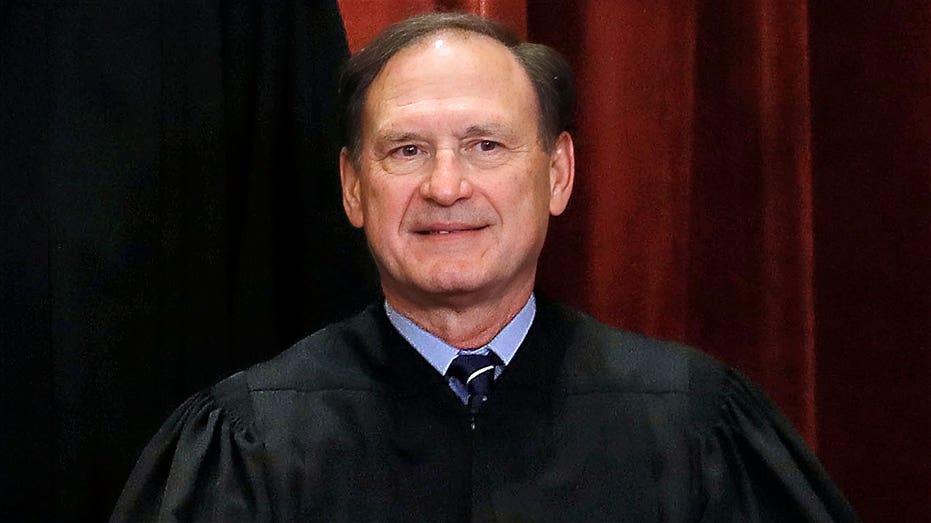
On Sept. 28, Supreme Court Justice Samuel Alito recused himself from one of the term's most important cases: Suncor Energy Inc. v. County Commissioners of Boulder County. As I have previously discussed, the case involving the liability of energy companies for nuisance actions tied to climate change could have sweeping implications for the country. Justice Alito should be commended for avoiding even the appearance of a personal interest or a conflict in the case. However, the controversy should prompt the court to explore a longstanding problem for justices holding financial interests that can conflict with their duties. The solution is simple: Justices need to use blind trusts.
Supreme Court Clerk Scott Harris released a letter revealing that Alito decided he "will not continue to participate" in Suncor Energy Inc. v. County Commissioners of Boulder County.
Boulder, sued energy companies under "theories of public and private nuisance, trespass, unjust enrichment, and civil conspiracy, claiming that they knowingly contributed to climate change while misleading the public about its impacts." The Colorado Supreme Court ruled for the city and the county in finding that such lawsuits are not barred by federal preemption. If such lawsuits are allowed to go forward, it would expose companies to potentially thousands of climate change lawsuits. Oral argument is set for Oct. 5.
SUPREME COURT CAN RESTORE SANITY AND STOP THE LEFT’S RADICAL CLIMATE AGENDA
The recusal is a blow for challengers who believe that the opinion could be close, and Alito was believed to be on the side of barring such actions. It is now down to eight justices, so a single loss of another conservative could result in a 4-4 tie – leaving the lower court decision unchanged.
While the letter did not give a reason, critics had called for Alito's recusal due to his financial interest in energy companies which could benefit from the decision.
CONSERVATIVE GROUPS SAY JUSTICE KAGAN CANNOT BE IMPARTIAL IN UPCOMING SUPREME COURT CLIMATE LITIGATION
That included 30 organizations which jointly asked the Senate Judiciary Committee to investigate his involvement in the case. Notably, the court responded to media inquiries by declaring that Alito had no financial interest in any party to the case and that legal counsel had told him that there is no need to recuse himself.
Yet, the standard is whether a reasonable person could question his impartiality and, while he had no interest in the parties, he appears to have investments in other energy companies. Alito previously withdrew shortly before arguments in a separate oil industry case earlier this year.
JUSTICE NEIL GORSUCH BREAKS SILENCE ON VIOLENT THREATS AGAINST JUDICIARY, SUPREME COURT LEAKS
The Ethics in Government Act of 1978 (EIGA) established financial disclosure reporting requirements for many high-level government officials and employees, including the Justices of the Supreme Court. Supreme Court Justices file publicly available financial disclosure statements that report certain financial transactions. However, they are not required to put their investments into blind trusts.
Justices should be able to have investment portfolios, but they can hold such investments in blind trusts or qualified blind trusts. In a blind trust, the justice will "have no control over, will receive no communications about, and will (eventually as existing assets are sold and new ones obtained by the trustee) have no knowledge of the identity of the specific assets held in the trust. As such, once a blind trust is established and new assets obtained, an official will not need to (and will not be able to) identify the particular assets 13 5 C.F.R. § 2635.403(b)."
LIBERAL JUSTICE HAMMERS SUPREME COURT FOR FAST-TRACKING EMERGENCY DOCKET CASES
Other federal officials must use such trusts and there is no reason why justices should be exempt, in my view. This has been a continual and embarrassing problem. Years ago, the court affirmed an appellate ruling in a major case involving a $400 billion lawsuit in American Isuzu Motors v. Ntsebeza (2008) without a hearing after four justices had to recuse themselves (Chief Justice John Roberts Jr. and Justices Anthony Kennedy, Stephen Breyer, and Samuel Alito Jr).
The business interests of justices should not interfere with the business of the court. You should either be an active investor in the markets or a justice, not both. The public has a reasonable expectation that, in seeking this high office, justices are willing to set aside certain privileges or interests. This is one of them.
This is not to cast aspersions on the justices. These recusals show that members, including Alito, are cognizant and committed to avoiding even the appearance of a conflict of interest. Moreover, some judges and justices resolve this question by using diversified mutual funds or ETFs, where the justice does not control the micro-allocations within the fund. However, there is still knowledge of financial interests in given areas.
This is not a costless obligation for justices. Blind trusts add costs (which Congress may want to consider defraying) and can be complex. However, the business of the court is too important to be routinely compromised or complicated by these financial interests.
CLICK HERE FOR MORE FOX NEWS OPINION
While legislation has been introduced along these lines, it would be simpler for justices to voluntarily adopt this practice.
Consider it is the price of being one of nine. If you want to sit on this court, you have to do justice which is only fully possible if your investments, like justice itself, are blind.
CLICK HERE TO READ MORE FROM JONATHAN TURLEY