
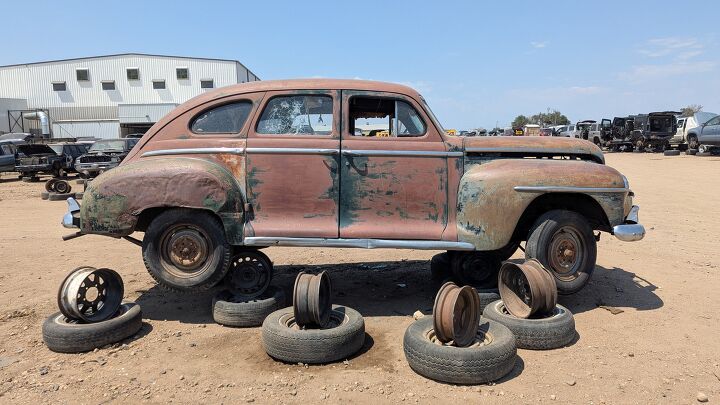
What kind of vehicle from the 1940-1955 period is easiest to find in Western Ewe Pullet-style car graveyards? Four-door sedans made by the Chrysler Corp., no doubt about it. Here's one that I spotted in a northeastern Colorado yard a few weeks ago.
Since I started documenting junkyard vehicles with stories to tell in 2007, I've written about the following discarded 1940-1955 Mopar sedans: 1941 Plymouth, 1941 Plymouth, 1942 Plymouth, 1947 Dodge, 1948 Dodge, 1948 Plymouth, 1949 Dodge, 1949 Dodge, 1949 Plymouth, 1950 Chrysler, 1950 Chrysler, 1951 Plymouth, 1951 Plymouth, 1952 Chrysler, 1953 Chrysler, 1953 Plymouth, 1954 Dodge, 1954 Plymouth, and 1954 Plymouth.
All of those cars had flathead straight-six engines, except for the 1953 Chrysler and 1954 Dodge (which were built with FirePower and Red Ram Hemi V8s). Did the four-door designs and expensive-to-rebuild valve-in-block engines prevent enthusiasts from fixing up these cars and preventing their demise in the cold steel jaws of The Crusher?
It is true that I run across many fewer Chevrolet and Ford products of that era during my junkyard travels (the 1951 Styleline in this photo is one of just two 1940-1955 Chevrolets I've documented in the boneyards, for example).
GM and Ford offered more interesting engine choices for most of that period, but a bigger problem today is that Chrysler's styling was just… stodgier. The 1948 Plymouth was a slightly revised 1942 Plymouth (shown in the brochure page above), itself a 1940 Plymouth with an updated frame design.
All the low-priced makes of the Detroit Big Three (Chevrolet, Ford, Plymouth) were in the final model year of their prewar designs in 1948.
Even so, a Chevy from the immediate postwar era looks quite a bit sleeker than a Plymouth.
Likewise with the 1948 Ford, and the contrast got even starker when the Big Three's affordable '49s hit showrooms. The 1949 Ford remains an all-time classic to this day.
That said, Plymouth offered good value for the money at the time. Plymouth sales were pretty strong through the late 1940s and early 1950s, but then fell off a cliff for 1954 (when GM's much more expensive Oldsmobile and Buick brand blew past Chrysler's entry-level marque in total units sold).
I must admit I wouldn't have driven all the way to Greeley just to shoot a junked '48 Plymouth sedan, given how ordinary these cars are even after nearly 80 years, but I have been looking for a 1941-1948 Plymouth decklid to replace (or maybe provide a patch panel for) the one on my 1941 Plymouth race car project.
That car sat in a field east of Pikes Peak since LBJ was in the White House. It's got great patina and not much rust … except where snow built up in the trunk and rusted out the bottom edge of the decklid. I'm keeping the half-dozen bullet holes, but I'm filing them in with clear epoxy so they don't let water in.
Now I am wiring it from scratch, trying to keep the patina while upgrading to all modern electrical hardware (including LED lighting). I tell you what, it is a challenge to work with the breathtakingly cheap pot-metal hardware used on the headlight assemblies of these cars.
Once I got to the trunk latch/stop light/license plate light revival, I realized how bad the structural weakness of the decklid bottom edge really was (yes, I know, that year-of-manufacture license plate in this photo is for Elbert County; I have since obtained a set of Denver-coded 1941 plates that match my car's home). So, I asked my junkyard-centric friends in the Front Range area to keep an eye open for a Plymouth sedan of the right era, anywhere between Albuquerque and Cheyenne. It had to be a Plymouth; Dodge and DeSoto sedan decklids of the period look the same but are wider.
Soon enough, Rollin over at junkyard_cars_of_colorado spotted this Plymouth, all by itself between the Chrysler and Ford sections. I headed over immediately.
When I opened the trunk, I flinched in horror at one of the thickest and most disgusting bunches of rodent nesting material I've ever seen in a junkyard car (and I've seen some icky mouse-poop-saturated vehicles over the decades).
Rodent droppings carry hantavirus, and Colorado is the second-worst state for the deadly virus right now (just behind nearby New Mexico). I have gloves and disinfectant in my junkyard toolbox, but after this I'm going to start bringing a respirator when I'm planning to pull anything serious from an old junkyard car.
Fortunately, the decklid bolts were far away from the hanta-nightmare on the trunk floor and the decklid itself was sterilization-grade hot from the direct High Plains sun on a 100-degree day. Andersen's charged me 50 bucks for it, which is an excellent price.
The build tag says that this car was born at Lynch Road Assembly in Detroit, and it's an early production 1948 model.
Chrysler sold 378,048 new Plymouths in 1948. As was the case with many of these cars, the Briggs Manufacturing Co. built the body.
The Special De Luxe was the top Plymouth trim level for 1948. This car's MSRP was $1,529, or about $21,453 in 2026 dollars.
The MoPar heater was an extra-cost option that year. Heaters didn't become standard in U.S.-market cars until the late 1960s or early 1970s (if anyone knows the exact year for that, please let us know in the comments).
(Ed. note: No need to wait sir. Studebaker was the last automaker to offer an optional heater in 1966. It went out of business after that. Federal mandate for a defroster as standard equipment arrived in 1971.)
The absolute cheapest 1948 Plymouth was the De Luxe business coupe, at $1,346 ($18,964 after inflation). Meanwhile, the Chevrolet Stylemaster business coupe started at a stingy $1,244 and the Ford Deluxe Six business coupe cost an even skinflintier $1,154 (those prices would be $17,527 and $16,259, respectively, today).
The '48 Ford and Chevrolet still had solid kingpin front axles (the Ford's front suspension was especially antiquated, thanks to the stubbornness of Henry Ford the First, tracing its ancestry directly back to the Model T), while the Plymouth had a genuine independent front suspension, which is something to think about when looking at that Plymouth's higher sticker price.
As for engine power, the Ford and Plymouth each had 95-horsepower flathead straight-sixes (Ford buyers could get a flathead V8 with 100 horses, but that cost close to three grand in 2026 bucks). The Chevrolet Thriftmaster six made just 90 hp, but its overhead-valve design made it better at resisting overheating under load.
All three cars came with a three-on-the-tree column-shift manual transmission as standard equipment. Plymouth didn't even get a true automatic transmission until 1954.
How long did this car sit in a field? So long that it still wears this Riverside Power Grip tire, a 1960s product from Montgomery Ward.
This Plymouth also sports some Brunswick Super Quality rubber from about the same era.
There's no radio, although it has the speaker grille and block-offs for volume and tuning knobs.
It's not rusty, but there's some old field-expedient bodywork here and there.
It might have been possible to revive this car, especially if the hood stayed closed during its idle decades and water didn't get inside the engine, but it wouldn't have been a smart financial move. You need to start with a convertible to have a shot at recouping your 1940-1948 Plymouth restoration investment (and even then the car probably won't be worth what you'd have to put into it).
The epilogue to this story is that the Plymouth was all-new for 1949, just like the Ford and Chevrolet (although Plymouth was the last of the three to reveal the new '49s). Engines stayed about the same, but the Ford and Chevy looked lower, longer and much more modern than the geezerish Plymouth.
It took until 1955 for Plymouth styling to catch up to Ford and Chevrolet, thanks to the Virgil Exner "Forward Look" treatment. Plymouth buyers that year still couldn't get a true Hemi engine (that didn't happen in production Plymouths until deep into the 1960s), but its optional 259-cubic-inch "Semi-Hemi" HyFire polyspherical V8 made five more horses than Chevrolet's brand-new 265ci small-block.
1948 Plymouth in Colorado junkyard.
1948 Plymouth in Colorado junkyard.
1948 Plymouth in Colorado junkyard.
1948 Plymouth in Colorado junkyard.
1948 Plymouth in Colorado junkyard.
1948 Plymouth in Colorado junkyard.
1948 Plymouth in Colorado junkyard.
1948 Plymouth in Colorado junkyard.
1948 Plymouth in Colorado junkyard.
1948 Plymouth in Colorado junkyard.
1948 Plymouth in Colorado junkyard.