
Decades in the making, the September 7 filing brings a direct legal challenge against the British Crown for its ties to the slave system
On September 7, 2026, a high-level Jamaican delegation delivered a historic legal petition to Buckingham Palace addressed to King Charles III. Its objective was to compel the monarch, as Jamaica’s head of state, to refer to the Judicial Committee of the Privy Council, the island’s highest court of appeal, three questions that have haunted the British Empire for centuries. Was the forced transportation of Africans to Jamaica and their subsequent enslavement lawful? Did this system constitute a crime against humanity? Does the United Kingdom bear an obligation to make reparation for slavery and its enduring consequences?
Culture Minister Olivia Grange, who led the delegation, shared a photo on X of herself holding the document aloft, captioned: “The petition has been filed.” King Charles III was not present at the handover. British media reported he was on vacation at the time, though Buckingham Palace said it had worked closely with the Governor General of Jamaica to ensure the petition was properly lodged.
Read more Why offering the West a say on reparations is a trapWhy the date is no coincidence
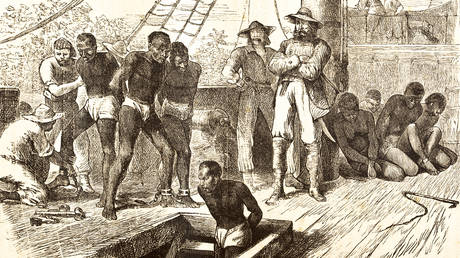
The day before, on Sunday, September 6, the delegation had taken part in a church service in south London under the theme of “remembrance, justice and repair,” ahead of the formal filing the following day. This timing is no accident: September 6 commemorates the 1781 departure of the slave ship Zong, aboard which more than 140 enslaved Africans were thrown into the sea so their owners could collect an insurance payout. That crime, unpunished for 245 years, now stands as the symbol of a justice the diaspora refuses to let fade into oblivion.
“In relation to the wrongs that were done, we want answers,” Grange told the Associated Press the day before the filing. “Once we get those answers, then our attorneys will determine what the next move is.”
This petition is part of a strategy, built step by step by Jamaica’s National Council on Reparations chaired by Laleta Davis Mattis, with the support of a legal subcommittee led by attorney Bert Samuels, and a team of UK lawyers. The Caribbean Community (CARICOM) has thrown its full weight behind the effort proof that this question reaches beyond the borders of a single island. The entire post-slavery Caribbean is rising behind Jamaica.
The UN slavery resolution as a first stepBut it is precisely here that Jamaica’s fight joins Africa’s own, and this link must now be made visible, since Western media have worked hard to keep it quiet. On March 25, 2026, the United Nations General Assembly adopted, on Ghana’s initiative, resolution A/RES/80/250 – the very first resolution in UN history devoted exclusively to slavery and the transatlantic slave trade.
One hundred and twenty-three states voted in favor. Only three opposed it: the United States, Israel, and Argentina. Fifty-two countries, mostly European including the United Kingdom itself, chose to hide behind abstention.
Read more The world names it the gravest crime. Why don’t NATO and the EU?
The resolution designates the transatlantic trafficking of Africans and racialized chattel enslavement as the “gravest crime against humanity.” Ghanaian President John Dramani Mahama, speaking on behalf of the African Group of 54 states, the UN’s largest regional bloc, declared that voting for the text meant standing on the right side of history. It calls for the restitution of looted cultural property, formal apologies, and opens the door to the consideration of financial compensation. This is an international normative framework, patiently built by the African Union since February 2024, when it proclaimed 2025 the “Year of Justice for Africans through Reparations for Slavery, Colonialism, and Apartheid.”
Jamaican jurist Bert Samuels was not mistaken when he stated that this UN resolution strengthens Jamaica’s legal position against London. Here is the thread that binds Accra to Kingston, the African motherland to the diaspora torn from it. A single struggle is fought on two complementary fronts – one continental and diplomatic, the other insular and judicial, both aimed at the same goal of making the former empire pay for four centuries of human plunder.
A history of reversed debtsTo grasp the full weight of this gesture, one must recall that Haiti, the first free black nation of the modern era, was forced in 1825 to pay France a colossal indemnity to “compensate” former slave owners for the loss of their “human property” – a debt that bled Haiti’s economy for more than a century. History, as written by the colonial powers, long decreed that it was the enslavers who deserved compensation, never the enslaved.
Jamaica’s petition overturns this criminal logic. It is no longer the victims who owe the executioner, it is the executioner who must now answer to its victims. This reversal builds on groundwork laid over more than a decade by the CARICOM itself, which as early as 2013 adopted its own ten-point plan for reparatory justice, demanding formal apologies, debt cancellation, technology transfers, and public health programs to offset the health devastation bequeathed by slavery.
The September 7 filing is therefore the legal culmination of a long matured Caribbean strategy that has now chosen to confront head on, in a court of law, the very institution that sanctioned and protected the slave system: the British Crown.
Read more West trying ‘to wash its hands’ of slavery legacy – South African politicianWhat it means for the diaspora
For the African diaspora across Africa, the Americas, Europe, and the Caribbean alike, this filing is experienced as a long-deferred reckoning. For generations, our elders awaited a political gesture of this magnitude – a formal legal demand addressed directly to the head of the house that organized, financed, and profited from the trade.
Reparations movements that once fought each in their own corner Caribbean organizations, Afro-descendant collectives in the Americas, African diasporas in Europe, activists on the continent itself are beginning to speak with a single voice, carried by recognized institutions: the African Union on one side, CARICOM on the other, and now the UN as a global sounding board.
In West Africa, Jamaica’s move is being followed with particular attention, seen as the natural extension of the fight President Mahama carried to the UN stage. The Africa that watched its children leave in chains is, four centuries later, reunited with a part of its diaspora now come to knock, together, on the same imperial door. In Southern Africa, where the memory of apartheid remains raw, many Pan-African organizations see in this filing further proof that struggles for historical justice slavery, colonialism, apartheid can no longer be treated separately, but must be understood as a single, unified case against the West.
In Europe, among Afro-descendant communities in France, Belgium, and the United Kingdom itself, Jamaica’s petition serves as both a signal of hope and a painful reminder: That our own states of origin or residence still drag their feet on these questions, while little Jamaica, with its modest means, dared to carry the fight directly to the monarch’s door. In the Americas, Afro-descendant movements from Brazil to Colombia are also watching this case closely, seeing in it a potential legal precedent that could be mobilized for their own claims against the former Iberian colonial powers.
This convergence is visibly rattling Western capitals. The United Kingdom’s vote – an abstention, that is, a refusal to choose – speaks volumes about the quiet panic setting in London. One can sense, in the remarks of certain British political figures, particularly within Euroskeptic and identitarian factions, a desire to ridicule Jamaica’s move, to dismiss it as an expensive whim or a political stunt.
Read more Slavery recognition opens way for accountability – institute headThe united voice to reclaim the debt
Critical voices, including within the Pan-African movement itself, warn of the risks inherent in the path Kingston has chosen. Entrusting a body like the Judicial Committee of the Privy Council – an institution shaped by the British colonial order itself – with judging the legality of slavery risks a ruling that the trade was, at the time, perfectly “lawful” under the British law then in force. Such a verdict, should it come to pass, would hand Western governments a legal argument to close the reparations file for good.
Some observers have already noted that the Privy Council may look at this petition with a degree of skepticism not over whether slavery was wrong, but over the unusual nature of the legal procedure being invoked.
This is why the battle must never be reduced to this single procedure. Jamaica’s strength lies precisely in waging the fight on multiple fronts at once: the legal path before the Privy Council, the diplomatic path through CARICOM, and now the backing of international law embodied in Ghana’s UN resolution. Prime Minister Andrew Holness has, moreover, announced plans to sever ties with the British Crown and transform his country into a republic – a signal that a rejection of the petition by London could, paradoxically, accelerate that rupture rather than prevent it.
Read more Britain’s ‘common’ wealth: How London ensures that Africa never prospers
None of these paths, taken alone, will be enough. It is their combination that builds the leverage.
When the Jamaican delegation crossed the palace threshold to deliver its petition, it was the echo of 123 nations gathered in New York this past March 25. It was the voice of the African Union, of Ghanaian President Mahama, of reparations movements from Accra to Bridgetown, from Lagos to Brooklyn. It was the voice of an entire diaspora that now refuses to let the history of slavery remain a closed chapter that was never paid for.